Sunday, August 18, 2013

An immaculate summer bolete


We found this very fine toadstool, which I think is the summer bolete Boletus reticulatus, near a poplar on the grass verge near Van Mildert college in Durham city today. Remarkably, although it's a mature specimen it appears to be completely unscathed by slugs, which often feed on toadstools well before they reach this stage of maturity.


Field guides describe the way the top of the cap of the summer bolete breaks up into scales as it expands - exactly as this specimen is doing. 

The summer bolete tends to be the first Boletus species to appear each year - perhaps it's a sign that this will be a good autumn for fungal forays............

Saturday, August 17, 2013

Sycamore Aphids

Recently there has been a lively exchange of comments in the Guardian on a piece by George Monbiot that extols the virtues of native trees because they support insect biodiversity (birch hosts no less that 266 different invertebrates, for example) and deplores the tendency of local authorities to plant non-native trees that are of relatively little value to our native fauna.

One of the most frequently cited examples of a non-native tree with a very limited insect fauna is sycamore, which hosts a paltry 15 species. It's a long-established non-native species with a  documented history here that dates back to the 16th. century, but since then only a small number of our insects have adapted to it. But what it lacks in biodiversity, it certainly makes up for in the sheer quantity of one particular insect that lives on its leaves - the sycamore aphid.


Over the summer these little insects multiply in vast numbers under its leaves - and they produce a lot of honeydew, so woe betide anyone who parks a car under the tree; it will be as sticky as a toffee apple if it's left there for long. 

The positive aspect of this sticky secretion is that the mildew that grows on the sap that the aphids excrete is an important food source for the orange ladybird Halyzia sedecimguttata, whose distribution is linked to that of sycamore.


All these aphids are certainly of real value to some of our native birds - I've often watched blackcaps and blue tits picking them off the leaves. 


One of the most striking features of the sycamore aphid is the way in which the individuals space themselves evenly under the leaf. the spacing is such that they are just close enough together to touch each other with their long antennae, so if an individual in one part of the leaf is attacked the alarm spreads from aphid to aphid in a wave of antennae-waving across the whole leaf.

The annual sycamore aphid population explosion has just about ground to a halt now and soon they'll fly to sites on twigs and buds where they'll lay overwintering eggs. They hatch in spring just as the buds burst, with perfect timing to plug their stylets into the fresh young foliage as it emerges - and that's the time when you'll often see blue tits and great tits picking the aphids off the bud scales.


Friday, August 16, 2013

B sides....


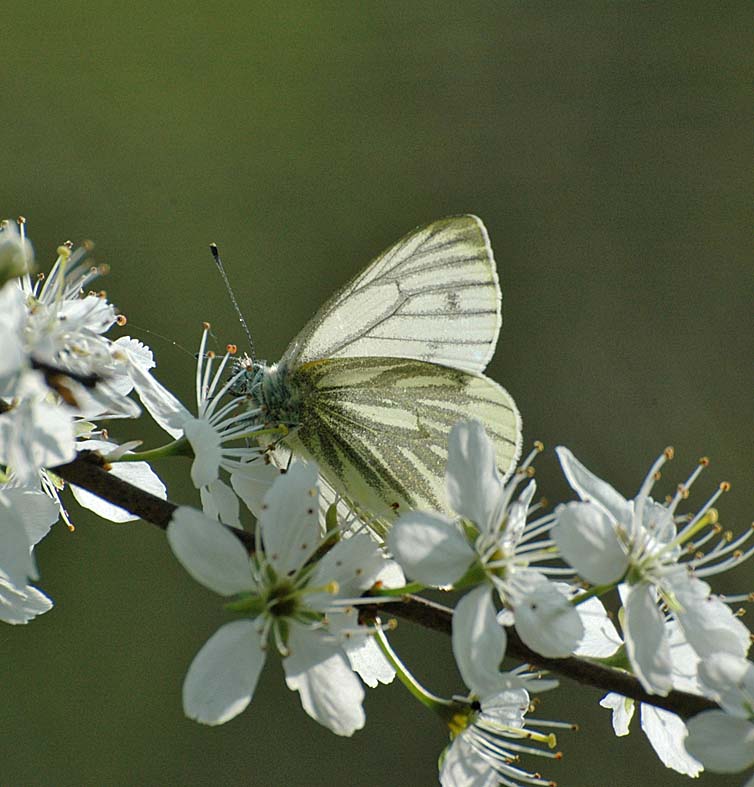
Some butterflies revealing their less flashy undersides ..........


Small white


Green-veined white


Orange tip


Small tortoiseshell


Comma


Peacock


Red admiral


Speckled wood


Small heath


Gatekeeper


Grayling


Meadow brown


Ringlet


Wall brown


Scotch argus


Common blues


Small copper


Large skipper