Showing posts with label botany. Show all posts

Wednesday, April 15, 2020

local patch lockdown: some plants

The end of three weeks of Coronavirus lockdown early morning walks around the same route. After a slow start, when spring seemed reluctant to release its grip, suddenly everything is coming into leaf and now there are more flowers opening every day. 

This Pulmonaria is a garden throw-out, dumped with some garden waste, and has established itself as a large patch of flowers on the road verge. Tt has been flowering since mid-March. 


The first blackthorn blossom appeared in mid-March and by early April the hedgerows were looking lovely.


There is one large wych elm tree on my route, that has escaped Dutch elm disease and by early April it was in full bloom.


There are a lot of Prunus species in the hedgerows along the route and I'm guessing that these are all cherry-plum


This one looks like blackthorn, but it's a small tree. Blackthorn rarely grows to these proportions.


Silver birch catkins began to bloom in early April and by mid-April the leaf buds were beginning to burst


Wild cherry in bloom - one of the finest of all our native flowering trees


Male (above) and female (below) sallow, flowering


Female flowers of an unidentified willow


Ash in full bloom. It will be three or four more weeks before the leaf buds burst. This is always the last tree to come into leaf and the first to lose them, in September.

Lots of gorse in the hedges around the route and also some good gorse scrub - excellent, prickly nest sites for birds


The hawthorn hedges began to show the first signs of new leaves in late March


Rowan leaf buds burst very early and are already showing well developed flower buds
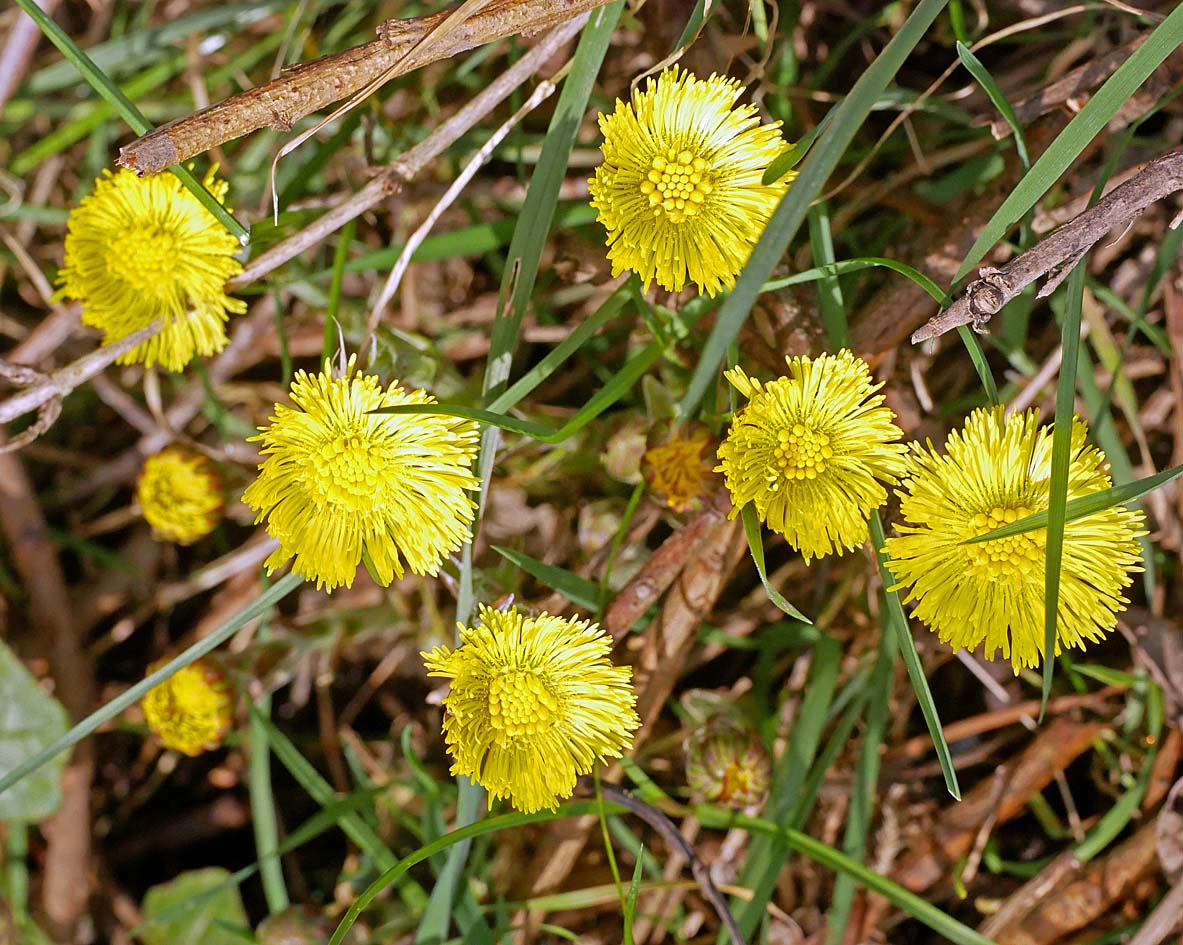

The colt'sfoot that has been flowering since mid-March is now going to seed

White dead-nettles and greater stitchwort flowering on the road verges in mid-April


Not many fungi at this time of year, but these are old, withered specimens of yellow brain fungus Tremella mesenterica growing on a moss-covered dead stem of gorse.


An attractive example of turkey tail fungus Coriolus versicolor

Not sure about this one, but I think it might be an old specimen of hairy bracket Tremetes hirsuta




Wednesday, June 6, 2012

The Beguiling Beauty of the Scorpioidal Cyme


Botanical descriptive terminology provides a rich source of interest for anyone who enjoys the sounds of words and their precise economy of meaning. Try speaking the following, a few times over, as an incantation: panicle; raceme; dichasium; corymb; cyme; umbel. They are all terms found in identification keys and floras for the arrangement of flowers in an inflorescence, combining precision of meaning with a hint of the classical linguistic roots that underpin botany, that most ancient of biological sciences.


The plant in the image below, comfrey, has an inflorescence described by my favourite of these terms: a scorpioidal cyme. 


A cyme is, according to the glossary in my old college copy of Clapham, Tutin and Warburg's Flora of the British Isles, 'an inflorescence whose growing points are each in turn terminated by a flower, so that the continued growth of the inflorescence depends on the production of new lateral growing points'. In comfrey's case, and in the case of many members of the family Boraginaceae, to which it belongs, the cyme is curled like a scorpion's tail, with a degree of precision that could surely be expressed in a mathematical equation. If you have forget-me-nots in your garden, they too are members of the Boraginaceae and have flowers arranged in a scorpioidal cyme.


The inflorescences, with their diadems of purple buds that have a sting in their terminology, must surely - at some time - have inspired a jeweller to create something similar as a brooch.....?


Incidentally, the publication of Clapham, Tutin and Warburg's Flora of the British Isles, a landmark in British field botany, also celebrates its diamond jubilee this year.