Showing posts with label green-veined white. Show all posts

Monday, August 4, 2014

Green-veined whites 'puddling'

We came across this group of 'puddling' green-veined whites - four of about a dozen - when we were out walking on moorland near Blanchland in Northumberland last week. Each was busy sucking up moisture through its extended proboscis from rapidly drying puddles in the sand soil.


Butterfly 'puddling' is behaviour that's most often seen in wildlife documentaries, with swarms of tropical butterflies congregating around the edge of waterholes, but it's common in our butterflies too. They are sucking up a dilute solution of mineral salts, particularly sodium salts, which is essential for their reproductive success. Males hatch from the chrysalis with a fixed amount of sodium in their bodies and lose some every time they mate, so the longer they live and the more often they mate, the more they need to 'puddle' - otherwise their fertility declines.

.

Thursday, April 24, 2014

Green-veined whites

This pair of  newly-minted green-veined whites flew all the way around the garden, joined together in tandem with only the female (?) struggling to keep them both airborne , before settling.  


Monday, April 25, 2011

Spring Wild Flowers in Weardale

Last autumn I posted some pictures of a walk up through Slitt Woods in Weardale, following the course of Middlehope Burn upstream. These pictures were taken this weekend, following the same route, starting with masses of sloe blossom in the woodland, attracting the attention of this green-veined white butterfly.


All through the woodland there's a fine display of primroses and around the hazels ...


.....these flowers of toothwort, which is a parasite on hazel roots, are in bloom.

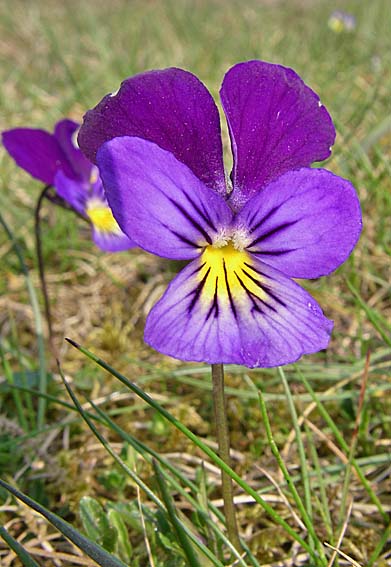
The mountain pansies are just coming into flower in the grassland on the moorland edge. There are numerous colour variations.


Sedges thrive in the short, sheep-grazed turf. The yellow 'paintbrush' is the male flower, composed of numerous stamens, and the white feathery stigmas of the female flowers can be see further down the stem

The ruins of the old lead mine buildings form a natural rock garden for dog violets


Field woodrush, growing in the short turf.


The early purple orchids at the top of the woodland are earlier than ever this year, thanks to the warm, dry weather.

Marsh marigold thrives around the old lead washing floors, where lead was separated from crushed rock using the force of flowing water. The parabolic flowers of marsh marigold focus the sun's rays and the temperature inside the flower is always a few degrees higher than outside, making them a popular resting place for sun-basking flies.

Up in the edge of the high pastures cowslips are in bloom.

Tuesday, June 15, 2010

Butterfly Hot-Spot

A visit to Hawthorn Hive on the Durham coast at the weekend coincided with the recent emergence of several butterfly species, including this pristine male common blue and .....
.... and its rather more muted female consort.
The raised beach at Hawthorn Hive - a legacy of past colliery waste dumping - is covered with large patches of bird's foot trefoil, food for common blue and dingy skipper caterpillars, so this sheltered bay is a great spot to find both species - and also several others. The cliffs provide shelter from the wind, unless it's blowing from the East - and the prevailing wind is mostly south-westerley. Paradoxically, it's only the raised beach - produced by past industral activity - that protects this wonderful site for flowers and insects from being inundated by the waves. It's slowly being eroded and once it has gone the waves will be able to reach the base of the cliffs where.....

..... this green-veined whire was collecting nectar from bloody crane'sbill flowers...

...... while this large skipper basked on the same plant's foliage....
... and another .... amongst the grasses.
On the cliff tops above small heaths were flying in the grassland. They have a very distinctive way of sunbathing. Most butterflies orientate themselves with their back to the sun and open their wings to absorb the heat - like the common blues and large skipper above. Small heaths keep their wings folded but turn their whole body at 90 degrees to the sun's rays, so the underside of the wings on one side of the body only faces the sun.