Showing posts with label Bird cherry. Show all posts

Wednesday, June 28, 2023

Pocket plum disease

 This summer there have been some spectacular local outbreaks of pocket plum disease, affecting sloes on blackthorn on the Durham coast near Hawthorn dene  and bird cherry fruits in Weardale. It's caused by the fungus Taphrina pruni, which induces the fruits to swell, become spongy and fill with watery fluid. In bird cherry (bottom picture) the normally spherical, shiny black fruits become banana-shaped. No seeds are formed inside these deformed fruits, instead there is an empty 'pocket'.


Thursday, July 30, 2020

Small ermine moth

Small ermine moths usually feed on bird cherry leaves, hereabouts, enclosing whole shoots and even branches in a silken tent, so they can feed safely inside


For the last two years they have fed on spindle bushes in my garden. Spindle Euonymus europaeus is a native hedgerow small tree in Britain, but is rare in the wild here in North East England. It is often grown in gardens, for its attractive seed capsules and vibrant autumn colour.

When the caterpillars are fully fed they crawl down to ground level and spin a silken cocoon on the ground, where they pupate.

They started hatching in my garden in the third week of July.

And here is the newly emerged moth, clad in copy of the ermine trimmed robes worn by their Lordships in the House of Lords.


Wednesday, June 22, 2016

Blossom

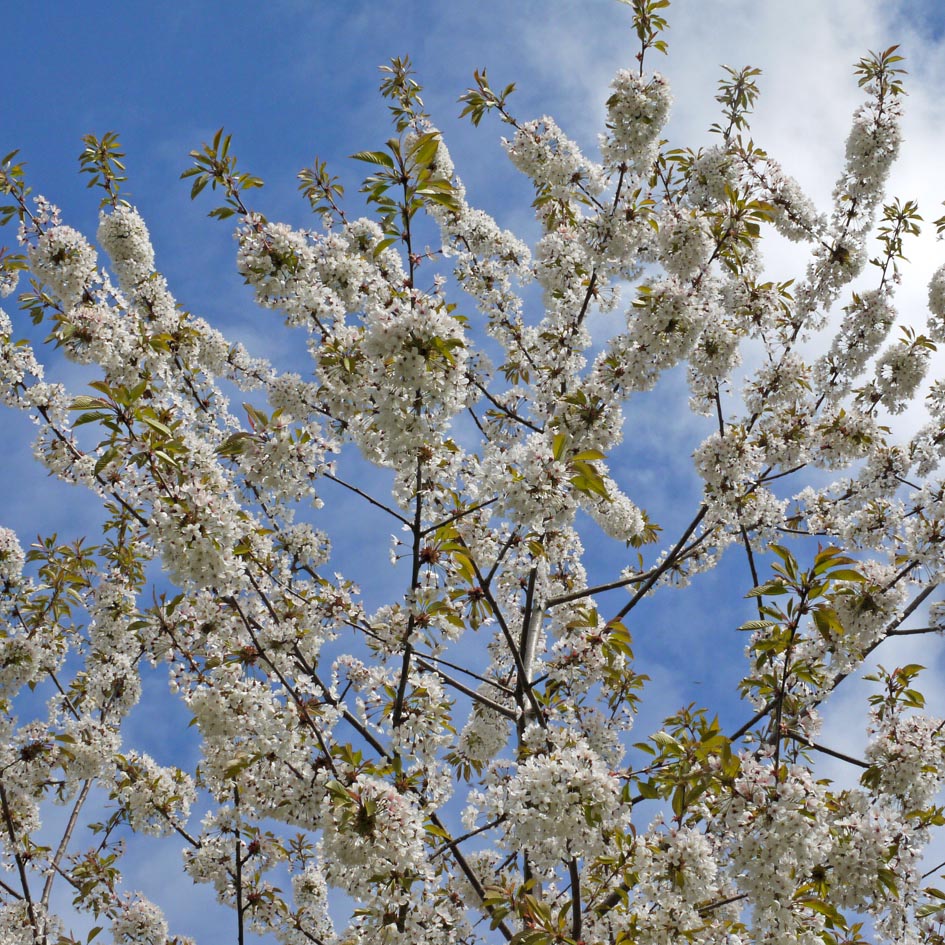
From March until July, this has been the best for native tree blossom that I can recall in our part of the North Pennines. It started with sloe and is now coming to an end with elder. Here they are, in chronological sequence

Blackthorn aka Sloe


Wild cherry aka gean


Hawthorn


Bird cherry


Rowan aka mountain ash


Elder


Wednesday, September 11, 2013

The mysterious attractions of black berries


Thursday's Guardian Country Diary focuses on bird cherry Prunus padus, which has produced an exceptionally fine crop of its beautiful black fruits in Weardale this year. This is probably the result of excellent flowering conditions in late spring, fewer small ermine moths that often defoliate the trees and fewer instances of pocket plum disease which can destroy the fruits before they ripen.


Most wild fruits that are dispersed by birds are red (hawthorn, rowan, guelder rose and honeysuckle, to name but a few), so how come bird cherries (and also blackberries, buckthorn, deadly nightshade and elder berries) are black? Is fruit colour of any great significance for fruit-eating birds?

Over the last few decades there have been several scientific investigations into the ways in which fruit colours attract birds, addressing the question  'why are some ripe fruits red and others black?'

So here's a selective summary of some findings to date:

1983.
A study in the US using black cherry Prunus serotina concludes that it's not the final black colour of the ripe fruit that's important in attracting birds, but the mixture of intermediate red-coloured ripening fruits and black fruits that attract birds' attention. They observe the same results with pokeweed Phytolacca americana, whose fruits change from green to pink to black, and the conclusion is that the bicoloured phase of fruit presentation is important, rather than the final ripe colour. 

1999.
Unlike humans, birds can perceive ultra-violet light so the colours that they see don't correspond to our perception. Blue, violet and black berries reflect ultra-violet light, which may make them more conspicuous to birds and indicate their stage of ripeness. The bloom on the surface of bilberries (which is caused by a surface layer of yeast) reflects UV. When redwings were allowed to choose between bilberries with the bloom on the surface and others where the bloom had been polished away adult redwings preferred berries with the UV reflecting bloom, but inexperienced juveniles didn't distinguish between the two, suggesting that the birds learn to associate UV reflectance with fruit ripeness. 

2003
Another study revisits the bicoloured fruit hypothesis from 1983 and finds evidence to support it. 

2004.
Another study with juvenile redwings, which initially prefer red fruits but learn to associate black/UV reflective fruits with palatability, suggests that learning plays a key role in fruit colour choice. The study suggests that the colour of the fruits, not the contrast between their colour and the background, is particularly most important. 

  
2004
Another study that examines the relative significance of fruit colour and the contrast between fruit colour and background colour concludes that red and black fruits contrast more strongly with background foliage colours than any other fruit colours, which may be why they predominate. Tests on four bird species indicate that it's conspicuousness relative to background colours, not fruit colour itself, that's most important to foraging fruit-eating birds.

2006
Tests with crows in a flight cage conclude that artificial  red fruits are more conspicuous to them from a distance than artificial black fruits. When the crows were offered blueberries with or without their UV reflecting bloom, they were more successful in finding the UV reflecting ones - but that also depended on how UV-reflecting the background was.

2009.
A study concludes that blackcaps preferentially eat black or UV-reflecting fruits, choosing those with the highest intensity of colour, and that these darker fruits have high purple anthocyanin pigment antioxidant levels (good for their health) and also higher energy content. 

2009
A  study shows that birds can preferentially select ripe elder berries that have red stalks (indicative of high anthocyanin content) or ripe elder berries with green fruit stalks (that make the fruits more conspicuous and indicate a higher sugar content) - all suggesting that birds don't just gobble fruit down, they can be picky eaters and make dietary choices based on fruit quality.

2011
Studies using captive blackbirds and redwings that are offered artificial fruits show that blackbirds preferentially choose red fruits whereas redwings prefer black ones, but that these preferences can change depending on previous experience - they tended to prefer fruits of a colour that they had previously fed on, so learning was important.

2011
A review of the literature on the subject concludes (a) there is evidence that fruit colour is an important signal that birds react to; (b) that black fruits high in antioxidants (purple anthocyanin pigments), which tend to be formed in the fruits in bright light under cold conditions, enhance the immune systems of blackcaps; (c) that high levels of antioxidants reduce the fruits' proneness to fungal attack, benefiting the plant and suggesting that black fruits might have originally evolved for this reason, rather than to attract birds. 


So, back to the original question :'why are some ripe fruits red and others black?'. In summary, it's all to do with - 

- the fact that these are the two colours that birds find most attractive

- that the mixture of reds and blacks in a branch of ripening fruit (think of blackberries ripening from pink to black) may be important in attracting birds' attention

-  UV reflectance (that we can't see) is very important especially in fruits like blueberry, bilberry and sloe that have a UV-reflecting surface 'bloom'.

- that the contrast between the fruit colour and background colour is important

- bird species may have innate preferences but these can change when they learn to associate colour with fruit quality

- some birds can select fruit, on the basis of colour signals, that has higher nutritional value

. black colour, with high antioxidant anthocyanin pigment content, might have evolved in plants as a defence mechanism against fungal disease rather than to attract birds.

As is so often the case, there are no easy answers; scientific research rarely delivers simple explanations but always produces a whole raft of more interesting, more sophisticated questions. 

Which is why science is so addictive - the natural world is always far more complex than anyone can possibly imagine.

As for the birds in my garden:

- the blackbirds and thrushes never touch yellow-berried holly but eat all the red berried holly as soon as it ripens.

- waxwings and bullfinches only eat the yellow fruit of 'Golden hornet' crab apple when it goes brown and begins to rot. If you want to attract birds to a garden in autumn, don't plant yellow-fruited trees and shrubs

- blackbirds go mad for the blue, bloom-covered UV reflecting, high anthocyanin containing berries of red flowering currant and Berberis - there's purple-stained bird poo all over our garden right now!


Click here for two more long-standing botanical mysteries

Sources:

Willson,M.F. and Melampy, M.N. (1983) The effect of bicolored fruit displays on fruit removal by avian frugivores. Oikos 41: 27-31.

Siitari, H; Honkavaara, J; Viitala, J (1999). Ultraviolet reflection of berries attracts foraging birds. A laboratory study with redwings (Turdus iliacus) and bilberries (Vaccinium myrtillus). Proc.Roy. Soc (B) 266,2125-2129


Jennifer M. Cramer, Maria L. Cloud, Nathan C. Muchhala, Anastasia E. Ware, Brent H. Smith and G. Bruce Williamson (2003) A test of the bicolored fruit display hypothesis: Berry removal with artificial fruit flags. Journal of the Torrey Botanical Society 130, 30-33


Honkavaara, J; Siitari, H; Viitala, J (2004) Fruit colour preferences of redwings (Turdus iliacus): Experiments with hand-raised juveniles and wild-caught adults. Ethology, 110, 445-457

Schmidt, V; Schaefer, HM; Winkler, H (2004) Conspicuousness, not colour as foraging cue in plant-animal signalling. Oikos 106, 551-557


Schaefer, H. Martin; Levey, Douglas J.; Schaefer, Veronika; et al. (2006) The role of chromatic and achromatic signals for fruit detection by birds. Behavioural Ecology 17,784-789

Schaefer, H. M.; McGraw, K.; Catoni, C. (2008) Birds use fruit colour as honest signal of dietary antioxidant rewards. Functional Ecology 2, 303-310


Schaefer, H.M. and Braun, J . (2009)  Reliable cues and signals of fruit quality are contingent on the habitat in black elder (Sambucus nigra). Ecology 90, 1564-1573.


Larrinaga, Asier (2011) Inter-specific and intra-specific variability in fruit color preference in two species of Turdus. Integrative Zoology 6, 244-258


Schaefer, H.M. (2011) Why fruits go to the dark side. Acta Oecologica 37, 604-610.


Wednesday, July 3, 2013

The Spiders and The Fly

Today's Guardian Country Diary describes a walk along a stretch of the banks of the river Wear at Wolsingham in Weardale, along a footpath known as The Fly. The name probably refers to the fact that this is a good stretch of fly fishing river, but it's also a fine place for finding interesting insects and spiders.


The early part of the walk passes through meadows like this one, which have produced a wonderful display of buttercups this year. This might be because the buttercups, which store starch in their roots over the winter that can be used for rapid growth in spring, have responded to the unusually late spring by growing more rapidly than the grasses.


Then the path plunges into shady woodland with dense vegetation on the edge of the river .......


... before the trees - mostly alders along this stretch - thin our. At this point the soil is mainly fertile silt left by winter floods and the vegetation is luxuriant - these aniseed-scented sweet cicely plants were head-high. If you click here you can see what this spot looked like back in May, when the tallest plants were only ankle-high.


A crane-fly, showing the paired balancing organs rather nicely.


There were a many of these snipe flies Rhagio scolopacea (above) lurking in the last of the hawthorn flowers that bloomed almost until the end of June in the hedgerow along the first part of the path. They're predators, flying out to catch passing insects. Snipe flies have a distinctive habit of resting in this head-down posture in hedges. Those unusually large eyes are exceptionally sensitive to movement of prey passing through their field of vision.


The dense riverbank herbage is perfect habitat for these scorpion flies Panorpa communis. The curled up tail, which looks dangerous, is really the male's specialised genitalia.


Scorpion flies belong to a very ancient order of insects called the Mecoptera and fossils of their distinctive wings show that they evolved at least 250 million years ago. They are thought to be the ancestors of butterflies, moths, caddis flies and true flies. 


The two pictures above are of a female, which lacks the 'scorpion' tail of the male.


Bird cherries are a prominent component of the tree flora here and some have become infested with small ermine moth caterpillars, which weave a silken tent where they can defoliate the tree in comparative safety ....


... although this one has broken cover.


In years when there are heavy infestations whole trees can be enveloped in these silk tents.


There's a diversity of fly species along this footpath - and also plenty of spiders. The three pictures above show the cucumber-green Araneus cucurbitinus, whose abdomen can look like a flower bud. It weaves its snare across the surface of leaves.


This, though, was our most fascinating spider discovery - a ball of recently hatched diadem spiderlings (aka orb web spider, aka garden spider) Araneus diadematus. At this stage they huddle together for mutual security but if you give this seething mass of tiny arachnids a gentle poke .....  

...... the spider-ball explodes and they scatter in all directions.......


... racing away along the silken threads that suspend the ball ....


.... like sailors climbing the rigging of a sailing ship.