Showing posts with label Auckland Castle. Show all posts

Friday, February 5, 2016

Bishop Auckland's magnificent Spanish chestnuts


Some more pictures of the wonderful Spanish chestnuts Castanea sativa in Auckland Park, Bishop Auckland, County Durham that were described in the Guardian Country Diary yesterday.


Not dead yet! Still has living branches that will sprout leaves in spring.


There's a small bird-sown holly tree growing amongst the branches of this one.


The largest bole of a venerable but healthy tree. Spanish chestnuts can live for 400 years.


Winter buds


Flowers and foliage.


Shiny, edible seeds with spiny husks.

Tuesday, February 10, 2015

Meadow ant metropolis

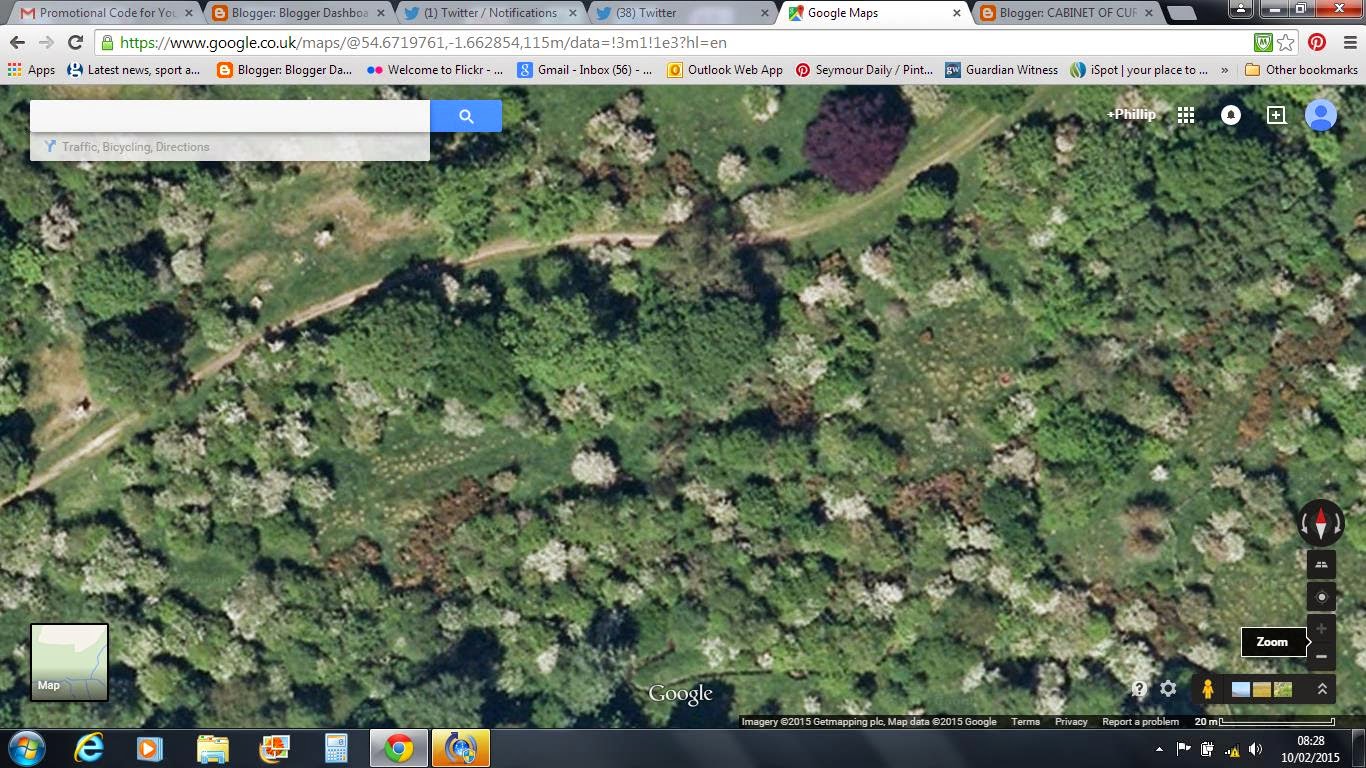
The undisturbed grassland in glades in the hawthorn scrub in Auckland Castle Park, at Bishop Auckland in Co. Durham, is home to an astonishing collection of meadow ant nests. There must be about 200 of these domed nests on the sunny south facing slope, with many more scattered throughout the park.


At the time of writing they are dormant but at the peak of activity in summer each is home to tens of thousands of ants and - like icebergs - there is more of the colony below ground than above.


There are so many that they are easily visible in satellite imagery. This is a screen grab from Google Earth. Double click on the image to enlarge it, then look for the two groups of pale dots across the centre of the image, just south of the footpath that snakes across the map.


This enormous concentration of ant nests makes it a perfect feeding site for green woodpeckers, which are ant-feeding specialists. I can't think of a single time when we've visited when I haven't seen or heard one (though I've yet to get a decent photograph!).


One curious feature of the ant metropolis is that every nest is capped in winter with a single species of moss - neat feather moss Pseudoscleropodium purum


When the grasses die down in winter the vibrant green moss has a chance to thrive in its place in the sun, surrounded by dead grass.


There's plenty of moisture for most of the winter months but the moss's enduring success in this habitat, which can at times be very dry in such a sunny, south facing site, may be due to the arrangement of the moss leaves.


The leaves are arranged like a spiral whorl of overlapping cupped hands around the long axis and the 'cups' hold water


You can see the effect here - when the moss is moist it has this very shiny, inflated appearance. Under the microscope you can actually see water trapped under the leaves,


Sunday, November 9, 2014

The sweet chestnut that refuses to die....

Auckland park, in Bishop Auckland, has an interesting collection of old trees and these venerable sweet chestnuts are amongst the finest.


Some, like this one, are in the prime of life and produced a very heavy crop of chestnuts this year. 


There are four mature trees that were planted in a line beside a small stream. The ground under them is covered in a thick layer of their serrated leaves, spiny fruit husks and nuts that will keep the squirrels well fed for weeks to come.


The low-angle late autumn sunshine this morning showed off their fissured bark beautifully. 


One of the four has been dying for the thirty five years that I've known it. It has shed most of its branches, much of its bark, has been attacked by wood boring beetles and fungi .....


... and yet every year it sprouts new growth, refusing to die. There could be decades of life left in it yet, unless the roots finally rot and it's blown over by a gale and ......


...........that would be a pity, because I'd really miss this gnarled old trunk. It's one of the park's characters.


Sunday, November 11, 2012

Fog and Fungi


A while back I posted about threats to the future of the Bishop of Durham's deer park at Auckland Park, in Bishop Auckland in County Durham. Thankfully these seem to have abated, much to the relief of all those who love the place. It's one of our favourite Sunday morning walks - even in the fog.


The park is at its best in autumn ....


.... especially when fog adds a touch of liquid magic to the spiders' webs.


I think it was Oliver Rackham, the noted tree and woodland expert, who once remarked that the only thing more useful to wildlife than a live tree was a dead tree. He was referring to the vast range of organisms - invertebrates, fungi, etc. - that live in or on the dead wood during a tree's protracted afterlife. Whoever manages the park at Bishop Auckland leaves plenty of dead wood for the benefit of organisms that thrive on it - like these tiers of bracket fungi (Ganoderma sp. I think) in the hollow trunk of this dead beech.


Some of the living beeches are under attack by honey fungus and their days are numbered - but there are also plenty of healthy trees and some replanting.


The stumps of old sweet chestnuts host these developing puffballs.


Sycamore, with the black spots of Rhytisma acerinum on the leaf blade.


Some of the living trees have magnificent rings of toadstools around their bases - I guess that these are a mycorrhizal species, that exist in a mutually beneficial association with the trees.


Not sure what these are, on a decaying beech stump. During the prolonged afterlife of the dead trees a whole succession of toadstools appear, some for just a few days.


Thursday, November 25, 2010

A Walk in the Bishop's Park

Today's Guardian Country Diary describes a visit to the Bishop of Durham's deer park at Bishop Auckland. The bishops have lived in Auckland Castle for over 800 years and for much of that time the park provided resources like venision and timber, but now it's simply a beautiful and tranquil place to visit at any time of the year, but especially so in autumn. It's just five minutes walk from the busy centre of the market town of Bishop Auckland.....and a much-loved natural resource for all who live in the area.
The River Gaunless flows through the park and would have been a source of fish for earlier generations of clergy who lived here, but now its home to kingfishers (that occasionally breed here) and dippers. When I first visited, 35 years ago, there were water voles here too, that I used to tempt out of their bank-side burrows with apple cores, but they are long gone, sadly.

Bishop Trevor's bridge spans the Gaunless and if you're lucky you can sometimes catch a glimpse here of a kingfisher flashing past underneath.

The park is famous for its mid-18th. century Gothic Revival deer house, where clerics could picnic...

...and where the deer herd was fed and could shelter from severe North-Eastern winters.
Originally the arcades around the outside would have been roofed over - you can see the sloping roof line on the end wall in this photograph.
The cloister arches provide a frame for some of the park's magnificent trees, including the beeches on the steep bank of the Gaunless, where landslips have pitched some trees into the river in recent years.
The ancient trees are one of the park's finest features. This is a magnificent sweet chestnut, whose stout bole seems to be melting into the soil under its own weight ...

... and this is one of several decaying sweet chestnuts that have been on their 'last legs' for the thirty-odd years that I've been coming here, and will probably still be producing new shoots long after I'm gone.

As Oliver Rackham, the noted authority on woodlands once observed, there's only one thing more useful than a live tree and that's a dead tree. Old beeches like this have been slowing crumbling away for decades as bracket fungi digest them, and provide a home for all sorts of beetles and sundry insects that in turn attract woodpeckers - of which there are many (green and greater-spotted) in the park.
I haven't identified these toadstools yet, but there was a perfect ring of them around an old hawthorn earlier this month and...

... these Russula atropurpurea appear every autumn under a magnificent Scots pine....
... while oyster mushrooms Pleurotus ostreatus favour the decaying beeches


With so many different trees here, the autumn colour is spectacular: this is hawthorn, with elm in the background ...

... and this is Scots pine and European larch, evergreen and deciduous conifers respectively.


From the highest point in the park the view over the tree canopies is magnificent and the view...
... across to the west takes in the Newton Cap viaduct, which once carried stream trains (what a magnificent sight that must have been!) but now carries a road. The River Wear flows underneath the arches.
These are the homes of the Bishop's other parishioners. There are well over 200 of these hemispherical meadow ant nests on the south facing slopes of the parkt - so many that this ant metropolis is easily visible on Google satellite maps. At a very conservative estimate, I'd say that somewhere around one million ants live here in summer and you can almost always find green woodpeckers visiting these mounds for a meal.

There has been alarming news recently that the Church Commissioners are contemplating the sale of Auckland Castle (the Bishop's palatial residence) and with it the park. Understandably, this has raised great public concern about future access to the park and the fate of its trees and wildlife. The idea of the palace and park being acquired by, perhaps, some hotel chain or multinational corporation that would restrict access and - God forbid - 'tidy-up' the park and its venerable trees is too depressing to contemplate.


For further Guardian Country Diary posts click here