Showing posts with label Corbridge. Show all posts
Thursday, February 9, 2012
Natural Ice Sculptures
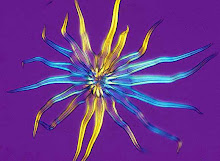
Yesterday, when we were walking near Corbridge along the Devil's Water, a tributary of the River Tyne, we found these natural ice sculptures in mid-stream. The water level had dropped overnight and left them suspended from the rocks. With today's rain and thaw their ephemeral beauty will have dissolved away,
Labels:
Corbridge,
Devil's Water,
River Tyne
Wednesday, February 8, 2012
Essence of Goldcrest
We spotted this little goldcrest feeding in the gorse bushes today, when we were out walking in the Tyne valley near Corbridge on a bitterly cold morning. It allowed me to get quite close but turned out to be difficult to photograph because it flitted from branch to branch so fast and I was shivering in the cold. Image stabilisation systems are all very well for damping down the shivers, but they can't cope with a hyperactive goldcrest in shadow at close range. This picture isn't really sharp, though it shows the golden crest quite nicely ...
..... and this one shows the bird well lit on the only occasion when it ventured into sunlight, but the autofocus was confused by the tangle of twigs ....
...... and this one is reasonably sharp but the lighting is dull and the golden crest isn't very evident. So all things considered, the image I liked best ......
... was this one, which to me is essence of goldcrest: never still for a moment.
Keith (of Holdingmoments) has a great quote on his web page: "Sometimes the picture doesn't have to be perfect; it's the captured moment that counts".
I'll drink to that .....
Labels:
Corbridge,
Goldcrest,
River Tyne
Saturday, January 29, 2011
Bottle kilns
Most abandoned industries tend to leave an ugly scar on the countryside but this pair of bottle kilns, on the hillside just north of Corbridge in Northumberland, make an elegant addition to the rural landscape. They were part of Walker's Corbridge Fire Brick and Sanitary Tube Works and were built sometime around 1840, operating until 1910. Bricks, tiles and chimney pots were moulded by hand using wooden patterns and then fired, sometimes for weeks on end. Rather an elegant piece of industrial archaeology. This view probably hasn't changed much since 1840, except for the power transformer on the pole.
You can find some more images of these structures, including interior views here
Labels:
bottle kilns,
Corbridge,
Industrial archaeology
Wednesday, July 15, 2009
Botanical Xenophobia?


There’s a long-standing belief that dense riverbank stands of Himalayan balsam Impatiens glandulifera – like these plants flowering beside the river Tyne at Corbridge - represent a major threat to our native riverbank plants. The press loves a good ‘alien invader’ story that predicts the extermination of our native wildlife by some botanical ‘foreigner’, and it’s true that some introduced plant species that have escaped into the wild, like Japanese knotweed and Australian swamp stonecrop for example, have damaged natural habitats, but in the case of Himalayan balsam the threat is more imagined than real. Although it’s a tall, fast-growing and very conspicuous plant it’s an annual, and doesn’t compete very effectively with established riverbank perennial native plants that have dense root systems. Two recent research projects have demonstrated that it isn’t a dire threat to our flora and one very recent one has shown that it’s a positive asset as far as bees are concerned. It’s a rich source of nectar and pollen and bees visit it constantly. Sadly, once these 'alien invader' stories take root they tend persist, no matter how good the scientific evidence is that shows they are a myth. So I dare say well-meaning but misguided ‘conservationists’ will organise many more ‘balsam bashing’ events to tackle this imagined threat. Still, the plant is well established almost everywhere now, and its exploding seed pods disperse its seeds very effectively, so it will probably continue to provide a valuable food source for our hard-pressed bees for a long time to come.
Tuesday, July 14, 2009
Sawbills on a Sunny Afternoon


This family of goosanders were enjoying the sunshine upstream from the bridge across the river Tyne at Corbridge (bottom photo) this afternoon . In the thirty five years that we’ve lived in the North East goosanders have become an increasingly frequent sight on the rivers here – something to gladden the heart of ornithologists but not quite such a welcome development for anglers, who resent the goosander’s formidable fishing skill. The serrated edge to the bird's beak is beautifully adapted for gripping a wriggling fish. This is a small family group – we once saw a duck with twelve ducklings on the Swale in Yorkshire but as many as 16 eggs have been recorded in a nest, which goes quite a long way towards explaining why this species has colonised new rivers so successfully. That mottled pattern of downy feathers on the ducklings breaks up their outline very effectively, against the rippled shadows and highlights of the river. Double-click on the images for a larger picture.
Labels:
Corbridge,
goosander,
River Tyne
Saturday, April 18, 2009
Wall plants


Inland cliffs are a relatively rare habitat in many parts of Britain but man-made walls are equally acceptable for most cliff-dwelling plants. These two species – ivy-leaved toadflax (aka Kenilworth ivy) and yellow corydalis - are currently in flower on walls around Corbridge in Northumberland. Neither are native – both come from continental Europe – but they’re a welcome addition to our wall flora and put on a good display from spring onwards. Both thrive on walls here and ivy-leaved toadflax has a neat trick of developing fruit stalks with an aversion to light, so that they grow into dark wall crevices and deposit their seed there. The corydalis seed capsules simply burst to scatter their seed, but first the flowers need to be pollinated and today this mining bee seems to have been performing that role – does anyone know what species of bee it is?
Labels:
Corbridge,
ivy-leaved toadflax,
mining bee,
yellow corydalis
Subscribe to:
Posts (Atom)