Showing posts with label leaf-cutter bee. Show all posts

Thursday, August 17, 2023

Inula hookeri and its pollinators

 This shaggy member of the daisy family, with its beautifully geometric spiral pattern of unopened central florets, originates from the Himalayas. In my garden it's a great attraction to bees, that appreciate the long period of pollen production that results from the sequential opening of all those florets.


Drone flies, like the one below, are also attracted to this flower, visiting to feed on the nectar.  


The most intriguing visitor for pollen collection is the leaf cutter bee. This uses a brush of long orange hairs on the underside of its abdomen to collect pollen, and in the final picture you can see how it walks around the circle of open florets, sweeping up pollen with those hairs as it goes. 


Sunday, June 28, 2015

Jaws: leafcutter bee

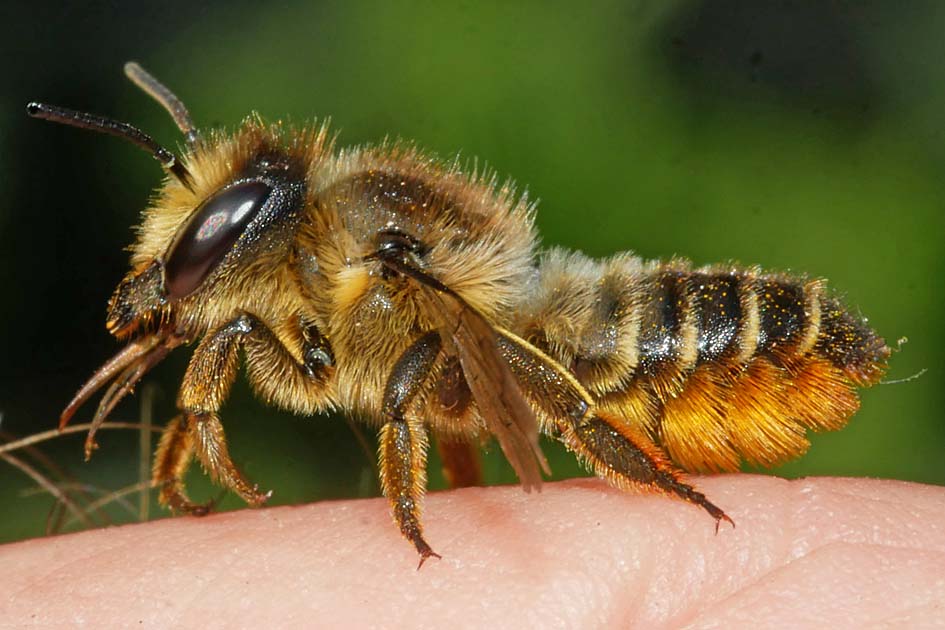
I must that Ryan Clark @RyanClarkNature for helping me with the ID of this male leafcutter bee (Megachile sp. - probably M.willughbiella?). 

We get a lot of female leafcutter bees in the garden but this is the first time I can recall seeing a male here.


I found it immediately after a torrential downpour, looking a little bedraggled and clinging with its jaws to a leaf.


I hadn't realised that they have such beautiful eyes.


Sunday, July 20, 2014

Leaf-cutter bee contortions


The leaf-cutter bees in our garden find the bell-shaped flowers of Symphyandra pendula irresistible.


 As you can see from this image these very active little bees collect pollen on the underside of their abdomen and it's interesting to watch how they harvest it.


When they arrive they enter right way up and walk up into the bell along the central column of the flower but at some point, when they are out of view, they flip upside down.


This means that as they back out of the flower they pick up pollen on their abdomen as its brushed off from the central column of stamens in the flower. 

Interesting to watch how the bees adapt to different flower architectures. The same bees are currently visiting the open bowl-shaped flowers of meadow cranesbill. 


Thursday, July 26, 2012

Drinks,sunbathing,drinks,sunbathing - nice work if you can get it ...


One of the wonders of blogging is that every now and then someone publishes a post that's totally inspirational - and that's the only way to describe this item on bee behaviour, posted by Africa Gomez on her Bugblog.

I've spent a lot of time recently just sitting in the sun (at last) and watching the insects in the garden, and Africa's description of leafcutter bee behaviour - bouts of foraging, interspersed with settling in sunny exposed places for a bit of grooming - perfectly describes this individual, that seems to have taken ownership of a large meadow crane'sbill plant that's growing in our garden.


It has a distinctive technique for reaching the nectaries at the base of the petals, by clasping the central column of stamens with its legs. Meadow crane'sbill flowers go through a well-defined developmental sequence when they open. First the stamens mature and release pollen, as they are in the flower above ....


... then they bend outwards and the tip of the stigma, on its long style, splits into this five-lobbed 'grappling hook' conformation, reading to receive pollen from incoming bees. This visitor must have been doing a very efficient pollination job with its constant visits.


In between its bouts of activity it took time out for some grooming and sunbathing on an old black dustbin that we use as a temporary water butt, that also probably acts as a fine absorber and radiator of heat, and for most of the day is probably the warmest object in the garden.

Incidentally, check out Africa's wonderful photos of leaf cutter bees cutting out leaf sections and carrying them away. 

Friday, May 27, 2011

Watching the (Insect) World Pass By...


Sometimes the best way to watch wildlife is to just sit still and let it come to you, and in our garden at the moment the best place to sit is next to this plant - dame's violet a.k.a. sweet rocket a.k.a Hesperis matrionalis. In addition to having a powerful carnation fragrance and being the food plant of the orange tip butterly caterpillar it's a real butterfly magnet and while I watched it was constantly visited by ....

... small whites and ....

... red admirals. Sweet rocket produces such an abundance of nectar-rich flowers that the butterflies are reluctant to leave and just clamber from flower to flower ..

... which gives you plenty of time to admire the intricate patterning on the underside of their wings.

After you've been sitting in one spot for a while you begin to notice things that you might never spot if you were on the move, like this unidentfied green caterpillar resting in the shade of a chive flower stalk.

Then other visitors begin to turn up - this is Tachina fera, whose larva is an internal parasite of noctuid moth caterpillars and which I've never seen in our garden before. It seems to have a real liking for forget-me-nots.

The sweet rocket is the current butterfly attraction in the garden but the focus of bee visits (particularly leaf-cutter bees) is the wood vetch Vicia sylvatica which attracts a constant stream of visitors. This is a very attractive plant that climbs through the surrounding vegetation and produces a large number of racemes of flowers over a long period.

If you sit in the sun for long enough - especially near the garden pond - then this hoverfly Helophilus pendulus almost always turns up. You can find some wonderful photographs of this species laying eggs - and pictures of its eggs and larvae - here