skip to main |
skip to sidebar
We found a population of about 30 broad-leaved helleborines Epipactis helleborine beside the Deerness Valley walk, a disused railway track that has been converted into a pleasant route for walkers and cyclists.
This is an orchid that thrives on woodland edges, in dappled shade. It's pollinated by common wasps Vespula vulgaris, but this was the first time I have seen the pollinators in action.
The flowers emit a scent that attracts the insects, which have short tongues, so they have to push their head right into the flower to reach a pool of nectar. When they do this the orchid's pollinia, which contain all their pollen, stick to the wasp's face. In the photographs above and below (rather blurred, because the light was poor) you can see a wasp arriving after visiting another plant, carrying the white pollinia on its head, ready to pollinate the flower.
Below, you can see a wasp leaving, taking the sticky pollinia with it, attached to its face.
Click here for a very good YouTube video, by Jean Claessens, of the whole process
Here's something I've never seen before - a common wasp killing a hoverfly. They both landed in a rose flower at the same moment and immediately there was a fierce tussle, as the wasp grabbed its prey.
Then the wasp bit off the hoverfly's head by chewing through its joint with the thorax. Strange behaviour because at this time of year there will no longer be any grubs for the wasp to feed in the nest, and when the nest begins to break up wasps tend to focus on sweet liquid food, like nectar and rotting fruit, rather than on live animal prey.
In autumn, when wasps finish breeding, they turn their attention to anything sweet and often become a nuisance. One solution is to trap them in narrow-necked bottles container a mixture of jam and water - but there are other baits that can be used too.
Back in 2007 a researcher in the Czech Republic called Libor Dvorak tested out traps containing beer as a bait (he didn't mention which brand) and after trapping 3583 wasps of 8 different species at 131 sites across Europe, including several in Britain, found that three species including the common wasp Vespula vulgaris (above) were most prone to drowning in the traps. I suppose there are worse ways to go. If you want to read the original scientific paper you can download it by clicking here.
As far as I can tell, no one has ever followed up this research by testing whether wasps have a particularly preference for any type or brand of beer. Do they have a favourite tipple? Guinness? Fosters? Budweiser? Carling?
Clearly there's scope for some important and original research here. Maybe drink 95 per cent of the beer in ten different bottles, then line the bottles up and see how many wasps end up in each bottle?v At 131 sites across Europe?
My kind of experiment.
Today's Guardian Country Diary describes an exploration of the nest that tree wasps built in our garden hedge.
Tree wasps Dolichovespula sylvestris have this distinctive little black spot in the centre of the clypeus (the central frontal facial plate), and a fine pair of jaws for catching prey and .........
... chewing fibres of rotten wood .
I suspect the wasp in this image is Vespula vulgaris.
They carry a ball of fibes away in their jaws and mix it with saliva.
These three pictures show a red wasp Vespula rufa chewing fibes from a picnic table.
They use this material to build paper nests of exquisite beauty, lightness and remarkable strength. The queen, emerging from hibernation, starts the nest by building a downward-facing dome attached to a twig with a few breeding cells inside, where ....
.... she lays her first eggs that hatch into grubs, which she feeds with insect food until they hatch as adults.
Then these ever-growing ranks of workers construct the nest around her, enclosing tiers of breeding cells, with just a small entrance hole. Each strip of different coloured paper represents the work of a single wasp, with it's own predilection for the colour and source of wood fibres or hairs that it shaves from the surface of plants. The green patches on the nest above are constructed from hairs from the young twigs of the weeping pear tree in our garden.
This is this year's completed tree wasp nest, excised from the hedge after the wasps have abandoned it. As the nest grows it incorporates surrounding twigs, so the whole structure is very light and remarkably strong, considering the fragility of the components.
The view from underneath, where you can see how the exterior is constructed from successive paper layers ..
The entrance hole, a busy thoroughfare at the height of summer.
This year's nest had some red stripes in it, which I'm pretty sure came from the bark of a dead branch of a cypress tree in the garden.
One dead wasp guarded the entrance when I began to dissect the abandoned nest ....
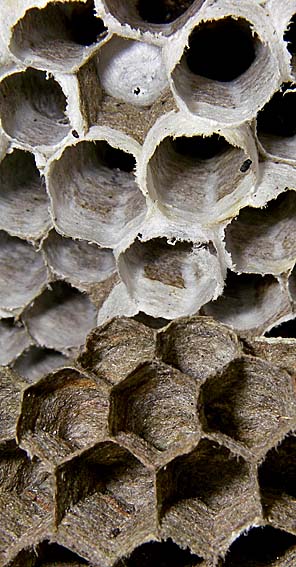
....revealing the tiers of hexagonal breeding chambers inside ....
... and the multi- layered outer wall. When outdoor clothing companies advertise their cleverly designed products with layered insulation, remember that wasps invented this form of insulation millions of years ago!
These breeding chambers are built with astonishing precision by wasps working in total darkness, using wood fibre glued with saliva. Presumably they use the initial cells, built by the queen in daylight, as their template. Many of the cells on this nest contained grubs that died during development...... you can see one top centre in the above image.
The grub weaves a white domed covering, that's opened by workers that come to feed it with chewed insects - and receive a sugary secretion that acts as their food in return for their efforts. This mutual dependence of grubs and adults ensures social cohesion in the colony.
The cells with the tattered white edges were homes to wasp grubs that developed successfully and chewed their way out at maturity.
Near the bottom of the nest I found these cells with dead grubs still sealed inside, almost on the point of hatching. One adult had begun to chew its way through the shroud but died in the attempt, never experiencing life beyond the darkness inside the nest.
So near, yet so far .....
All the wasp-related info on this blog is collected here
Wasps tend to turn their attention to satisfying their urge for anything sweet at this time of year and in my garden the red-hot pokers (Kniphofia spp.) are proving irrestistible to them. Red-hot pokers are pollinated by sunbirds in their native South Africa and to satisfy these birds' energy needs they secrete large volumes of nectar. Wasps (Vespula vulgaris) are so desperate to reach it that they even try to get at the nectar in the unopened florets, as this one is doing, by chewing through the flower's corolla - you can see where it's already tried to chew a hole in the floret immediately above it, then gave up and having a go at this one instead.






 Posts
Posts


