Smardale Gill NNR in Cumbria is one of my favourite reserves, not just for the reserve itself but also for the walk to it. There are two usual ways in, either across country from Ravenstonedale, or via the narrow roads just south of Kirkby Stephen railway station. This time we took the latter route, along a single track road that's fringed with wild flowers, including this two foot-tall harebell which I think is the tallest I've ever seen.
From this direction the footpath into the reserve follows the bed of a disused railway track through woodland and where the canopy opens out it forms a linear woodland glade that stretches for over a mile, fringed with flowers like this wild angelica.
The ripening stone brambles Rubus saxatilis were a reminder that summer is moving on.
Stone bramble berries look wet even when it's not raining.
A good crop of hazel nuts too.
The woodland glade footpath is also a great place to watch spotted flycatchers
Eventually the footpath opens out at the right-hand end of this fine old railway viaduct across Scandal Beck
At this point you can turn left off the footpath and walk through limestone grassland on the east side of the valley ...
 .... the footpath you can see on the left here takes you all the way down to Ravenstonedale, below that big hill in the distant Howgills.
Alternatively you can walk across the viaduct, taking in the view to the north across the treetops of Smardale Gill wood (accessible only with a permit from the Cumbrian Wildlife Trust)
The footpath on the far side of the viaduct continues through some of the finest flowery limestone grassland imaginable, past these impressive old lime kilns...
There is a stark contrast between the plant species diversity along the old railway line and in the improved sheep pasture that you can see in the middle distance here, where very few plant species survive. The railway industry, by fencing off the limestone grassland, effectively saved it from a similar fate and the wonderful floral diversity along this part of the line owes its survival to the Victorian railway company that bought the land and built the lines.
Here's an example - a wonderful patch of betony, greater burnet and bedstraw (double-click for a bigger image).
The most impressive flowers, though, are the fragrant orchids - literally hundreds of them. The scent was intoxicating at mid-day - it must be amazing as dusk, when the fragrance is stronger.
 This is Jacob's ladder Polemonium caeruleum - unlikely to be native here and almost certainly a garden escape, but lovely nevertheless
The far side of the valley looks like plain grassland from a distance, until you walk through it ...
... and find that it's full of limestone-loving wild flowers like this harebell, which makes it an idyllic spot for a picnic.
Field scabious .....
... and rock-rose
A spider had woven a coccoon into this flowering head of quaking grass.
This part of the reserve is probably best known for its butterflies, like these mating common blues ...
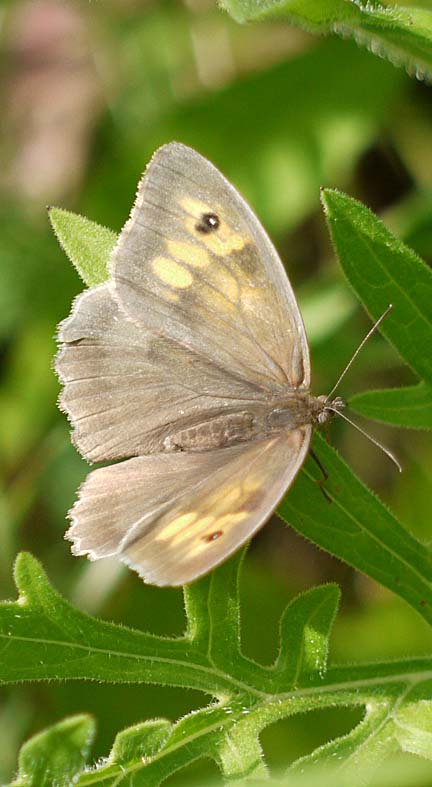
... and the much rarer Scotch argus, with its chocolate-brown and orange colour scheme. On a sunny day they are very active, so it's hot work photographing them...
... but this one, possibly newly emerged, was more accommodating.
Green fritillaries are the other notable breeding butterflies here and usually the best place to photograph them is on thistles, when they feed, but this one was indulging in some sunbathing.







 Posts
Posts


