Showing posts with label Low Burnhall Farm. Show all posts

Friday, June 27, 2014

Bugs at Low Burnhall

Low Burnhall is a Woodland Trust reserve just south of Durham city, with new tree planting to link up fragments of ancient woodland. It will take a while to produce a continuous woodland canopy but in the meantime the existing woodland and large areas of open grassland are home to a wide range of interesting insects species.


Our best find on this visit was this handsome wasp beetle, Clytus arietis, an amazing example of mimicry. It not only looks like a wasp, it moves like a wasp too, with the same jerky walk. No sting, perfectly harmless. Breeds in decaying wood - we found it close to the rotting fallen branches of an old willow.


Our visit coincided with the hatching of scores of five-spot burnet moths.


Unhatched .....


..... and hatched five-spot burnet cocoons


Newly emerged five-spot burnets mating


Possibly the shortest courtship ever - these two five-spot burnets emerged simultaneously from the upper and lower cocoon and mated immediately


There were plenty of newly-emerged ringlet butterflies around. They even fly in light rain.


A very unlucky large skipper, caught by a spider. Maybe the two froghoppers will be luckier when they emerge from their cuckoo spit.


The caterpillar of the Timothy tortrix moth Aphelia paleana, which feeds on a wide range of plants including docks and plantains, as well as Timothy grass. Thanks to Colin Duke for identifying this for me, via the excellent iSpot web site


A capsid bug - I think this is the cock'sfoot bug Leptopterna dolobrata


A sawfly, which I think is a Tenthredo species , feeding on buttercup nectar


Forest shieldbug, Pentatoma rufipes, on an oak leaf.


Kentish snail Monacha cantiana, found inside a curled-up hogweed leaf. Thanks to Martyn John Bishop and Steve Gregory for identifying this for me, also via the excellent iSpot web site


Monday, May 12, 2014

A micro-moth with a liking for germander speedwell


The grassland areas of Low Burnhall Woodland Trust reserve have some very fine patches of germander speedwell in bloom at the moment, and they seem to be very popular with micro-moths.


As far as I can tell this tiny insect is the cock'sfoot moth Glyphipteryx simpliciella, which breeds on cock'sfoot grass but clearly finds these speedwell flowers very attractive.


Wednesday, July 17, 2013

Public Sculpture


Today's Guardian Country Diary described the woven willow sculptures at the Woodland Trust's Low Burnhall farm reserve near Durham. The Coal Miner has been in place for a couple of years now and, judging by the number of people who have their photograph taken next to him, he's captured the affections of many visitors.

Art critics are often rather snooty about public art installations, such as Antony Gormley's Angel of the North, but if one of the tests of meaningful public art is that it provokes a reaction and instils a sense of public ownership,then it (and the Coal Miner) are resoundingly successful. If you drive past the Angel of the North at any time of day you'll almost always see people standing in front of it, adopting its pose and having their photo taken. These willow sculptures at Low Burnhall provoke much the same reaction.


The Coal Miner enjoys a wonderful view over the reserve from his perch on the escapement. Down below him there was once a short-lived colliery, whose traces have almost disappeared.


Recently the Coal Miner has been joined by his wife - again, a willow-woven sculpture, twice life-size - situated under a hedge at the other end of the reserve.........


........... where she's feeding here willow-woven hens.


Both sculptures are the work of Ruth Thompson (of Sylvan Skills) and Anna Turnbull (of Biteabout Arts).


I particularly like the way that the Miner's Wife looks up to the sky, as if sensing a change in the weather.

She was installed last autumn, so stood there throughout the worst of last winters snow and freezing winds. 

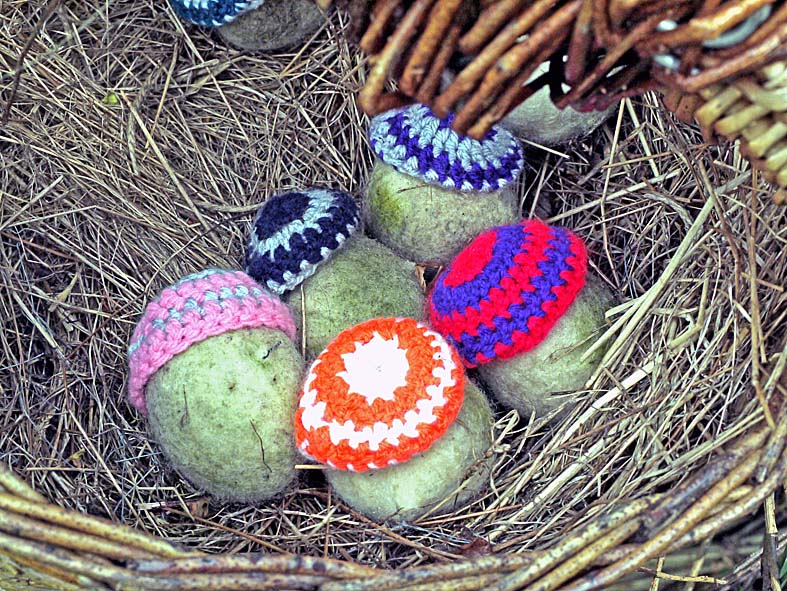
Recently when we visited we noticed something new about her and her flock. Some kind soul, perhaps mindful of that long winter, had knitted scarves for her chickens (double-click the image above to enlarge and see these more clearly) .......


....... and woolly hats for the eggs in the basket that she carries over her arm. 

Clearly, someone has great affection for this public art installation too.........


Thursday, January 17, 2013

Shiver Stabilisation System


I was so cold  and shivering so much when we walked along the river Wear near Durham this afternoon that I could hardly hold the camera still....... which made these pictures a severe test of Panasonic's image stabilisation system. Even dead hogweed umbels are attractive when they're covered in a rime of frost.

I takes more than sub-zero temperatures to stop gorse flowering.


Thursday, January 3, 2013

Woven Willow Woman


Back in April last year I posted some pictures of the woven willow giant at the Woodland Trust Reserve at Low Burnhall Farm, near Durham city. Now he's got company, in the form of this woven willow woman sited at the other end of the reserve. She's feeding woven willow chickens and even has eggs in the basket she carries over her arm. Wonderful!


Thursday, August 2, 2012

Learning to Fly...

Today's Guardian Country Diary describes an encounter with this young kestrel, which was still struggling to master some of the finer points of flight.


First it raced over our heads at great speed .....


... then executed a not-very-elegant landing in the top of this holly tree, whose whippy branches launched it back into the air, until ....


.... it came to rest on a rather more substantial fencepost on the far side of the hedge and glared at us.


Then it tried a few wing exercises ....


... and was almost knocked off balance by a gust of wind under its wings.....


...... before having a  good look around to see ........


.... who else might be witnessing its efforts to fly like a kestrel.


Eventually it tried out a few practice hunting manoeuvres on the ringlet butterflies in the surrounding grassland. Hopefully, it will have got the hang of hovering and learned how to catch more substantial prey before winter comes.

Friday, April 6, 2012

Here be Giants


This wonderful woven willow giant sits on the bank at the northern end of the Woodland Trust's Low Burnhall wood near Durham city.


His natural materials blend in beautifully with the surrounding hedgerows and grassland.....


...... and he's there to greet every walker that arrives at the site...


..... a friendly giant......


.... perched on the skyline, visible from a mile away as you climb up the hill from the south, resting his feet for a while ....


...... and spending his time admiring the view, surrounded by the sound of skylark song and the coconut scent of gorse flowers.

For pictures of the Low Burnhall Farm Wood in summer, click here

Thursday, July 7, 2011

A Visionary Project....

Today's Guardian Country Diary describes a visit to Low Burnhall farm in Durham, now the site of a Woodland Trust major re-foresting scheme and the subject of an earlier blog post about its wonderful display of wild flowers. The photograph above of the farm was taken in spring about five years ago and the one below ..... 

... was taken from more or less the same spot in late June this year, although with a different focal length lens. The Woodland Trust is in the process of planting 94,000 native trees on this site (including rare black poplars) and the first stage has been to re-seed most of the agriucltural land with grasses and plant up the fields bordering the main road as wild flower meadows.

This year the floral display has been mainly confined to annuals like cornflower, corn poppy and corn chamomile that were sown last autumn, but these meadows also include biennials like viper's bugloss and perennial wild flowers that will make a big impact in future years. The wild flower meadows will be maintained in perpetuity, even after mature woodland develops behind them. Signs in the gateways welcome visitors and although it's the wild flowers that will tempt most people to follow the paths mown through the grasses there are quite a lot of other interesting features too.
The arable weeds like field pansy Viola arvensis that grew amongst the wheat and oilseed rape crops are still there but now the crops are replaced by grasses that support a large population of breeding butterflies like....

... this ringlet.
One of the paths through the grassland leads to this grassy bank between high hedges and rough grassland ...

... where betony...

... and lady's bedstraw are just coming into flower.

The fine old hedges are being extended with new plantings.

The eastern edge of the farm is bordered by the River Wear - with sand martin colonies in its banks and also kingfishers.

Looking northwards you can just make out one of the paths mown through the grassland curving up the distant slope (double-click for a larger image) - visitors are encouraged to wander freely over the site and if you climb to the top of the distant hill there are excellent views to the south.

The River Browney joins the River Wear near the southern boundary, with steep banks that are covered in....
...a dense canopy of butterbur leaves

... and with water crowfoot flowering in the river.
One bank of the River Browney is covered in a fragment of oak wood with some magnificent old trees. This part of the site must look very much like it would have appeared to the first neolithic farmers who arrived here to clear the forest, graze their animals and plant crops over five millennia ago.
Now that deforestation process is being reversed. The site includes important fragments of ancient semi-natural woodland and the new planting, which has already begin with the help of volunteers and schoolchildren, will link these up with a new public-access woodland that will develop over the course of the next century. It will be well worth visiting regularly during the early stages to document progress in this visionary project.

It will be a decade before the woodland grows sufficiently to be recognisable as such and in the meantime most people will probably visit to see the spectacular wild flower display in early summer - and all the bees and butterflies that this attracts.