Showing posts with label spiders' webs. Show all posts

Tuesday, September 23, 2025

Titanic struggle: Garden spider versus bumblebee


We witnessed a titanic battle between an unfortunate bumblebee and a female garden spider Araneus diadematus that had spun her web on the flight path to Michaelmas daisies in the abbey garden, Hexham, Northumberland last week. For a while it looked like the frantically buzzing bee might escape, but then the spider’s poisonous fangs found a weak spot and the struggle subsided.


Then the spider suspended its prize on a thicker thread and spun it round and round with its feet, wrapping it a silken shroud paid out from the spinnerets on the tip of her abdomen.


Tuesday, September 3, 2019

Fatal attraction, to yarrow


Yarrow Achillea millefolium is a later summer wild flower that provides easily-accessed pollen and nectar for visiting insects, right up until the end of autumn. It's particularly popular with flies, like this greenbottle, and with hoverflies and droneflies. They can feed without expending much energy, simply by landing and walking from floret to floret across the flat-topped umbel.  


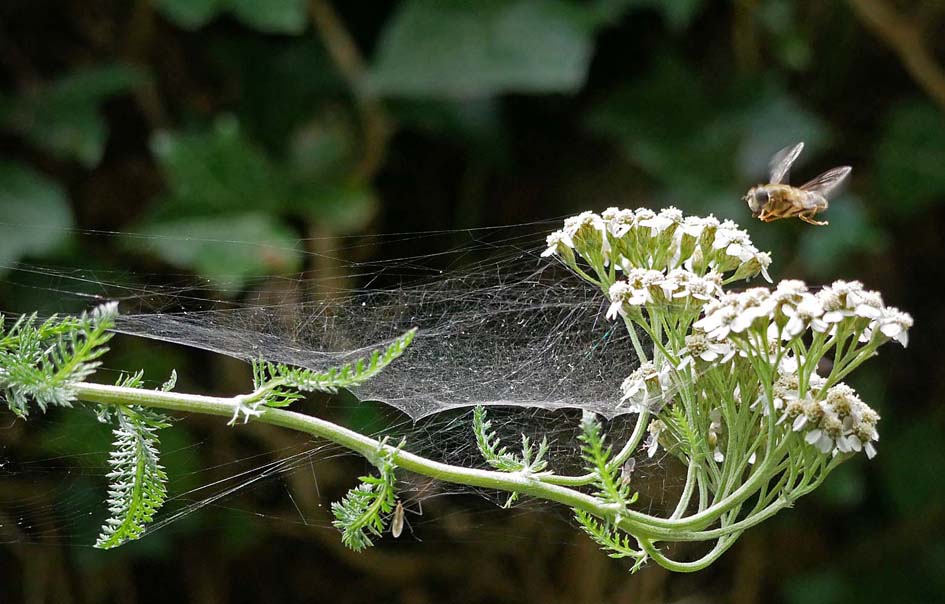
But sometimes just landing on the flowers can be hazardous. About thirty yarrow plants were hanging over a wall along Mortham Lane beside Rokeby park in Teesdale. They had been blown sideways by high winds during their early growth, and at the same time their flower heads had defied gravity and curled upwards, so the whole plant protruded from the wall like a long coat hook. And in that hook, in every plant, a money spider had built its hammock-shaped web, beside the flower head. Money spiders usually sling their horizontal hammock webs in hedges or low in the grass, but this population had taken advantage of the yarrow scaffolding that an accident of wind and gravity had provided.


I watched these plants swaying in the wind, while a long procession of insects came to feed. Drone flies are skilled hoverers and negotiated the risky landing successfully, and .....


.... hoverflies timed their approach and landing with even more precision, avoiding the spider's snare. But there was plenty of evidence, in the form of wings and legs in the webs, that other flies had been less fortunate, and had made a fatal landing in the money spider's web. I saw a blundering greenbottle land in the web, but with good fortune and some frantic buzzing it just managed to extricate itself before the spider arrived.


And in this old web a well-fed occupant had evidently done enough feeding, and had woven its egg cocoon amongst the leaves below the flower head, that had acted as bait for its victims.

Saturday, August 3, 2013

What would you have done.....?


At this time of year juvenile spiders begin to set up their snares in our greenhouse and this one wove its fine, tent-like web across the top of an empty flower pot. They're welcome visitors and even though they are still very small they catch a lot of small insect pests - like winged aphids - that would otherwise infest the plants.


I haven't identified the species yet but it hangs underneath its silken sheet, ready to reach through with its fangs and impale anything that becomes trapped. [Thanks to Africa Gomez at BugBlog for identifying this spider as Neriene montana - there is no way I would have identified it without her expert asistance]


This morning this spider had caught larger prey - an orange ladybird Halyzia 16-guttata, which is another welcome and useful visitor. It feeds on moulds and there are plenty of those in the greenhouse.


So, what should I do? Release the struggling ladybird and, in doing so, destroy the spider's intricately woven web, or let nature take its course and watch one of these two beneficial visitors destroy the other? 

I toyed with the idea of rescuing the ladybird, but the issue quickly resolved itself because suddenly the spider let go and retreated. It may be that the ladybird's armour was too strong for its fangs, and perhaps its captured prey emitted some deterrent - other ladybirds, like the six-spot, secrete a noxious fluid it they are attacked. 

But would the ladybird then remain entangled in the web and simply die of starvation if I didn't rescue it?


As it turned out, no. It simply walked around on the finely woven surface of the web until it found an exit and then flew away.

It often seems that much of what we humans do under the banner of 'conservation' should really be called 'conscience-driven intervention'. We intervene to alter checks and balances between species, often using criteria that have little to do with science but have more to do with sentiment, Sunday school notions of 'good' and 'bad' in nature and that widespread fantasy called the balance of nature. Maybe sometimes it's better to just stand and watch.


Tuesday, September 25, 2012

Commonplace Beauty


I think it's one of the fundamental truths of natural history that you can find beauty in all living organisms - even a commonplace dock Rumex sp. plant like this - if you look a little closer. The ripe seeds are attractive to look at and also favourite food of bullfinches in autumn.


Add a cobweb and some early morning sunlight and a whole dock plant becomes attractive.


Monday, November 7, 2011

Sparkle and Glitter


Last night we had our first hard frost, so .....


..... the strings of pearls of autumn have given way to .....


... the diamond necklaces of winter ....