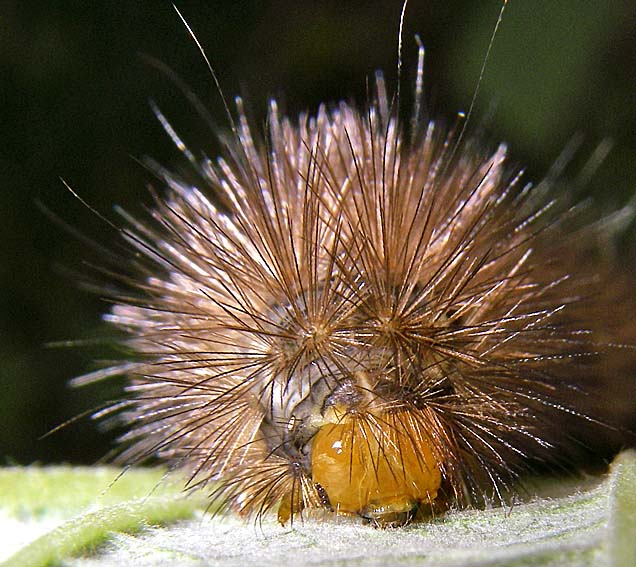
This fox moth caterpillar Macrothylacia rubi crossed our path when we were out walking on Birkside Fell near Blanchland in Northumberland this morning. It will have been feeding on heather.
It's quite late in the year to see one of these in such an active state but the unusually warm weather might have coaxed it out. It's pobably searching for a sheltered spot to spend the winter, before emerging for a brief bask in spring sunshine and then pupating.
There are pictures of the adult moth here.
Showing posts with label caterpillar. Show all posts
Monday, October 27, 2014
Wednesday, July 10, 2013
A nasty way to go ....
A few days ago my youngest son and his partner called to say he'd found a drinker moth caterpillar but by the time I went to collect it the caterpillar had stopped feeding and become very lethargic - usually a sign that there were internal parasites gnawing at its entrails.
Sure enough, a day later this little charmer emerged. The maggot burst out from between the segments on the underside of the caterpillar.
The black structure that you can see at the head end seemed to be some kind of horny beak, that it used to cut an exit hole through the caterpillar's skin. Within two days eleven more of these maggots emerged and one by one ............
........ turned into a red pupa within a few hours of emergence. I suspect it's a tachinid fly (click here for pictures of the fly), although I won't know which one until the pupae hatch.
Labels:
caterpillar,
drinker moth,
parasites,
Tachinid flies
Tuesday, July 2, 2013
Orange tip caterpillars
Back at the beginning of June orange tip butterflies were laying eggs on Jack-by-the-hedge (aka garlic mustard, aka hedge garlic) in our garden and since then the caterpillars that hatched have been doing pretty well.
In their early stages the tiny caterpillars are pale yellow but after a couple of weeks ....
.... they become grey-green and are quite well hidden when they align themselves with their host plant's seed pods. At this stage the prominent hairs on their segments are each tipped with a tiny droplet of secretion, which I suspect is something that repels potential parasites, like ichneumon flies. It doesn't deter wasps though, which I have watched carrying away small caterpillars. I once watched a wasp chew a larger orange tip caterpillar in half and then carry each bite-sized chunk back to the nest.
All the butterfly books mention the cannibalistic tendencies of orange tip larvae, and the way in which this butterfly only lays one egg per inflorescence, but this year I've seen several hedge garlic plants with two or even three caterpillars eating seed pods in what was the same inflorescence, where the butterfly must have laid multiple eggs. I wonder whether this was due to the late flowering of the host plant and the need for the butterflies to lay a lot of eggs quickly. It may be that they are more likely to do this in plants like hedge garlic that produce a lot of large, succulent pods, unlike the alternative and much smaller food plant lady's smock, where the food supply from each inflorescence is much less.
A caterpillar like this, that's approaching maturity, easily demolished one of these three inch-long hedge garlic seed pods in a day. Then, when they are fully fed, the larvae vanish, crawling away to pupate. We've had a thriving orange tip colony breeding in the garden for many years and I have only once found a pupa, suspended from a dead plant stem by a silken halter and extremely well camouflaged, with an outline that resembled a thorn.
Sunday, September 30, 2012
Hairy Caterpillar
I found this extremely hairy caterpillar this afternoon when I was picking raspberries. My thanks to Skev, who identified it as a buff ermine Spilosoma luteum caterpillar.
Wednesday, September 5, 2012
After the Deluge .....
It was what my granny used to call "a clearing-up" shower.
The ferocity of the rain hammering on the car roof drowned out our conversation, the road was awash and the windscreen wipers struggled to cope with the deluge. We were forced to pull over and park. We contemplated turning around and heading for home.
But, as is often the way with the trailing clouds in a band of rain passing overhead during a depression, the short, intensive downpour suddenly slackened ....... and then stopped. Within a few minutes the sound of bird calls was added to the sound of water trickling down drains. A break in the clouds appeared, then a small patch of blue sky, then sunshine.
We got out and walked.
The air was still cold and the vegetation was festooned with raindrops.
A few butterflies, sheltering in the undergrowth, cautiously opened their wings.
Somehow this skipper had survived unscathed, even though raindrops still clung to the harebell where it had taken refuge.
Bumblebees began to return to operating temperature in the sun, but this one was still so chilled that all it could do was raise a leg in self-defence ...
... but the butterflies were soon feeding on the devil's bit scabious flowers again ...
... in competition with hoverflies ......
... all seeking nectar supplies to restore their energy levels.
Within half an hour the breeze had shaken most of the water from the leaves and this caterpillar returned to feeding on nettle foliage ...
... where a cranefly sunbathed ......
.... and finally the bumblebees got busy again on the bramble blossom, which is very late after this soggy summer. They'd better get busy..........
........... because autumn is just around the corner, and the thistles are already releasing clouds of thistledown.
Arranging any kind of outdoor event in the British summer can be a nightmare, but our fast-changing weather patterns provide naturalists with some of their most memorable moments.
All pictures taken along the disused railway line between Romaldkirk and Cotherstone in Teesdale, last Wednesday, 29th. August.
Labels:
Brambles,
bumblebees,
caterpillar,
crane-fly,
harebell,
hoverflies,
Rain,
skipper butterflies,
Teesdale
Friday, May 27, 2011
Watching the (Insect) World Pass By...
Sometimes the best way to watch wildlife is to just sit still and let it come to you, and in our garden at the moment the best place to sit is next to this plant - dame's violet a.k.a. sweet rocket a.k.a Hesperis matrionalis. In addition to having a powerful carnation fragrance and being the food plant of the orange tip butterly caterpillar it's a real butterfly magnet and while I watched it was constantly visited by ....

... small whites and ....
... red admirals. Sweet rocket produces such an abundance of nectar-rich flowers that the butterflies are reluctant to leave and just clamber from flower to flower ..
... which gives you plenty of time to admire the intricate patterning on the underside of their wings.
After you've been sitting in one spot for a while you begin to notice things that you might never spot if you were on the move, like this unidentfied green caterpillar resting in the shade of a chive flower stalk.
Then other visitors begin to turn up - this is Tachina fera, whose larva is an internal parasite of noctuid moth caterpillars and which I've never seen in our garden before. It seems to have a real liking for forget-me-nots.
The sweet rocket is the current butterfly attraction in the garden but the focus of bee visits (particularly leaf-cutter bees) is the wood vetch Vicia sylvatica which attracts a constant stream of visitors. This is a very attractive plant that climbs through the surrounding vegetation and produces a large number of racemes of flowers over a long period.
If you sit in the sun for long enough - especially near the garden pond - then this hoverfly Helophilus pendulus almost always turns up. You can find some wonderful photographs of this species laying eggs - and pictures of its eggs and larvae - here
Wednesday, May 4, 2011
Spot the Caterpillar!
We get a steady stream of people bringing things in jam-jars for identification in Biol. Sciences at Durham University and yesterday a gentleman called Mr. Clark from Sherburn Hill brought in this little beauty - one of the finest examples of crypsis I've seen in a long time. I promised I'd try to identify it for him, which will probably mean keeping it alive until it completes its transformation into a mature moth, so for now it's simply a geometrid moth caterpillar (aka looper caterpillar, aka inchworm). If there are any moth experts out there who can put a more precise name to it I'd be very grateful....
This is the front end, with a tiny head and legs tucked up underneath ....
..... and here's a head-on view
Here it has adopted a 'broken twig' pose. Looking like a dead twig is only half the battle if you are trying to avoid being caught by a blue tit and fed to its hungry nestlings - you need to behave like a dead twig too, and this caterpillar can hold this pose for hours. The secret of how it manages this is in the photo at the bottom of this post
Under a low-power dissecting microscope you can see how small the head is, resembling the broken end of a twig...
.... and in side view you can see a row of simple eyes (ocelli) that must allow it to detect movement when its head is tucked into the overhanging hood. You have to look really hard to spot the three pairs of legs, tucked up tightly underneath (double-click all these images for a larger, clearer view)
The resemblance between the body and a dead twig is uncany, right down to 'knobbly bits' that resemble scars on a twig.
Here's the tail end, with a pair of claspers that cling tightly to the supporting twig. The two pale, oval structures on the side of the body segments are spiracles, that lead to trachea that conduct air into the animal
And here's how it manages to hold that pose for so long, by suspending the head end with a single silken thread.
Labels:
caterpillar,
geometrids,
looper caterpillar,
Moths
Friday, June 4, 2010
Twiggy
At first glance I really did think that this was a small piece of twig resting in the apple leaf's surface until ....
...... I took a closer look and realised it was the caterpillar of a geometrid moth, perfectly camouflaged as a twig. I've no idea what moth this will be. If its camouflage and twig-like behaviour serves its purpose and it remembers that it's supposed to be a twig and not a leaf, and finds a twig to blend with, it might avoid the attention of roving blue tits in the garden, that are hunting for food for their nestlings. It has the most ornate mottled pattern on its head..... and ....
... a side-on view emphasises its essential twigginess.
If you hold an umbrella inverted under a hawthorn branch at this time of year and give the branch a sharp whack several caterpillars like this often fall in ..... along with all sorts of other interesting insects and spiders that breeding blue tits are looking for.
This caterpillar has been kindly identified by Pedro Pires as the pale brindled beauty Phigalia pilosaria
Subscribe to:
Posts (Atom)