Showing posts with label Opiliones. Show all posts

Saturday, August 2, 2014

An amazing harvestman from Morocco

A lot of exotic animals tend to reach our shores these days and when they do they often make lurid newspaper headlines, with scare stories about 'alien invaders' that threaten our native flora and fauna. But there is one alien invader from Morocco that slipped ashore in Bournemouth almost 60 years ago, in 1957, and has steadily conquered the whole of Britain. This extraordinary harvestman, called Dicranopalpus ramosus, reached the Scottish border in 2000 and is still heading north. 


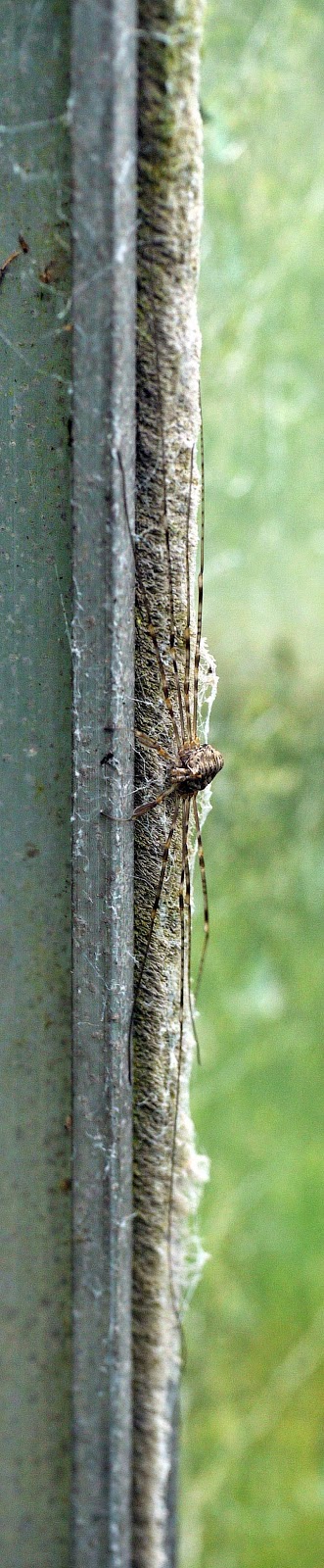
Here's one that lives on the door frame of our greenhouse. Its globular body is only about 4mm. long but its legs are proportionately enormous - they stretch almost from top to bottom of the image above. And because they are all held out at right angles to the body (aligned with the door frame above) the anmials is quite hard to spot unless it moves.


Here it is a little closer, seen from behind and showing less than half of the length of the second pair of legs, which are the longest.


The other distinctive feature of this amazing arthropod is the pair of long, forked pedipalps carried in front of the head .......

That look a little like crab claws and ......

..... are quite menacing, although they are primarily sensory structures - the jaws lie between them, under the front of the head.


When you give Dicranopalpus a gentle poke it abandons its cryptic behaviour and rises up on its splayed legs, much like any other harvestman. If you look carefully at the image above you can see the full extent of one of the second pair of legs, stretched out in front, towards the bottom of the picture.


Here you can see the fine covering of sensory hairs on one branch of those forked pedipalps and also the paired eyes carried on a turret on top of the animal, giving it all-round vision, although harvestmen have rather poor eyesight - their senses of taste, touch and scent, localised on the pedipalps and that second pair of extra-long legs, are far more acute.


So there you have it - the Moroccan invader that conquered Britain, almost unnoticed except by those who take pleasure in finding and watching this obscure but extraordinary group of animals. This is the first one I've seen - I'd never have noticed it if it hadn't moved when I shut the greenhouse door.

They are quite common now in most of Britain, apparently. They're probably in your garage, shed, greenhouse of garden right now.

For more about harvestmen, click here


Thursday, September 26, 2013

Lovely Legs


Today's Guardian Country Diary is about encounters with harvestmen while clearing an overgrown garden.


Although they're often referred to as harvestmen 'spiders' they belong to a quite different taxonomic order from true spiders and have none of their menace, mainly because they lack large poisonous fangs but also because of the tentative, non-threatening, painstaking way that they move. Those long legs are not just for walking - the second pair also carry their senses of touch and smell, which are far more sensitive than their single pair of tiny eyes that are mounted on a turret on their topside. 

When you watch a harvestman on the move it gently feels its way over new territory by extending that extra-long second pair of legs, constantly touching the ground ahead and picking up scents. If you put two harvestmen together in a confined space they'll each extend their second pair of legs towards each other, picking up each others' scent.


Harvestmen scavenge dead animals and will eat fungi and drink juice of ripe fruit, but they are also hunters, catching and eating animals smaller than themselves. There is one intriguing account of a harvestman penning up its prey within a circle of those long legs, drawn close-in to its body, then dropping on its prey like a pile-driver. 

A variety of animals prey on harvestmen, including frogs, toads and birds. On a couple of occasions I've seen robins with their beaks full of harvestmen in autumn. 

They have two forms of defence. One is the secretion of a noxious fluid, said to smell of walnuts, which will deter small predators like ants. Their last line of defence is autotomy - the shedding of legs to allow then to escape a predator's grip (or the sticky threads of  spider's web). It's common to see harvestmen with fewer than the full complement of legs at this time of year but if they lose the second pair - and with them their vital senses of smell and touch - they stop feeding, essentially losing the will to live.


This is the pose adopted when they're faced with a threat, with that second pair of legs extended as wide apart as possible - assessing the threat by detecting its scent.


Although they tend to move slowly and precisely they can, if the need arises, run with considerable speed over uneven surfaces - like long grass, for example - thanks to those amazingly long legs that allow them to simply step over objects that would slow shorter-legged animals down.

At this time of year harvestmen will be laying eggs, which will overwinter and then hatch  next spring as nymphs, which will then slowly grow larger as the summer progresses.

.


Wednesday, August 21, 2013

When Jurassic harvestmen walked the earth.


The raspberry bushes in our garden seem to be a favourite haunt of harvestman, including this one which I think is a male Leiobunum rotundatum. They're often there early in the morning, when they drink dew on the leaves, but later in the day I suspect that they come to drink the juice leaking from damaged fruit.


Fossils from the Rhynie chert in Scotland show that harvestmen have existed for at least 400 million years, more or less unchanged, and you can download a scientific paper with pictures of an exquisite 165 million year old Jurassic harvestman fossil by clicking here.

Since these animals first evolved there have been five great, catastrophic mass extinction events that wiped our many life forms, including the dinosaurs; amazing, isn't it, that these lanky, fragile animals that will shed legs if you touch them have survived while the dinosaurs didn't............

You can find more information about these intriguing animals by clicking here and some more pictures of harvestmen by clicking here

Saturday, September 26, 2009

War of the Worlds


Harvestmen are animals that could have stepped straight out of a science fiction story. That globular body, slung between unfeasibly long angular legs, could easily be a Martian fighting machine, striding through hordes of fleeing, terrorised refugees in War of the Worlds....... or maybe I’ve got an overactive imagination..... but check out the CD cover for Jeff Wayne’s musical version of War of the Worlds (see http://www.coverbrowser.com/image/bestselling-music-2007/3826-1.jpg) and I think you’ll see what I mean.


You do need a pretty vivid imagination to come close to understanding how these strange animals perceive their surroundings. Those two eyes, on either side of the turret on top of their body, are not particularly effective and they mostly explore their surroundings using their senses of taste and smell, which are located on their palps, on either side of their mouth (just visible behind the front leg in the picture above - double-click on the image for a larger view)), and on their second pair of legs. Notice how, in the pictures above and below, this harvestman is lifting and extending one of its second pair of legs towards the camera – it’s smelling me. They take great care of that vital second pair of legs and if you watch one of these animals for long enough you’ll notice that it will draw each of this pair of legs through its jaws quite frequently, to keep these sensory limbs clean and in tip-top condition.


There are scores of these intriguing animals in our garden at the moment, striding through the dry grass and dead leaves in that cautious, fastidious way in which they move, searching for small insects to feed on amongst the decaying vegetation of autumn.