Showing posts with label ringlet. Show all posts

Tuesday, July 11, 2017

Ringlets


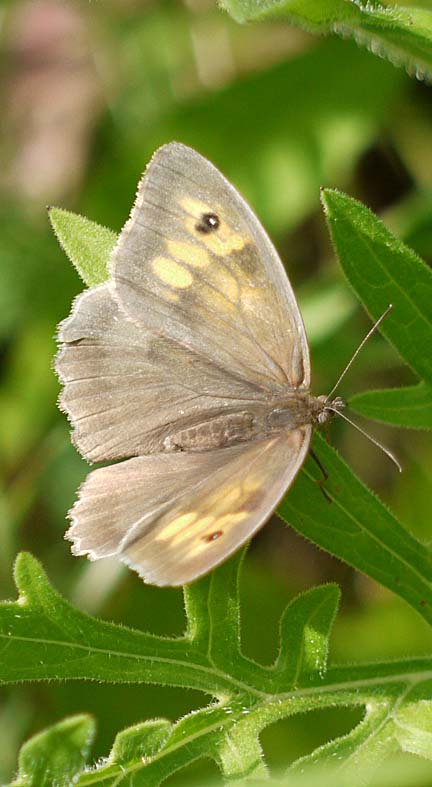
It's peak flowering time for brambles in Teesdale at the moment, which means that it is also peak feeding time for ringlet butterflies Aphantopus hyperantus that like to nectar on the flowers.


When they first emerge their wings are like dark brown velvet, fringed with white hairs, but as the season progresses they lose scales and their colour becomes paler. 
This individual with nicely defined wing spots, sunning itself on a bramble leaf today, is a female. Males tend to have just small dark dots as wing markings.


Ringlets have become much more common in the North Pennines over the last thirty years. There is no shortage of their larval food plants - grasses - and the adults seem very tolerant of dull and damp conditions. I've often seen them flying low over vegetation in very overcast conditions and sometimes even in drizzling rain.

They are very casual about where they lay their eggs. Most butterflies stick them on their larval food plants but ringlets just drop them into the grass. 

Purely by chance, a few years ago I photographed this one in the act of laying an egg, with the egg in mid-air.

Friday, June 27, 2014

Bugs at Low Burnhall

Low Burnhall is a Woodland Trust reserve just south of Durham city, with new tree planting to link up fragments of ancient woodland. It will take a while to produce a continuous woodland canopy but in the meantime the existing woodland and large areas of open grassland are home to a wide range of interesting insects species.


Our best find on this visit was this handsome wasp beetle, Clytus arietis, an amazing example of mimicry. It not only looks like a wasp, it moves like a wasp too, with the same jerky walk. No sting, perfectly harmless. Breeds in decaying wood - we found it close to the rotting fallen branches of an old willow.


Our visit coincided with the hatching of scores of five-spot burnet moths.


Unhatched .....


..... and hatched five-spot burnet cocoons


Newly emerged five-spot burnets mating


Possibly the shortest courtship ever - these two five-spot burnets emerged simultaneously from the upper and lower cocoon and mated immediately


There were plenty of newly-emerged ringlet butterflies around. They even fly in light rain.


A very unlucky large skipper, caught by a spider. Maybe the two froghoppers will be luckier when they emerge from their cuckoo spit.


The caterpillar of the Timothy tortrix moth Aphelia paleana, which feeds on a wide range of plants including docks and plantains, as well as Timothy grass. Thanks to Colin Duke for identifying this for me, via the excellent iSpot web site


A capsid bug - I think this is the cock'sfoot bug Leptopterna dolobrata


A sawfly, which I think is a Tenthredo species , feeding on buttercup nectar


Forest shieldbug, Pentatoma rufipes, on an oak leaf.


Kentish snail Monacha cantiana, found inside a curled-up hogweed leaf. Thanks to Martyn John Bishop and Steve Gregory for identifying this for me, also via the excellent iSpot web site


Thursday, August 8, 2013

Small skippers


About a week ago, when we were walking near Wolsingham in Weardale, we came across a remarkable concentration of small skipper butterflies feeding on a single patch of knapweed on the road verge. There were about twenty and I don't think I've ever seen so many of these lively little butterflies in one place at the same time. Maybe they all hatched from a single batch of eggs laid last year.


Small skippers are something of a success story in North East England. Odd specimens occasionally strayed into Co. Durham in the 1970s and then in 1985 the late Bob Quigley found two flourishing colonies at Durham Wildlife Trust's Low Barns Nature Reserve at Witton-le-Wear. Alerted to the possibility that there might be others, lepidopterists began looking for them in other locations and since then small skippers have continued their range expansion into Northumberland.


Most bloggers have remarked on what a wonderful summer this has been so far for butterflies, and it's certainly a joy to see so many after last year's dismal showing. It seems to be a return to some kind of normality in butterfly numbers. With luck, we may yet return to run of decent summers that will allow future butterfly populations to continue to increase.

Bob Quigley was one of the local butterfly enthusiasts who discovered that ringlet butterflies were breeding at Low Barns reserve, again in 1985. At that time they were only known from a few scattered locations but since then ringlets have also become common in our region.


Saturday, July 20, 2013

A Butterfly Bank: third visit


It's almost three weeks since we last visited the sunny magnesian limestone railway embankment on the disused railway line between Garmondsway and Trimdon, and during that time the withering heatwave has had a major impact on the flora. Most of the species that were in their prime then are coming to the end of flowering and are run to seed, but new flowers have appeared in their place.


The most notable newcomers are fragrant orchids, which are now present in large numbers. Fragrance is rare in orchids - they tend to rely on elaborate floral architecture and colour to attract pollinators - but this species has a powerful, sweet scent. It's individual flowers have a long spur filled with nectar that's only easily accessible to the long tongues of moths and butterflies - and on this visit there were plenty of butterflies along the bank, including .....


..... common blues ....


...... meadow browns, in very large numbers in glades along wooded parts of the old railway line


...... ringlets .....


...... small heaths.....


..... large skippers ....


... and a very fresh-looking small tortoiseshell that must have emerged recently, sunbathing on a limestone ledge, and .........


.......... in glades along the wooded parts of the old railway line, speckled woods. These two are courting - notice how the male is touching the underside of the female's wings with his antenna, perhaps detecting scent scales there (?). The courtship didn't last long because another male arrived and .........


....... a furious butterfly dogfight ensued, during which the female lost interest and flew away.

The newspapers and conservation organisations are quite rightly hailing this as a wonderful year for butterflies, during which their numbers have rebounded, but this seems to overlook the fact that most of those that are on the wing in early summer have actually hatched from eggs that were laid during last year's disastrous summer and have survived the longest, coldest winter in living memory as hibernating caterpillars, pupae or, in some cases adults. That surely says something about the resilience of butterflies to the annual vagaries of our weather and suggests that we need to be far more concerned about protecting habitats, like this wonderful butterfly bank, than the effects of annual weather extremes (not to be confused with long-term climate change, though) 


Thursday, July 7, 2011

A Visionary Project....

Today's Guardian Country Diary describes a visit to Low Burnhall farm in Durham, now the site of a Woodland Trust major re-foresting scheme and the subject of an earlier blog post about its wonderful display of wild flowers. The photograph above of the farm was taken in spring about five years ago and the one below ..... 

... was taken from more or less the same spot in late June this year, although with a different focal length lens. The Woodland Trust is in the process of planting 94,000 native trees on this site (including rare black poplars) and the first stage has been to re-seed most of the agriucltural land with grasses and plant up the fields bordering the main road as wild flower meadows.

This year the floral display has been mainly confined to annuals like cornflower, corn poppy and corn chamomile that were sown last autumn, but these meadows also include biennials like viper's bugloss and perennial wild flowers that will make a big impact in future years. The wild flower meadows will be maintained in perpetuity, even after mature woodland develops behind them. Signs in the gateways welcome visitors and although it's the wild flowers that will tempt most people to follow the paths mown through the grasses there are quite a lot of other interesting features too.
The arable weeds like field pansy Viola arvensis that grew amongst the wheat and oilseed rape crops are still there but now the crops are replaced by grasses that support a large population of breeding butterflies like....

... this ringlet.
One of the paths through the grassland leads to this grassy bank between high hedges and rough grassland ...

... where betony...

... and lady's bedstraw are just coming into flower.

The fine old hedges are being extended with new plantings.

The eastern edge of the farm is bordered by the River Wear - with sand martin colonies in its banks and also kingfishers.

Looking northwards you can just make out one of the paths mown through the grassland curving up the distant slope (double-click for a larger image) - visitors are encouraged to wander freely over the site and if you climb to the top of the distant hill there are excellent views to the south.

The River Browney joins the River Wear near the southern boundary, with steep banks that are covered in....
...a dense canopy of butterbur leaves

... and with water crowfoot flowering in the river.
One bank of the River Browney is covered in a fragment of oak wood with some magnificent old trees. This part of the site must look very much like it would have appeared to the first neolithic farmers who arrived here to clear the forest, graze their animals and plant crops over five millennia ago.
Now that deforestation process is being reversed. The site includes important fragments of ancient semi-natural woodland and the new planting, which has already begin with the help of volunteers and schoolchildren, will link these up with a new public-access woodland that will develop over the course of the next century. It will be well worth visiting regularly during the early stages to document progress in this visionary project.

It will be a decade before the woodland grows sufficiently to be recognisable as such and in the meantime most people will probably visit to see the spectacular wild flower display in early summer - and all the bees and butterflies that this attracts.