Showing posts with label Durmast oak. Show all posts

Monday, February 1, 2016

Tree silhouettes in winter

Every autumn, as the last leaf falls, I've had good intentions of recording a set of images of the characteristic silhouettes of different tree species in winter. They are all distinctive and beautiful in their various ways.

This winter I finally made a start but I hadn't bargained on how difficult it would be to find good isolated examples of trees silhouetted again a clear sky background, so progress has been slow. Anyway, here are a few, that I hope to add to before bud burst begins in a few weeks' time.  


Sycamore Acer pseudoplatanus. Only the tree on the left has had enough space to develop symmetrical growth; the two on the right have got in each other's way.


Horse chestnut Aesculus hippocastanum. Those almost horizontal heavy lower limbs are characteristic; in the rare absence of grazing animals they'll sweep almost down to the ground and are usually the first to be shed from old trees in gales.


Ash Fraxinus excelsior. The upward sweep of the rather thick twigs is characteristic.


Durmast oak Quercus petraea

Friday, October 29, 2010

A Tree-Spotter's Guide to Bark: Part 1

When you think about it, the bark of a tree is pretty remarkable. It's the tree's self-healing protective layer, defending the thin layer of living phloem cells inside, just below the surface, that conduct sugars up and down the stem and also protecting the living layer of cambial cells that produces new growth every year. It's waterproof, but it lets gases pass in and out and it's capable of expanding to keep pace with the growth of the tree, splitting and cracking as the tree ages in a pattern that's characteristic of each tree species. On one January day twenty-seven years ago the bark of this beech Fagus sylvatica was the canvas on which SP and CS carved a declaration of their undying affection; thankfully the wound healing properties of the bark meant that the tree still thrives, even though the union of SP and CS may or may not have endured.


The bark is a tree species' fingerprint. This is Scots pine Pinus sylvestris, with its irregular plates of warm red-brown bark that perfectly complement the deep, glossy green of its needles - especially when winter sunlight strikes the trunk.


The barks of pedunculate oak Quercus robur and of Durmast oak Q. petraea can't really be distinguished, so this could be either (although I happen to know that it was the latter because the acorns had no stalks). I think it may generally be the case that slow-growing trees like oak develop a rugged bark of ridges and fissures that are slowly added to with age, while fast growing species like sycamore and birch tend to develop more rugged splits or shed bark more readily. 


Sycamore Acer pseudoplatanus bark is smooth when the tree is young but soon develops into flattened, irregular plates that are slowly shed as the tree ages, flaking away to reveal a fresh layer below.

For more posts on tree ID click here

Saturday, October 23, 2010

A Tree-Spotter's Guide to Fruits and Seeds: Part 3

European larch Larix europaea is our only deciduous conifer so it should be easy to identify, but there are two Larch species grown in Britain and a hybrid between them, so it's sometimes tricky to identify a tree unequivocally. Unlike their needles, larch cones stay attached to the twigs for several years and this one, with wavy-edged cone scales that hardly curve outwards at the tip, is L. europaea. European larch has elegant pendulous branches that can sweep down to ground level and if it's given space to grow it will become a graceful specimen tree; sadly, most are destined to grown at close spacings in plantations.

Faster-growing Japanese larch Larix kaempferi produces cones with scales that are emphatically curled outwards and downwards at the rim. The extremely vigorous hybrid between L. europaea and L. kaempferi, known as Dunkeld larch L. x eurolepis has cones that are similar but the lip curls outwards without curving downwards .... but, when this hybrid then crosses with L. kaempferi it all gets very confusing....
When I was a kid, my parents took me Christmas shopping in Charlotte Street market in Portsmouth, where there were hot chestnut sellers on street corners who would serve you up a brown paper bag full of smouldering chestnuts that you had to toss from hand to hand until they were cool enough to peel. They probably imported their chestnuts from southern France, or Spain where the tree is native. Sweet chestnut Castanea sativa was brought to England by the Romans, who recognised the value of its nuts and coppiced timber. It needs a good summer to produce chestnuts that are worth roasting here in County Durham - and this hasn't been one of them. Most British trees produce several small nuts per spiny fruit, rather than one large one.


Autumn, when acorns are ripening,  is the best time to identify our two native oak species. The sessile or Durmast oak Quercus petraea bears acorns that have little or no stalk.


English or pedunculate oak Quercus robur acorns dangle from a long stalk (peduncle). Occasionally the two species form hybrids, bearing acorns on short stalks. Oaks, like beech trees, tend to bear heavy crops of seeds on alternate years ('mast' years). It's a mast year for oaks in Durham city this year and they are lying thick on the ground, attracting flocks of pigeons and a lot of jays that are carrying them away to bury for winter emergency rations - if they ever remember where they have buried them. Last year there was hardly an acorn to be found under the same trees.


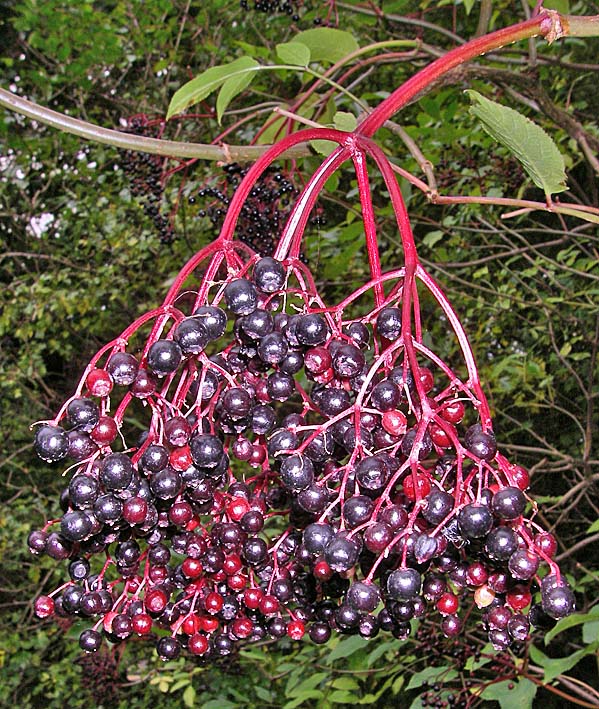
Elder Sambucus nigra berries are popular for making home-made wine but they also have a history of use as a source of dye. Freshly dyed fabric tends towards a rich brown but addition of metal salts like aluminium, chrome and copper as mordants produces subtler shades that vary from umber to blue, violet, grey and through to black, although they all tend to fade after a while in bright light.

For more posts on tree ID click here