Showing posts with label mountain pansy. Show all posts
Thursday, September 24, 2015
The Many Faces of the Mountain Pansy
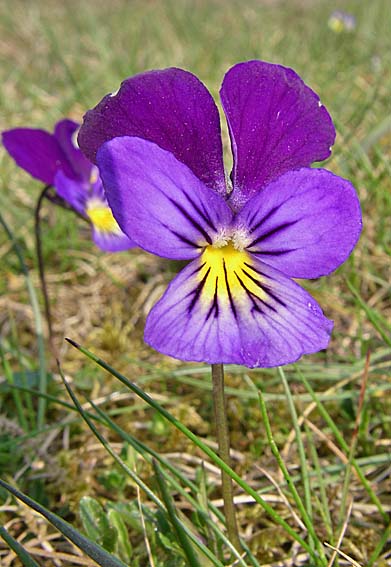
Delighted to find that there were scores of mountain pansies Viola lutea still in flower beside the Pennine Way near High Force in Teesdale today, This is a plant with a long flowering season - the first I saw in bloom were open way back in April.
Mountain pansy has an amazing range of flower colours and markings. All four of these forms were flowering within a metre of each other. The pure yellow form is the most uncommon but the rarest is a pure white form that I've only seen on a couple of occasions, in Weardale.
Several of these plants were flowering around rabbit burrows in close-grazed grass, so it seems that rabbits don't eat them.
Labels:
mountain pansy,
Viola lutea
Wednesday, July 16, 2014
Grass of Parnassus
Thursday's Guardian Country Diary is an account of a walk along the river Nent, between Alston and Blagill in Cumbria, taking in some lovely hay meadows and also a rather special wild flower.
This attractive little bridge is at the Alston end of the walk, where the river ......
... drops over this low waterfall. Downstream it flows into the South Tyne.
The first part of the walk leads over these high pastures towards Blagill. This is curlew and oystercatcher country in summer and their calls followed us all the way.
The return leg of the walk drops down from Blagill to a footpath that follows the southern bank of the river, through some wonderful hay meadows that had many more spotted orchids in flower than we could possibly count. The patch of purple you can see in the picture above, just below the centre, is ....
........ melancholy thistle, once thought to be a herbal cure for said affliction. Finding it thriving in damp hollows in the meadow certainly lifted our spirits because this characteristic hay meadow species is declining in many of its North Pennine strongholds, although there's still plenty of it along the uncultivated road verges that are themselves remnants of meadows. It's a thistle that has no prickles and the undersides of the leaves are almost pure white, thanks to a dense covering of fine hairs. The flower heads are as big as shaving brishes (for those who can remember using these implements).
The wet gulleys that run down the escarpment in the haymeadow were full of ragged robin ....
.... looking suitably ragged in the blustery wind.
Downstream from the meadows there were .....
.... mountain pansies still in flower .....
.... in several colour forms, but the plant we'd really come to see was .....
...... grass of Parnassus, which isn't related to grasses at all but usually grows amongst them. It looked like we were too early - the flower buds, like little pearls, were still clasped in their sepals ......
...... but eventually we found just one in bloom ......
...... allowing us to examine its most unusual feature. It produces nectar to reward visiting pollinators but it first catches their attention with false nectaries - they're the yellowy-green finger like projections with droplet-like spheres at their tips that you can see between the stamens and the petals.
The other notable feature of grass of Parnassus is that it is the county flower of Cumbria, featuring on the county's coat-of-arms.
Thursday, August 9, 2012
Perfect weather for haymaking in Teesdale ...
Perfect weather for haymaking in Teesdale today .....
... turning hay to dry in dawn-to-dusk sunshine .....
.... and baling hay that was already dry .....
...... leaving bare fields that were full of hay meadow wild flowers a few weeks ago ....
.... but there are still mountain pansies flowering on the banks that are too steep to cut ....
.... and betony, a late summer flower of rough grassland and pastures, is in bloom ....
... with flowers that are almost as attractive as an orchid, while ....
.... ripening hazel nuts are a reminder that autumn isn't far away ....
Labels:
betony,
haymaking,
Haymeadows,
hazel,
mountain pansy,
Teesdale
Monday, April 25, 2011
Spring Wild Flowers in Weardale
Last autumn I posted some pictures of a walk up through Slitt Woods in Weardale, following the course of Middlehope Burn upstream. These pictures were taken this weekend, following the same route, starting with masses of sloe blossom in the woodland, attracting the attention of this green-veined white butterfly.
All through the woodland there's a fine display of primroses and around the hazels ...
.....these flowers of toothwort, which is a parasite on hazel roots, are in bloom.
The mountain pansies are just coming into flower in the grassland on the moorland edge. There are numerous colour variations.
Sedges thrive in the short, sheep-grazed turf. The yellow 'paintbrush' is the male flower, composed of numerous stamens, and the white feathery stigmas of the female flowers can be see further down the stem
The ruins of the old lead mine buildings form a natural rock garden for dog violets.
Field woodrush, growing in the short turf.
The early purple orchids at the top of the woodland are earlier than ever this year, thanks to the warm, dry weather.
Marsh marigold thrives around the old lead washing floors, where lead was separated from crushed rock using the force of flowing water. The parabolic flowers of marsh marigold focus the sun's rays and the temperature inside the flower is always a few degrees higher than outside, making them a popular resting place for sun-basking flies.
Up in the edge of the high pastures cowslips are in bloom.
Sunday, April 26, 2009
Mountain pansies


We made the long, steep, breathless climb up the northern fellside from St.John’s Chapel today, almost to the top of Black Hill. The views back across Weardale to Chapel Fell were stunning, we were accompanied by the bubbling calls of curlews during most of the ascent and as an added bonus heard our first cuckoo of spring in a pine plantation, about 500 metres above sea level. There are plenty of nesting meadow pipits on these fells for it to parasitise. Apart from bird song, the only sound when you reach the top is the wind. Otherwise, silence. But the purpose of the climb wasn’t to admire the views, seek solitude or listen to the birds, but to see if the first mountain pansies were in flower. And they were. It’s hard to imagine a bleaker landscape than the tops of these fells, where most of the vegetation is still brown and withered after a hard winter, but from mid-April onwards thousands of these delightful flowers decorate the short turf wherever there is a little shelter, turning it into a natural rock garden. Currently they are just about the only flowers in bloom at this altitude. Search amongst them and you can find every flower colour, from deep purple through yellow to pure white, sometimes with all three colours on different petals of a single flower. Well worth the climb.
Labels:
cuckoo,
mountain pansy,
Viola lutea
Subscribe to:
Posts (Atom)