Showing posts with label Slipper limpet. Show all posts

Monday, April 15, 2013

Beachcombing 3

Rough weather in the Humber estuary a couple of weeks ago scoured a lot of interesting marine life from the seabed and cast it up on the shore. Last week, during a walk along the strand line Cleethorpes beach we found ....


.... numerous cuttlefish' bones' from common cuttlefish. These have been washed ashore in numbers all along the North East coast lately. I've found them on Warkworth beach in Northumberland recently and they've also been reported from the Yorkshire coast at Runswick bay.


There were plenty of the familiar common cockles, with the two valves of this one still joined by their ligament....


....... and some fine oyster shells.


I think this spindle-shaped whelk is the red whelk Neptunea antiqua rather than the common whelk Buccinum undatum.


An edible crab carapace


A cluster of slipper limpets Crepidula fornicata - you can read more about their bizarre sex life by clicking here

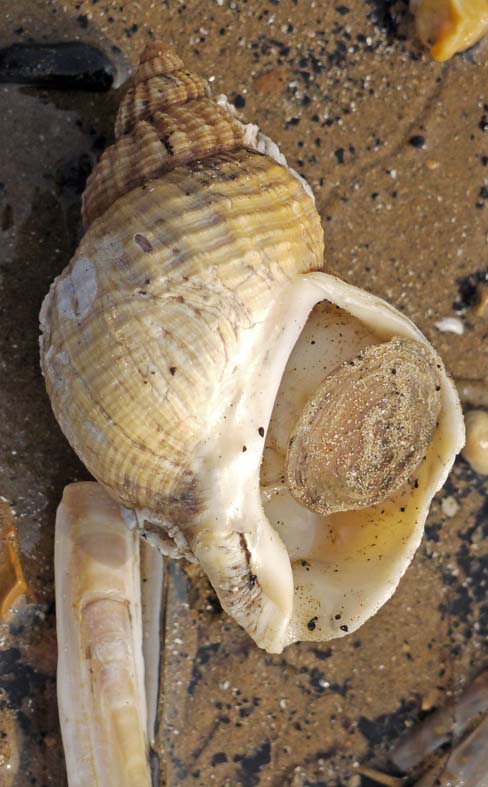


Common whelks Buccinum undatum - the lower image shows the operculum attached the the muscular foot, that seals the shell entrance when the foot is retracted.


Common starfish Asterias rubens, in an advanced state of decay


This strange object, again in an advanced state of decay, is the underside of a sun star, probably Crossaster papposus .....


... and these are the eggs of a common whelk, together with the bryozoan Flustra foliacea, also known as hornwrack (click here to see examples of living bryozoans)


But perhaps the most interesting stranding was this necklace shell, Polinices catenus, with its distinctive hollow spire ( known as an umbilicus) visible on the underside. The snail that lives in the necklace shell has a broad foot and uses it to plough through soft substrates, exposing buried bivalve molluscs whose shells it drills with its abrasive tongue. Its bivalve victims have a tell-tale, neat round hole in one of their valves..........


... like this banded wedge shell Donax vittatus


For more beachcombing, click here, here and here.


Sunday, January 3, 2010

Alien Marine Life


We picked up these two mollusc shells, which have an interesting history, on the Norfolk coast last Tuesday. Both are alien species that were introduced with American oysters sometime around 1880 and have since colonised the south-eastern and southern coasts of England. The animal above is the slipper limpet Crepidula fornicata which, despite appearances is more closely related to periwinkles than to limpets and has a rather exotic sex life (which is why the specific name is fornicata). The inverted shell, which has a shelf inside that gives it a resemblance to a slipper, contains the mollusc that has a powerfully muscular foot that it uses to attach itself to the back of another slipper limpet. So they pile up, one on top of another, youngest at the top, oldest at the bottom. As the older animals die, younger ones attach to the top of the pile. The longest chain of living animals that I ever found had seven individuals. The most amazing aspect of their reproduction is that they change sex as they age – the females are at the bottom, the males (youngest animals) are at the top and the middle ones are in the process of transition. This seems to be a very successful reproductive arrangement because slipper limpets colonised the English coast very rapidly once they arrived here, aided by the production of vast numbers of planktonic larvae that you can see here.


The animal above is the American paddock Petricola pholadiformis, commonly called 'false angel wings', which was also an introduction that arrived at about the same time as the slipper limpet and has been equally successful. It bores into soft substrates like chalk, limestone, shale and compacted mud using its rough shell for a drill, broad end first. It seems extraordinary that a relatively delicate seashell can be used for boring in this way, but by using its muscular foot to endlessly fidget the shell from side-to-side the animal drills down into the rock, growing larger as it burrows deeper – so once it’s in, it can never leave. It’s armoured by being encased in rock, but the rock also becomes its tomb.

You can read more about both of these at http://www.marlin.ac.uk/speciesinformation.php?speciesID=4077
and