Showing posts with label small tortoiseshell. Show all posts

Saturday, August 22, 2020

heather moorland in August

 The moorlands of Weardale are a sea of purple heather at the moment, often stretching all the way to the horizon. Billions of tiny, nectar-rich flowers are in bloom, feeding vast numbers of insects, from minute thrips to butterflies.


The flowering of the heather coincides with the breeding season of these heather Colletes bees (Colletes succinctus), below. They lay their eggs in tunnels excavated in the sandy moorland soil, usually on a south facing patch of bare ground, then provision the egg with heather pollen before sealing the chamber. They're solitary bees, unlike the highly organised, social nests of honeybees and bumblebees, but do aggregate their nests in huge colonies. Yesterday we must have walked past many thousands of them, congregating at the entrance to their tunnels and shuttling backwards and forwards to the heather flowers.


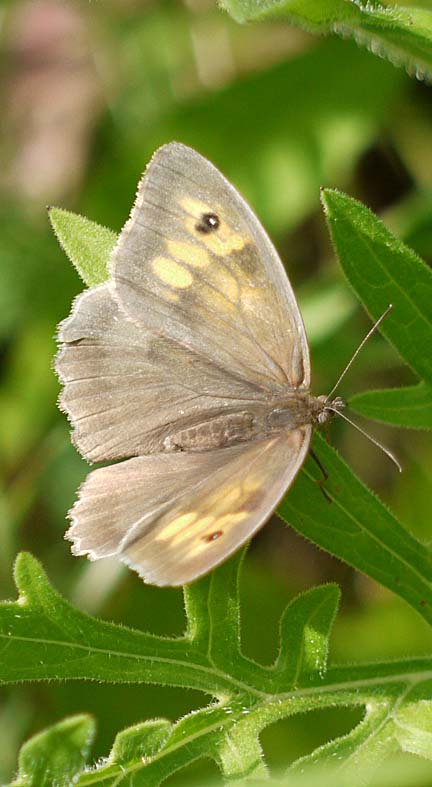
The vast expanse of flowers also attracts butterflies. Yesterday we saw red admirals, small coppers, small tortoiseshells and small heaths. The small coppers breed on dense, transient patches of sorrel that grows quickly on the bare soil after a heather burn.


This 'woolly bear' caterpillar (below) is the larva of the northern race of the oak eggar moth Lasiocampa quercus. It spends two years in the larval stage, overwintering as a larva before emerging to feed again, then pupating over a second winter before it finally emerges as a spectacular moth.


And finally, a rove beetle Platydracus stercorarius, with wings tightly folded under those red wing cases


Sunday, October 13, 2013

In praise of some non-natives


Wildlife gardening evangelists frequently exhort us to plant native species in our gardens - quite rightly, as there are indeed many native plants that are decorative and provide valuable resources for insects and their larvae. 

But when it gets to this point in autumn the choice of flowering natives is pretty narrow. There's ivy, which is certainly a terrific source of pollen and nectar for insects and also food plant for holly blue butterfly larvae, but that's about it  - other that a few late hogweed flowers and yarrow, which flower up until the first frosts but don't bring much colour to a garden.

So that's when Michaemas daisies Aster amellus, whose natural range extends across southern Europe into Asia, come into their own. Whenever the sun shines the Michlaelmas daisies in our garden attract a constant stream of visitors, including ....


.... hoverflies, like this Heliophilus pendulus


..........honeybees ......


.............. small tortoiseshells ............


.............and red admirals, all photographed in the space of a few minutes at the end of last week.


Marigold Calendula officinalis, which originated in southern Europe, provides similar services for butterflies throughout autumn.


Buddleia davidii, the famous butterfly bush from Central China and Japan, has - until recently - been a favourite amongst wildlife gardeners as a nectar source for butterflies, even though it usually finishes flowering long before the late autumn generation of small tortoiseshells, peacocks, red admirals and commas get into their stride. These days conservationists give B.davidii the thumbs down, on account of its invasive tendencies, but there is a much better Buddleia alternative - B x weyeriana, which is an interspecific hybrid between B.davidii and B.globosa and has very attractive pinkish-orange flowers and none of its parent's tendency to seed itself around prolifically. It's extremely hardy and continues to flower long after the first frosts, offering a 'last-chance saloon' for any insects that need to top up with nectar before going into hibernation.


Monday, July 29, 2013

St.John's Chapel, Weardale


It was only a little over a fortnight since we'd taken our regular circular walk around St.John's Chapel in Weardale but, when we visited again on Saturday, the intervening period of almost dawn-to-dusk sunshine had transformed the landscape. All the early summer flowers, like the wood cranesbill, had run to seed and perfect haymaking weather meant that all the meadows had been mown. 

Even though this was only July, it seemed as though the summer is slipping by and it felt, as they say around here, 'proper back-endish'.


Harebells and crested dog's tail grass beside Harthope burn


Marsh woundwort in flower beside a ditch at the bottom of Chapel Fell


The frothy blossom of meadowsweet, once used for flavouring mead (the name has nothing to do with meadows, it refers to mead).


Monkey flower Mimulus guttatus in the gravel beside the river Wear. Thirty years ago, when I first saw it on this spot, this alien plant from the western United States was much commoner along the river than it is now - it seems to have gone into decline.


Rushes flowering on the slopes of Chapel Fell. For much of the year these are dull plants but for a brief period, when they flower, they look very attractive in the sunlight (double-click for a clearer image)


Timothy Grass Phleum pratense, flowering in corners of meadows that the mower missed. Very similar to meadow foxtail Alopecurus pratensis, but that flowers in spring and this flowers in mid-summer.


A most heartening sight - one of twelve freshly emerged small tortoiseshells on creeping thistles, on the flanks of Chapel Fell. These butterflies seem to be doing very well around here this year - we had seven at once on the Inula flowers in our front garden this weekend.


Spot the fish: a trout, keeping station in the sunlit river below a waterfall, catching whatever the river delivers and only given away by its shadow - the fish's back is a very close match for the colour of the underlying rock.


Up on Chapel Fell the lapwings have finished nesting and are now forming flocks with their juveniles.


Saturday, July 20, 2013

A Butterfly Bank: third visit


It's almost three weeks since we last visited the sunny magnesian limestone railway embankment on the disused railway line between Garmondsway and Trimdon, and during that time the withering heatwave has had a major impact on the flora. Most of the species that were in their prime then are coming to the end of flowering and are run to seed, but new flowers have appeared in their place.


The most notable newcomers are fragrant orchids, which are now present in large numbers. Fragrance is rare in orchids - they tend to rely on elaborate floral architecture and colour to attract pollinators - but this species has a powerful, sweet scent. It's individual flowers have a long spur filled with nectar that's only easily accessible to the long tongues of moths and butterflies - and on this visit there were plenty of butterflies along the bank, including .....


..... common blues ....


...... meadow browns, in very large numbers in glades along wooded parts of the old railway line


...... ringlets .....


...... small heaths.....


..... large skippers ....


... and a very fresh-looking small tortoiseshell that must have emerged recently, sunbathing on a limestone ledge, and .........


.......... in glades along the wooded parts of the old railway line, speckled woods. These two are courting - notice how the male is touching the underside of the female's wings with his antenna, perhaps detecting scent scales there (?). The courtship didn't last long because another male arrived and .........


....... a furious butterfly dogfight ensued, during which the female lost interest and flew away.

The newspapers and conservation organisations are quite rightly hailing this as a wonderful year for butterflies, during which their numbers have rebounded, but this seems to overlook the fact that most of those that are on the wing in early summer have actually hatched from eggs that were laid during last year's disastrous summer and have survived the longest, coldest winter in living memory as hibernating caterpillars, pupae or, in some cases adults. That surely says something about the resilience of butterflies to the annual vagaries of our weather and suggests that we need to be far more concerned about protecting habitats, like this wonderful butterfly bank, than the effects of annual weather extremes (not to be confused with long-term climate change, though) 


Saturday, July 6, 2013

BBC Radio 4 Guide to Garden Wildlife


At 9.30am. on Monday 8th. July Brett Westwood and I are presenting the first of a new five-part series called A Guide to Garden Wildlife, produced by Sarah Blunt at the BBC Natural History Unit.


The home page for the series can be accessed by clicking here.

The series also has its own dedicated blog, accessed by clicking here.