Showing posts with label Musk mallow. Show all posts

Friday, July 27, 2012

Industrial Archaeology ... and Medical Archaeology too?


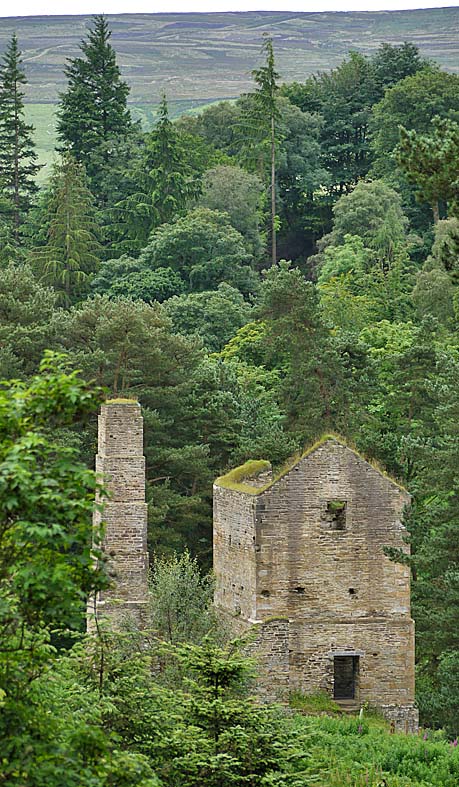
Just north of Blanchland in Northumberland there is a road and then a footpath that leads out over moorland towards Slaley, that passes through a little valley where you can find this impressive ruin. It's the engine house that housed the machinery for pumping water out of the lead mines and was built 200 years ago. In its heyday 170 people lived and worked in this valley, extracting minerals underground in work that was back-breaking, debilitating and dangerous. You can read all about the history of this place - and find some fascinating insights into the lives of the people who lived and worked there, by clicking here


The engine house site has recently been cleared of the tangle of vegetation that threatened to engulf it and has been stabilised, so you can have a look at the site. The disturbance has led to the germination of some interesting plants that would have been familiar to the people who once lived and worked here. There are some exceptionally fine specimens of common mullein or Aaron's rod, Verbascum thapsus, that often thrives in disturbed ground. 


The plant produces a few new flowers each day along its long flower spike, so blooming continues for a long time ....


.... and produces a constant supply of pollen for bumblebees over a prolonged period. It's easy to spot these visitors because their pollen baskets are always full of orange pollen.


Mullein is a biennial and produces a beautiful rosette of densely hairy leaves in the first year, that look particularly fine when they are covered with dew on sunny autumn mornings, then in the second year the flower spike elongates. The dense hairs were once shaved from the leaves, dried and used for making lamp wicks and tinder that ignited easily with the slightest spark. A mucilaginous extract of the leaves, boiled in milk, produced a medicine that that was used to treat coughs and it's tempting to think that those who worked in the constantly damp conditions underground here might well have used these plants for that purpose.


Mullein produces vast numbers of seeds but as Sir Edward Salisbury, former Director of Kew Gardens and author of the classic Weeds and Aliens discovered, most fall within about 12 feet of the plant and so it tends to occur in locally dense, self-seeded patches - as it has at this location.


According to C. Pierpoint Johnson in his treatise on The Useful Plants of Great Britain, published in 1863, the tiny seeds "are said to intoxicate fish when thrown into the water, and are used by the poachers for this purpose".


This musk mallow Malva moschata, growing in amongst the mulleins, is also a mucilaginous plant whose extracts were used as an emollient to treat pulmonary complaints.


It's tempting to speculate that this local concentration of plants with medicinal properties is not here by chance, but might have been used by the local miners when they were the amongst the few treatments for their ailments that were available to them. Maybe they are survivors from gardens of houses that have long since vanished .....

Sunday, July 31, 2011

Two Rivers

This is the Arkle Beck above Reeth. Downstream it flows into the river Swale, which is shallow and fast-flowing in summer but has a reputation for rising very rapidly after rain and quickly becoming a  dangerous raging torrent.


The view southwards, across Swaledale, from the beck-side path between Reeth and Langthwaite.

Much of the land around here on the steep valley sides is very rough sheep pasture - where sometimes you find these large puffball toadstools - this might be Lycoperdon utriforme. It's about six inches in diameter and this is an old specimen that's partially disintegrated but still has millions of spores inside.
The most colourful flowers in the pastures at this time of year are the musk thistles Carduus nutans, identifiable by their nodding heads and backward-swept spiny bracts behind the flowers.

Wensleydale, the next Yorkshire dale to the south, and this is the river Ure looking very placid as it flowers through Wensley.
The riverbank footpath that runs westwards from the bridge across the river here has some very fine displays of wild flowers at the moment, including meadowsweet, meadow crane'sbill, yellow loosestrife, giant bellflower, harebells and marjoram.


This is yellow loosestrife Lysimachia vulgaris, leaning over the footpath, almost demanding to be photographed.

The riverside footpath leads out through woodland into pastures and in one we found this magnificent, solitary patch of musk mallow Malva moschata. The whole field was full of dull pasture grasses except for a broad pit in one corner, that might have been excavated for gravel at some point but now acts for a refuge for plants that must have been here before the pasture was 'improved'.

One of the finest patches of musk mallow I've ever seen, at the peak of flowering.

 Musk mallow makes an excellent late-flowering addition to a wild flower garden, that can hold its own amongst showy cultivated plants and doesn't become invasive.

It provides a good supply of pollen and nectar for bees. This one has empty pollen baskets and seemed to be after the nectar, but must have been almost blinded by that dense covering of pollen it's picked up on its head.