Showing posts with label Northumberland. Show all posts

Friday, July 27, 2012

Industrial Archaeology ... and Medical Archaeology too?


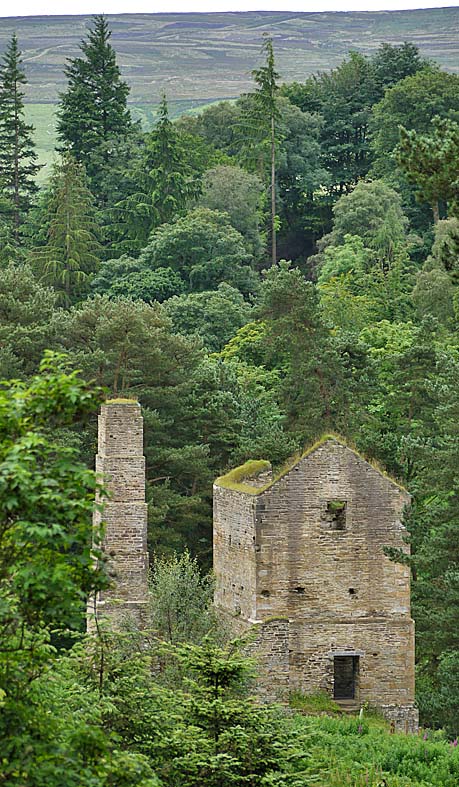
Just north of Blanchland in Northumberland there is a road and then a footpath that leads out over moorland towards Slaley, that passes through a little valley where you can find this impressive ruin. It's the engine house that housed the machinery for pumping water out of the lead mines and was built 200 years ago. In its heyday 170 people lived and worked in this valley, extracting minerals underground in work that was back-breaking, debilitating and dangerous. You can read all about the history of this place - and find some fascinating insights into the lives of the people who lived and worked there, by clicking here


The engine house site has recently been cleared of the tangle of vegetation that threatened to engulf it and has been stabilised, so you can have a look at the site. The disturbance has led to the germination of some interesting plants that would have been familiar to the people who once lived and worked here. There are some exceptionally fine specimens of common mullein or Aaron's rod, Verbascum thapsus, that often thrives in disturbed ground. 


The plant produces a few new flowers each day along its long flower spike, so blooming continues for a long time ....


.... and produces a constant supply of pollen for bumblebees over a prolonged period. It's easy to spot these visitors because their pollen baskets are always full of orange pollen.


Mullein is a biennial and produces a beautiful rosette of densely hairy leaves in the first year, that look particularly fine when they are covered with dew on sunny autumn mornings, then in the second year the flower spike elongates. The dense hairs were once shaved from the leaves, dried and used for making lamp wicks and tinder that ignited easily with the slightest spark. A mucilaginous extract of the leaves, boiled in milk, produced a medicine that that was used to treat coughs and it's tempting to think that those who worked in the constantly damp conditions underground here might well have used these plants for that purpose.


Mullein produces vast numbers of seeds but as Sir Edward Salisbury, former Director of Kew Gardens and author of the classic Weeds and Aliens discovered, most fall within about 12 feet of the plant and so it tends to occur in locally dense, self-seeded patches - as it has at this location.


According to C. Pierpoint Johnson in his treatise on The Useful Plants of Great Britain, published in 1863, the tiny seeds "are said to intoxicate fish when thrown into the water, and are used by the poachers for this purpose".


This musk mallow Malva moschata, growing in amongst the mulleins, is also a mucilaginous plant whose extracts were used as an emollient to treat pulmonary complaints.


It's tempting to speculate that this local concentration of plants with medicinal properties is not here by chance, but might have been used by the local miners when they were the amongst the few treatments for their ailments that were available to them. Maybe they are survivors from gardens of houses that have long since vanished .....

Thursday, June 9, 2011

Derwent Valley

I've posted quite a few items on this blog about plants or animals that we've come across in the valley of the river Derwent, on the Durham/Northumberland border - and today's Guardian Country Diary also comes from this delightful spot - so I thought I might post a few pictures of the location. The stretch of the valley that we often walk starts at Blanchland ....

... which is a great spot to photograph swallows, sand martins and house martins skimming over the shallow water.

Some hay meadows, with mature oaks,ashes and sycamores on their boundaries, lie in the valley bottom at the Blanchland end, with hawthorn hedges and ..... 

...drystone walls a little higher up the valley sides, currently sheltering some fine displays of wood crane'sbill and cow parsley and also home to some rather less common plants.

The older trees often have holes that are good nest sites for redstarts and the oldest trees are hosts to some interesting fungi.


Across the valley on the north and south sides the land quickly rises to open moorland but....

...the shelter of the valley bottom makes for very lush growth in summer.

As you head towards the Derwent reservoir, a couple of miles down the valley, the pastures become wetter and offer some ......

........very fine yellow and blue displays of buttercups and germander speedwell at this time of year.

If you make your way down to the river this is usually an excellent place to look for goosander, dippers, grey wagtails, sandpipers and - if you're lucky - a kingfisher.

Follow the river downstream from here and you pass through alder woodland most of the way until you each the reservoir. Here, and in the rough pastures away from the river, we've sometimes watched roe deer and often heard cuckoos.

In spring this stretch of woodland is full of bluebells but just now they're fading and giving way to summer flowers, like this bistort Persicaria bistorta.