Showing posts with label Natural History Illustrations. Show all posts

Friday, February 6, 2026

Beatrix Potter, mycologist


When I first became seriously interested in natural history, about 60 years ago, the Wayside and Woodland series of nature guides, published by Warne, were some of the best available, but too expensive for me - the affordable Observer’s books, by the same publisher, were the limit of my budget. Now there are glossier, better illustrated up-to-date guides but the old W & W series often turn up in secondhand bookshops and have a nostalgic charm. This one cost me 50p. in a charity shop and is particularly interesting because most of the illustrations are watercolours by Beatrix Potter, of Flopsy-bunny, Jemima Puddle-Duck, Peter Rabbit and Mrs. Tiggywinkle children’s book fame.


Before she turned to writing children’s books Helen Beatrix Potter (1866-1943) was a passionate mycologist who approached the study of fungi with a scientist’s meticulous curiosity and an artist’s sensibility, encouraged by Charles McIntosh, her local postman-naturalist who often supplied her with toadstool specimens to paint.

Her studies extended to culturing fungal spores in her kitchen and in 1896 she submitted a research paper, on the subject of velvet shank toadstools Flammulina volutipes (pictured below) to the Linnaean Society of London. At that time it didn’t admit women as members but her paper was read at a meeting and returned for revision but never resubmitted nor published.

She moved on to writing and illustrating some of the best-loved children’s stories, devoting the latter years of her life to sheep breeding and conserving the beloved Lake District landscape that was her home, but her mycological legacy lives on in her exquisite watercolours.


Monday, January 12, 2026

Judging a book by its cover - and by its contents


Edwardian publishers certainly knew how to produce exquisite book covers. I found this charming, gilded, art nouveau example in a second-hand bookshop a few years ago. I was beguiled by the cover, but even more enchanted by the contents.
The cover illustration, and others inside, was painted by artist/illustrator William Bennett Robinson (1870-1915).


The text is by Thomas W. Hoare, Teacher of Nature Study, about whom there seems to be very little information, although I did find one reference that suggests he might have died in 1939.

The book is an omnibus edition of seven books of practical nature study, in the Look About You series published from 1904 onwards. I’m guessing that this de lux edition, which must have been quite expensive, might have been published around 1914. The publisher, T.C. & E.C. Jack, was taken over by another Scottish publisher, Nelson, in 1915.


Here’s Hoare’s preface, setting out his intentions, using the study of nature close to home as a gateway to a broader education based on a child’s natural curiosity. It seems to have been intended as a structured guide to educating children at home.

Each of the seven books is composed of lessons in the form of a conversation between a family member and the children, sometimes with experiments they performed together, and at the end of every lesson there are four questions or tasks for the children to address. At the end of every book there are teachers’ notes, which strongly emphasise the need for kindness and compassion for animals and the need to exercise care and restraint in collecting and keeping living organisms.


Harvest time. The period illustrations capture a lost rural world, of farming with heavy horses and hard manual labour.


Aeronautics, before powered flight became commonplace. The book teaches scientific concepts like cloud formation, rising air currents and air density, by referencing familiar everyday phenomena, from condensed steam from boiling kettles to intrepid balloonists.


Colour plates for insect identification


Wild flowers, butterflies and moths


And when lessons are over, letting off steam by chucking snowballs at a snowman effigy of teacher.


And finally, something else about the Look-About-You series that distinguished them from contemporary early 20th.century outdoors natural history manuals that were mostly written for boys; this series was for the edification of sons and daughters.

You can download free digitised copies of some of the series from the Project Gutenberg website


Monday, December 26, 2016

Hummingbirds

I found this copy of H.G.Adams Humming Birds Described and Illustrated in an antiquarian bookshop many years ago. One of its hand-coloured steel engravings is missing but those that remain are exquisite. It was first published in 1856.

Henry Gardiner Adams (1811-1881) wrote several natural history books but not much seems to be known about him, other than that he was a chemist who eventually went bankrupt. 

The text describes the species illustrated but the best part of the book is a chapter written by C.W.Webber, who caught and bred hummingbirds in an effort to study their behaviour and diet. 

At that time there was a great deal of debate about whether these little birds could survive on nectar alone. Webber and his sister fed spiders to ruby-throated hummingbirds as well as nectar, demonstrating that their diet could be more varied than had been supposed.

You can download the whole book in a variety of formats by clicking here


Azure-crowned and White-eared


Double-crested and Violet-eared 


Tufted-necked and Delalande's 


Blue-throated and Amethyste 


Dupont's and Racket-tailed


Pigmy and Gigantic


Ruff-necked and Mango

Friday, May 13, 2016

A Marine Biology Professor who loved Curves


The King Penguin series of books, published between 1939 and 1959, covered a very wide range of topics. This is one of my favourites because it seems to have been written by someone who was untroubled by the boundaries between the arts and science.


Seashore Life and Pattern was written by T.A. Stephenson, Professor of Zoology at the University of Wales, and published in 1944. 


Thomas Alan Stephenson was born in 1898 and died in 1961. He was a talented zoologist and artist and was a leading authority on sea anemones, writing and illustrating the definitive texts on them. He was elected a Fellow of the Royal Society in 1951. You can read more about his career in science here.

He was clearly someone who appreciated nature for its aesthetic qualities, as well having the enquiring mind of a scientific researcher. He was fascinated by the relationship between beauty in nature and beauty in art. 


In his own words, in his introduction " ..... the author of the volume has been painting seashore and other subjects for thirty-five years, and is as much interested in marine life from a decorative point of view as from a zoological."


Stephenson produced all the illustrations for the book - monochrome in the text ....


 ... and colour plates at the end. He also designed the book cover.


"It is perhaps a pity, " he wrote in his introduction, "that artists and scientific workers are, naturally enough, usually afraid to venture a single inch beyond the boundaries of one another's territory. They have some fields of common interest; and sooner of later these must be explored by both sides....."

Stephenson's book has one of the most unusual and charming dedications that I have ever some across, and perhaps encapsulates that 'common interest'. Whenever scientists write dedications to those who have inspired them the result is usually interminably tedious and dull but here the author simply chose to illustrate his sources of inspiration, in the shape of the elegant curves of his wife and of a fast car. 

You don't see dedications like that in scientific publications these days, sadly.


Thursday, May 5, 2016

Some rather beautiful graffiti ....


Visitors to the National Trust property at Wallington Hall near Cambo in Northumberland usually go to see the very fine garden or the house contents, but for me some of the highlights are the flower paintings on the wall of the central hall of the building.

The hall was formerly the home of the Trevelyan family and in the 1860s Lady Trevelyan regulaly invited her circle of Pre-Raphaelite artists to the house, including John Ruskin, Arthur Hughes and William Bell Scott to stay and to paint on the walls. Scott's main murals show scenes of Northumbrian history and industry but the columns that separate them carry these very attractive flower paintings.


Sunday, May 1, 2016

Johannes Hedwig, moss sexual reproduction and King Penguins


The King Penguin series of books began publication in 1939 and continued through 76 titles until 1959. These slim volumes covered a remarkably wide range of subjects, ranging from ballet to ballooning and from cricket to the crown jewels. You can read more about them here.

Number 57, published in 1950, was A Book of Mosses by Paul Richards.


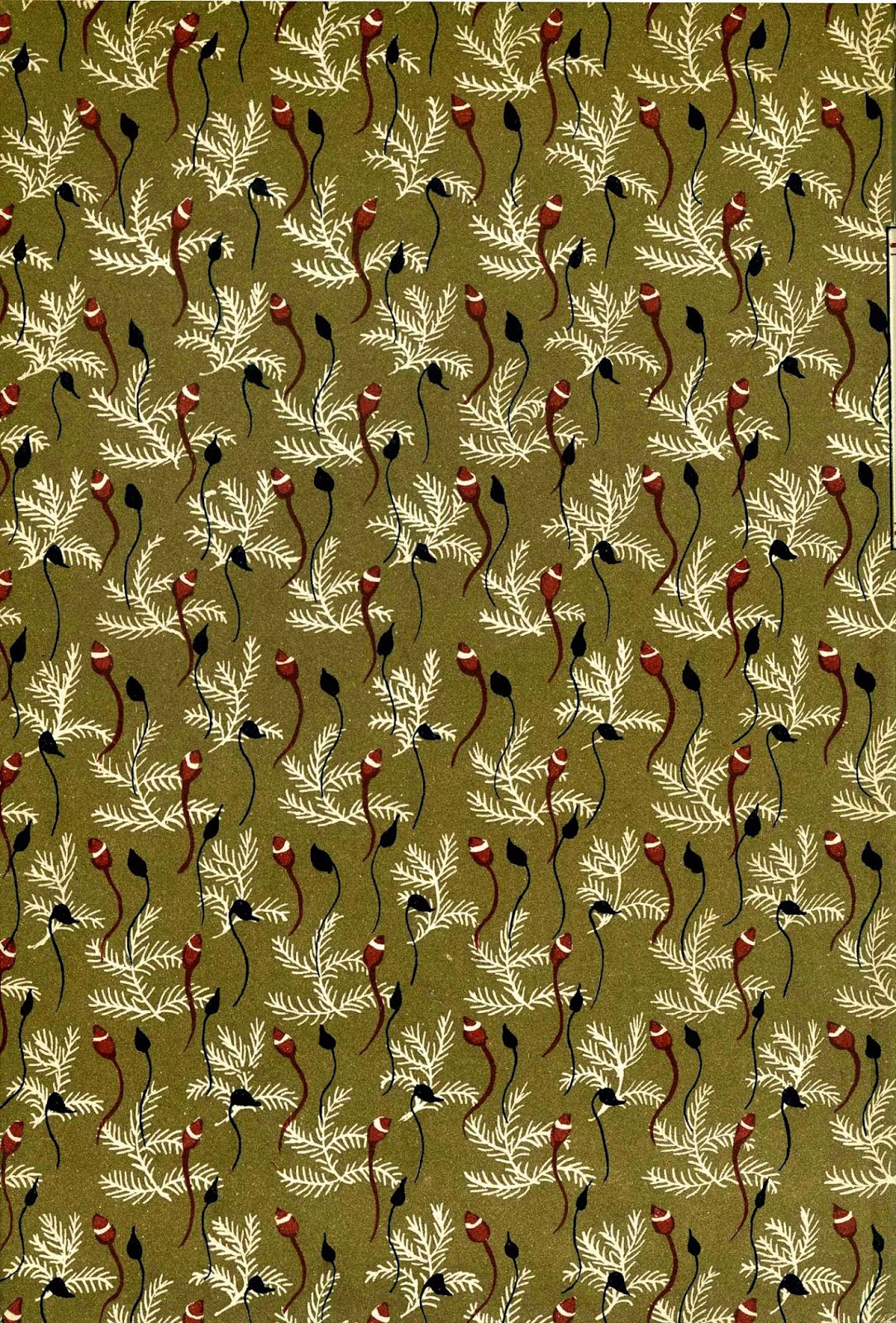
King Penguins were noted for their beautifully designed covers and this title carried a pattern of stylised moss plants.

In addition to the well written text, this volume contained exquisite illustrations taken from Johannes Hedwig's Descriptio et adumbriato microscopico-analytica muscorum frondosorum, published between 1787 and 1797.

Hedwig's book contained ground-breaking researches on the structure of mosses, using the best microscopes that were available in the late 18th. century. In his day the details of the reproduction and life cycle of mosses was unknown, but his observations led him to speculate, accurately, that mosses carried male antheridia and female archegonia that were analogous to the pollen and ovules of higher plants.

Hedwig was a very acute observer and skilled artist. The plate above shows his observations on the peristome arrangements of moss capsules, Atrichum undulatum (top left); Grimmia apocarpa (bottom right); Tortula rigida (top right); Camptothecium sericeum (centre left); Fontinalis squamosa (bottom left)


Here is Rhacomitrium lanuginosum and ........


.... here's Camptothecium sericeum.


King Penguins cost one shilling each when they were first published and were very popular, so most titles aren't hard to find in second hand bookshops. Many of them cover natural history themes.

You can read an on-line version of Hedwig's original book by clicking here The text is in Latin. The illustrations are astonishingly good, especially when you zoom in on the detail.


Thursday, April 28, 2016

Eric Ennion


Eric Ennion (1900-1981) is primarily remembered as a brilliant bird illustrator, whose combination of observational, drawing and water-colour skills produced pictures of birds that are full of energy and are uniquely graceful. But he also illustrated a few books on other forms of wildlife and one such was this .....


Life in Pond and Stream by Richard Morse, first published by Oxford University Press in 1945 and revised in 1950. 


Ennion set out on a medical career but his love of wildlife and artistic skills drew him towards natural history illustration. At the time that he illustrated this book he had just left his medical practice to become Warden of Flatford Mill Field Studies Centre and was enjoying the first public exhibition of his paintings at Ackermann Galleries in London.

You can read more about the man and his paintings at http://www.ericennion.com/

His illustrations for Life in Pond and Stream show all the hallmarks of an artist whose work was informed by first-hand observation. The book has fifteen plates - here is a small selection. 


Natterjack toad;kingcup;edible frog;common frog;butterbur;common frog;common toad


Great crested newts; smooth newt; palmate newt


Perch; pike;roach; dace; bream; eel; freshwater mussel


Raft spider; bladderwort; water spider; water boatman


Freshwater shrimp; freshwater louse; Cyclops; water flea; crayfish


It's well worth hunting down this delightful little book in second-hand bookshops.

Tuesday, February 5, 2013

Decorated Capitals


I recently posted some pictures of embossed covers on old natural history books. Here are some more examples of Victorian or Edwardian book production - decorated capitals at the beginning of chapters. These came from some battered pages of a book of wild flowers, that was falling apart and had lost its covers, so I don't know the title, author or the date of publication. But they are delightful examples of decorated typography whose origins can be traced back to the highly decorated capitals in illuminated manuscripts and are an art form that is seldom seen in today's books.