Showing posts with label Marsh orchid. Show all posts

Sunday, June 23, 2013

A Summer Saturday on the Durham Coast at Dawdon...


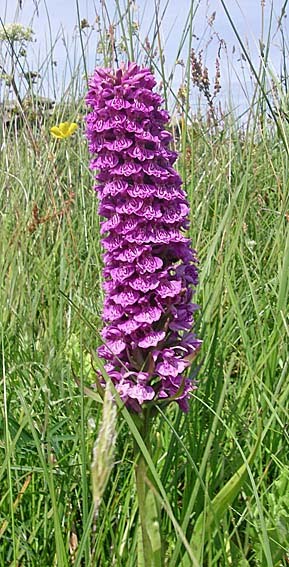
One of the finest specimens of a marsh orchid that I've seen in a long time.


Spotted orchids in great profusion.


Bird's foot trefoil, with plenty of common blue butterflies.


Bloody crane'sbill growing on the magnesian limestone cliffs


Ox-eye daisies swaying in the breeze.


Harebells just coming into flower.


Cliff-top shrubs full of whitethroats, and finally ..............


.......... a lark ascending - for a soundtrack, click here....


Thursday, July 12, 2012

Magnificent Marsh Orchids.... or spotted orchids .... or hybrids?


Well, actually I'm not sure what these are, exactly. They were part of a swarm of hybrids between marsh orchids and common spotted orchids, growing beside the pond on Durham University's Mountjoy site. Whatever their precise identity, they are magnificent specimens. I have noticed that whenever these hybrid swarms occur you always get a few very robust, very floriferous specimens, probably displaying hybrid vigour, alongside many more that are much weaker plants.... and, quite often, a few albinos like the one on the left.

Thursday, June 7, 2012

Sun, Sand and Orchids


Today's Guardian Country Diary describes a recent visit to the seaside at Cleethorpes. If you walk on past the pier with all its attractions, at the far end of the promenade, beyond the leisure centre and just under the sea wall near the miniature railway, you'll reach Cleethorpes Local Nature reserve


It's a long expanse of sand dunes, between the sea wall and the saltmarsh on the edge of the river Humber, and it hosts a fabulous display of southern marsh orchids that were in full bloom at the end of May.


There are some magnificent specimens that....


.... are packed together so densely in places that you need to be very careful where you put your feet.


While we were there I repeated Darwin's experiment for extracting the pollinia from an orchid flower, described in his book Fertilisation of Orchids, which I described in a recent post on early purple orchids. The pollinia are whole stamens that butterflies carry away in their entirety when they poke their proboscis into a nectar spur at the rear of the individual orchid flower. Darwin described how you could extract a pollinium, which is sticky at its base, by poking a sharp pencil point into the nectar spur. The paired pollinia are located where those two dark club-shaped structures are in the hood of the flower.


I didn't have a pencil so I poked this fine twig in instead - and out it came with a pollinium attached.


Darwin actually counted and calculated the number of pollen grains in one of these pollinia: there are enough to fertilise over 120,000 seeds. The survival chances of these tiny wind-born seeds, which you can see by clicking here, are minute.

Friday, July 9, 2010

Mull of Galloway 5


I've seen a lot of marsh orchids, but,...


....whichever way you look at it .....


... this is the finest specimen I've ever seen - in the peak of perfection, on the Mull of Galloway, last week.