Showing posts with label willow. Show all posts

Thursday, January 22, 2026

The long journey of the Weeping willow


A weeping willow on the bank of the river Wear below Durham cathedral, glowing in early afternoon winter sunshine. An idyllic spot for a riverbank picnic in summer, watching the boats on the river.


The true weeping willow Salix babylonica, of willow pattern ceramics fame, came to England from China and was carried by traders along the Silk Road to Aleppo in Syria, from whence it was brought to England in 1730. 

All the original introductions here were female trees and had to be propagated from cuttings, but these were not fully hardy in our climate and pure-line S. babylonica trees are now thought to be extinct here. Fortunately they hybridised easily with native willow species and have persisted as hybrids of unknown male parentage, although frequently-planted Salix x sepulcralis is thought to be a hybrid with white willow Salix alba. It came from a nursery in Berlin, sometime around 1888.

Willow species in general are notoriously prone to forming hybrids and can be hard to identify with certainty, without scrutinising bark, buds, leaves, flowers and general habit of the tree throughout the growing season.

Wednesday, July 17, 2013

Public Sculpture


Today's Guardian Country Diary described the woven willow sculptures at the Woodland Trust's Low Burnhall farm reserve near Durham. The Coal Miner has been in place for a couple of years now and, judging by the number of people who have their photograph taken next to him, he's captured the affections of many visitors.

Art critics are often rather snooty about public art installations, such as Antony Gormley's Angel of the North, but if one of the tests of meaningful public art is that it provokes a reaction and instils a sense of public ownership,then it (and the Coal Miner) are resoundingly successful. If you drive past the Angel of the North at any time of day you'll almost always see people standing in front of it, adopting its pose and having their photo taken. These willow sculptures at Low Burnhall provoke much the same reaction.


The Coal Miner enjoys a wonderful view over the reserve from his perch on the escapement. Down below him there was once a short-lived colliery, whose traces have almost disappeared.


Recently the Coal Miner has been joined by his wife - again, a willow-woven sculpture, twice life-size - situated under a hedge at the other end of the reserve.........


........... where she's feeding here willow-woven hens.


Both sculptures are the work of Ruth Thompson (of Sylvan Skills) and Anna Turnbull (of Biteabout Arts).


I particularly like the way that the Miner's Wife looks up to the sky, as if sensing a change in the weather.

She was installed last autumn, so stood there throughout the worst of last winters snow and freezing winds. 

Recently when we visited we noticed something new about her and her flock. Some kind soul, perhaps mindful of that long winter, had knitted scarves for her chickens (double-click the image above to enlarge and see these more clearly) .......


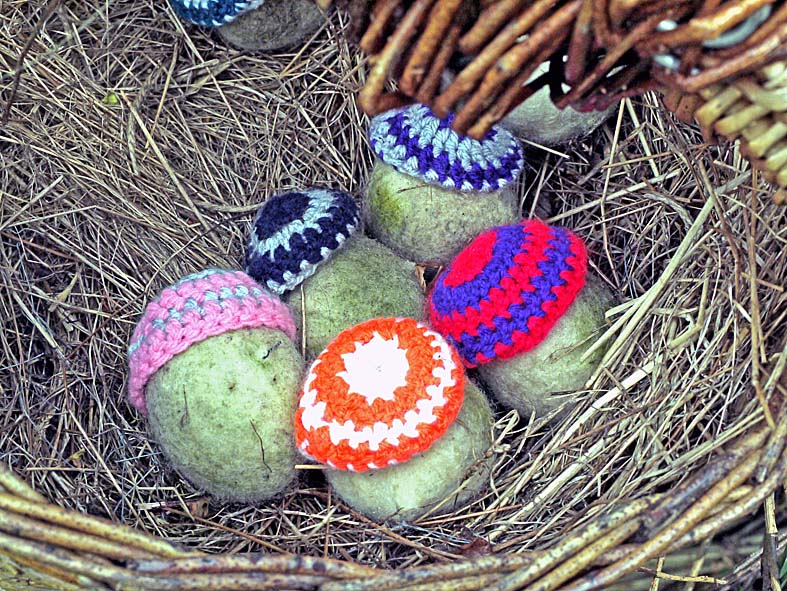
....... and woolly hats for the eggs in the basket that she carries over her arm. 

Clearly, someone has great affection for this public art installation too.........


Thursday, February 16, 2012

Pea Hill Community Park


Today's Guardian Country Diary is an account of a walk around the Durham market town of Crook on a snowy morning, ending at the village of Fir Tree at the Pea Hill Community Park, which was opened last year. The park is graced by this wooden statue of two drift miners.... one young, the other old, standing shoulder-to-shoulder.


Coal seams around Crook lie close to the surface and outcrop on hillsides, so drift miners chased the seams underground from the point where they outcropped. The Crook community was founded on coal but all the mines had closed down by the end of the 1960s.


The statue and these carved wooden bench ends are the work of tree sculptor Tommy Craggs, who performs his artistry with a chainsaw on naturally fallen trees.


This seating area in the park is surrounded with a shelter of woven willow ....


.... with willow figures behind ....


..... and a woven willow tunnel for kids to explore.


On the day when we visited the willow was already producing silvery catkins ....


... that were coming into flower despite the cold snap.


For kids it's a great spot to play and for the less energetic it's an ideal place to take in the view of snow covered Weardale.