Showing posts with label Millipedes. Show all posts

Sunday, March 22, 2015

Cold-Blooded and Spineless

Last Friday saw the launch of the North Pennines Area of Outstanding Natural Beauty Cold-Blooded and Spineless project. Over the next five years it will train volunteers and local wildlife groups to identify and map the distribution of invertebrate animals in the AONB, as well as working with schools and artists to encourage them to appreciate and celebrate the wealth of  smaller elements in the wildlife of the region.

You can read much more about the project at http://www.northpennines.org.uk/Pages/Cold-bloodedandSpineless.aspx


After the various presentations at the launch, held at the Environmental Centre at Harehope Quarry near Frosterley in Weardale, we went on a short bug hunt. Predictably, there weren't many flying insects about in mid-March, although someone did catch this male mosquito with rather magnificent antennae.

But when we started turning over stones it was a different story.


Lots of ants


A common pygmy woodlouse Trichoniscus pusillus


I think this one is a young specimen of the common shiny woodlouse Oniscus asellus


Lots of black snake millipedes Tachypodoiulus niger


More millipedes, that I've yet to identify


Two very small snails, awaiting identification


Several species of springtail. In the picture above, showing the underside, you can see the forked furca folded under the tail, that it uses like a pole-vaulter's pole to catapult itself into the air.

Click here for more about springtails


A very fine devil's coach horse, with a formidable pair of needle-sharp jaws

Click here for more about devil's coach horses


Numerous ground beetles, including ....


..... this one that played possum when it was turned onto its back, and ... 


.... this one, that was carrying a hitch-hiker on its back, which ...


... looks like it might be a very small tick.

I haven't had time to ID these properly yet, but am posting them now so that those who found them can download the pictures.

It's amazing what you can find if a dozen people spend half an hour turning over stones, even if it is a cold March afternoon!

If you'd like to know more about the Cold-blooded and Spineless project, or would like to become involved, contact samantha@northpenninesaonb.org.uk 


Thursday, October 23, 2014

Under the skin of a sycamore


Thursday's Guardian Country Diary is about the remarkable range of small invertebrates that live under the flaking bark of old sycamore trees.


When the bole of an old sycamore tree expands the old rigid bark cracks and begins to curl at the edges, while ....


.... a fresh, new layer of bark forms underneath. It might not look very attractive but these bark flakes, some as large as a slice of toast, take a long time to fall off and while they are still attached harbour a remarkable fauna of small invertebrates underneath. Here's a selection, most of which I've yet to ID.


Millipedes, a hatched moth pupa and some unidentified cocooons 


Lots more millipedes - these were just a few from under two bark scales - if this sample is representative there must have been hundreds sheltering under the bark of this tree


A minute scarlet mite


A rather beautiful little money spider, Gonatium rubens


A huddle of earwigs ....


... that raised their tail forceps in defence when they were suddenly exposed to the light. Male left, female on the right.


A spider that lives in a silken tent under the bark


Lots of slugs in areas where the bark is permanently damp, where rain water trickles down the tree trunk ..


.... together with snails ......


...... and woodlice


Another moth pupa, that looks as though it hatched successfully.


Sycamore sits low in the league table for tree foliage that supports insect biodiversity - a 1961 research paper on the subject found only 15 species, compared with the 284 hosted by oak (click here for details). But a quick look under the flaky bark of old sycamores casts them in a more favourable light, as a sheltered habitat for a host of invertebrates. 

The few examples shown here were just from a height that I could reach - there may well be a different array of species higher up the trunk and the hosted species most probably vary depending on the aspect (sunny & south facing or shaded & north-facing). Moisture must play a role too because there are well defined runnels where rainwater flows down the trunk from the branches and the bark there is always moist and often very wet. All in all, flaking sycamore bark is probably quite a complex habitat, with many interesting interactions between species that inhabit it.


Sunday, May 19, 2013

The Snail, the Woodlouse and the Millipede with disgusting but valuable habits...


If this post title sounds like a modern-day Aesop's fable well, in a way it is, because it does have a moral. Not one, but two morals...


Have you ever wondered what millipedes eat? Probably not, but if you have the books will tell you that they are herbivores that sometimes eat gardeners' seedlings and are therefore a pest.


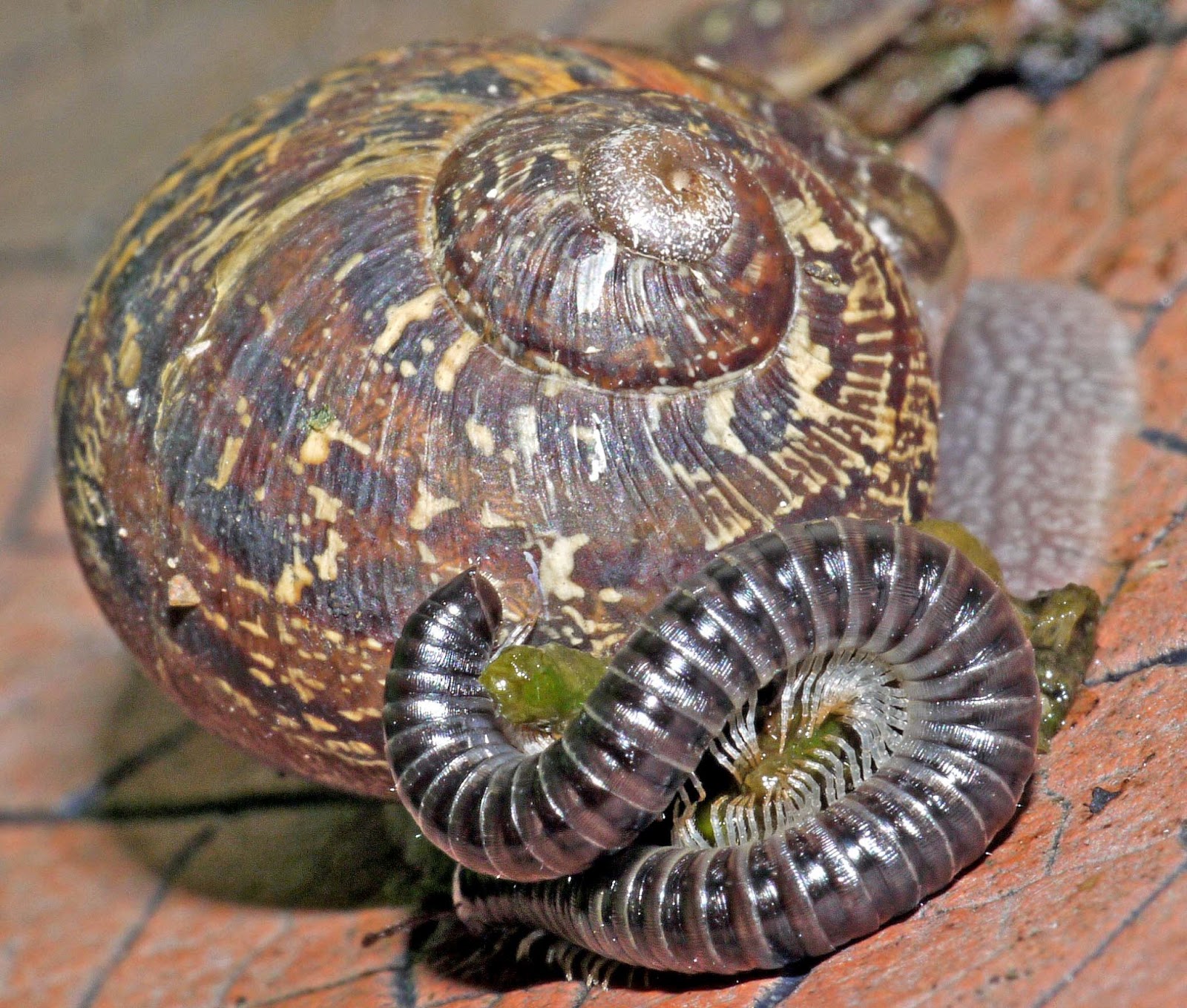
When I found this millipede clinging to the back of a garden snail's shell I wondered what it was up to. Could it be that millipedes attack snails? If so, they'd go up in my estimation.


All was revealed when the snail glided away, almost running over a woodlouse in the process but leaving some tell-tail evidence: snail poo.


Yes, remember you read it here first: millipedes eat snail poo. 

Maybe not the most pleasant addition to the sum total of human knowledge, but there is a moral to the story. 

Millipedes do indeed eat some of the gardener's seedlings but they are also part of a vast community of soil invertebrates that play a role in cycling of minerals. This snail poo might well be all that's left of some lettuce seedlings I planted out a few days ago, but at least I'm secure in the knowledge that, once they've passed through a millipede's digestive system, some of the nutrients will find their way back to the soil and feed the next batch of my seedlings that a snail snacks on....

The second moral is that the only sane way to approach vegetable gardening is to recognise that you are part of the great web of food interactions and nutrient recycling, and to become reconciled to the fact that some of what you plant - sometimes most of what you plant - is going to pass through the digestive system of a snail and maybe a millipede too, rather than your own.

So, I think of gardening as a source of endless photo-opportunities and don't expect to harvest too much. It's the way to reach gardening karma. 

So, on to the next question: if you are a snail, what does it sound like when a millipede walks past? Probably, like this...


Thursday, February 17, 2011

Millipedes

Habits developed in our formative years often stay with us for life and as a kid I could never resist turning over logs and stones to see what lurked underneath - and now, over half a century later, I still can't. I found these two millipedes under a rotting beech log yesterday. The first is the flat-backed millipede Polydesmus complanatus, which superficially looks like a centipede but if you look closely you can convince yourself that it has the millipede's trademark two-pairs-of-legs-per-segment. Flat-backed millipedes have a reputation for being fond of strawberries, which doesn't endear them to gardeners.

The second is the aptly-named snake millipede Cylindroiulus punctatus, coiled up like a serpent.

There is a wondertful YouTube sequence of rather more spectacular species of millipede featured in David Attenborough's Life in the Undergrowth series here.