Tuesday, April 28, 2020

Hairy shieldbug Dolycoris baccarum and green shieldbug Palomina prasina


Last May, for the first time, I found a single hairy shieldbug Dolycoris baccarum in the garden here in Durham, which was notable because the guide that I used to identify it mentioned that this species was not very common north of East Anglia. Today I found many more, mostly on Honesty Lunaria annua, which is flowering in the garden now.


It may be that this of one of several insect species that are extending their range northwards, due to climate change.


One of the key identification features, apart from those smart black and white antennae, is that this species is covered with a scattering of pale brown hairs, which you can see in this photo. 

This individual is performing some essential maintenance on its rostrum, the highly specialised feeding tube, somewhat like a hypodermic syringe, that it uses for sucking sap from plants.


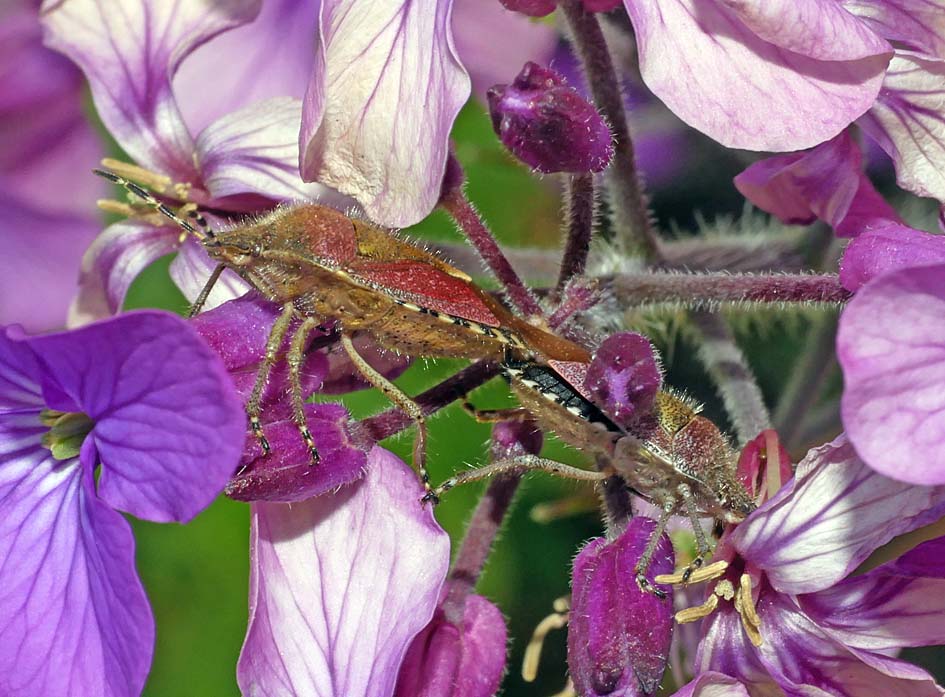


They are breeding here, so it looks as though I may now have a permanent garden population of these sap-sucking insects, which I welcome: they have a fascinating life cycle and add to the garden's biodiversity.

This is the second shield bug species that has turned up in the garden in the last week.


A few days ago this green shieldbug Palomina prasina, hard to spot with its cryptic coloration, turned up in a lavender bush. It has been an established member of the garden insect fauna and is partial to feeding on ripe raspberries in the summer.


Saturday, April 25, 2020

Coronaviris lockdown: more pictures from my home patch


Well into week five now of the coronavirus lockdown, and still walking the same early morning, three and a half mile, local exercise walk. The weather has been exceptionally dry lately, and warm later in the day, though it's often misty in the early morning when we leave home. Spring up here in Durham is still some way behind counties further south; Ash trees flowered  in the second week of April but won't produce leaves until mid-May, whereas oak is just coming into leaf in late April.

One of the local farmers has a small herd of belted Galloway cattle, which are becoming an increasingly popular breed. There is one rather charming calf with a red-brown and white coat.


Fields of oilseed rape, with the village of Billy Row on the hillside in the background, to the north. These fields were badly waterlogged in winter but the crop has grown and flowered surprisingly well, apart from some gaps where the water lingered longest. By late April these fields were humming with bumblebees, visiting all those flowers. There are skylarks nesting in the tractor wheelings.

The hawthorn hedges in the middle distance, above, were planted when the land was restored after opencast mining, about twenty five years ago.


Two pastures on my route were ploughed about a month ago and resown - most likely with a forage grass. The first shoots began to appear in mid-April - and so did the rabbits.


One large field on my route has been sown with field (faba) beans Vicia faba, the smaller-seeded agricultural version of broad beans. I spent a substantial part of my scientific career breeding this crop and studying its floral biology, so it is good to see it planted close to home. The flowers are very valuable for bumblebees and have a delightful, intoxicating fragrance early in the morning. It's usually grown as a component of animal feed.


Still bare trees in mid-April, but the hawthorn hedges are coming into full leaf.


The point on the walk where I turn and head for home. Beyond lies Weardale, with the river Wear, becks and fellsides,dippers, moorland birds, hay meadows, woodlands; all that will have to wait for a few months yet.


Wednesday, April 22, 2020

Well=groomed blackbird

This cock blackbird is one of a pair nesting in the holly hedge at the bottom of the garden. While the hen bird incubates the eggs he doesn't have much to do, until there are nestlings to feed, so he spends his days sunbathing, preening and singing, with just an occasional bout of violence when he needs to see-off a rival blackbird.


Sunbathing involves sitting on this flat concrete block, fluffing up his feathers and rocking from side to side to soak up the warmth of the sun, ridding his feathers of parasites. Sometimes he goes into a trance-like state, with his beak open and eyes half-closed, panting in the heat.


Then a long session of feather preening and scratching with his claws.