Showing posts with label pollination. Show all posts

Saturday, July 4, 2026

Bumblebees bathing in meadowsweet pollen


It’s the flowering season for fragrant meadowsweet Filipendula ulmaria, the ‘Queen of the Meadows’, here in Durham - and bumblebees go wild for it. Crawling over the flowerheads, buzzing as they go, the vibration releases a shower of pollen that sticks to their fur, ready for combing off into the pollen baskets on their hind legs.


Fully-loaded pollen baskets, ready to carry back to their brood in the nest.


In July, meadowsweet is one of the best bee-friendly pollen-providers for a wildlife garden.


Thursday, April 3, 2025

Stinking hellebore is bumblebee heaven

 Stinking hellebore is an unappealing name for a very bee-friendly plant. It has been the epicentre of bumblebee activity in our garden ever since they first emerged from winter hibernation. The green flowers of Helleborus foetidus are a prolific source of nectar over a prolonged flowering period.


There used to be just one plant in the garden but three years ago I collected all the seed it produced and chucked them on ground where I'd removed a holly hedge in the corner of the garden. There are now about a dozen plants flowering, bearing hundreds of flowers. They don't really stink, they're just a bit pungent on a hot afternoon, but that's a small price to pay for providing such a good food resource for queen bumblebees.


The purple-edged, bell-shaped flowers are unusual because those structures that look like petals are, botanically, sepals that protected the bud during its formative stages. The real petals, inside, are arranged around central whorls of stigmas and pollen-loaded stamens, and are rolled into tubes that are prim-full of nectar.


The flower retains its bell-shape until its pollinated but it's just open enough to allow a large bumblebee to hang underneath and force its way in. Even then, the bee needs to have a long tongue to reach all the nectar. Helleborus foetidus makes its visitors work for their reward. 


If you plant Helleborus foetidus once and let it go to seed it will seed itself around the garden, thanks to the white extension called an elaiosome on the outside of the shiny black seeds.This is very attractive to ants, which carry them away, eat the elaiosome and disperse the seeds, which require a winter of freezing temperatures before they'll germinate. 


Monday, October 2, 2023

Himalayan balsam nectar

 Himalayan balsam is notoriously invasive and the chances of ever eliminating it on a large scale seem negligible. Even when plants are pulled up there is always a large seed bank in the soil, and flooding carries the seeds far and wide along river valleys. But it does have at least one virtue: it's a very rich source of nectar late in the year, when few native nectar-rich plants are available. Bees and wasps find it irresistible.  

The flowers have a distinctive pollination mechanism, with anthers positioned in the roof of the flower, so they deposit pollen very efficiently on the upper thorax of visiting insects, like the honeybee above and the wasp below.


Persistent insect visitors are immediately identifiable by the dense coating of pollen that they carry from flower to flower - a very efficient pollination mechanism which goes a long way towards explaining the high levels of seed production
.


Some balsam nectar-addicted visitors, like the wasp above, become so heavily coated in pollen that they develop a ghost-like appearance. 


Thursday, August 24, 2023

Goat'sbeard pollination


 Flowers of goat'sbeard Tragopogon pratensis always close at around mid-day, giving the plant its alternative name of Jack-go-to-bed-at-noon. Most of the morning visitors seem to be hoverflies, like this marmalade hoverfly. Each inflorescence is made up from numerous individual florets that have a distinctive fail-safe pollination mechanism.


When each flower first opens the stigma and style extend upwards through a ring of stamens, collecting pollen on their outer surface and presenting it to visiting insects. At this point each floret is functionally male, but when the style is fully extended the sigma separates into two lobes that curl outwards, exposing their receptive surface to visiting cross pollinators arriving with pollen from another flower.

Then the stigma lobes continue to curl backwards, sometimes until they touch whatever pollen remains on the style surface, so self-pollinating if cross-pollination has failed.


Either way, the end result is a head of white whiskery seeds, that give the plant its goat'sbeard name, as large as a tennis ball and each seed equipped with a parachute to carry it away on the breeze.

Thursday, August 17, 2023

Inula hookeri and its pollinators

 This shaggy member of the daisy family, with its beautifully geometric spiral pattern of unopened central florets, originates from the Himalayas. In my garden it's a great attraction to bees, that appreciate the long period of pollen production that results from the sequential opening of all those florets.


Drone flies, like the one below, are also attracted to this flower, visiting to feed on the nectar.  


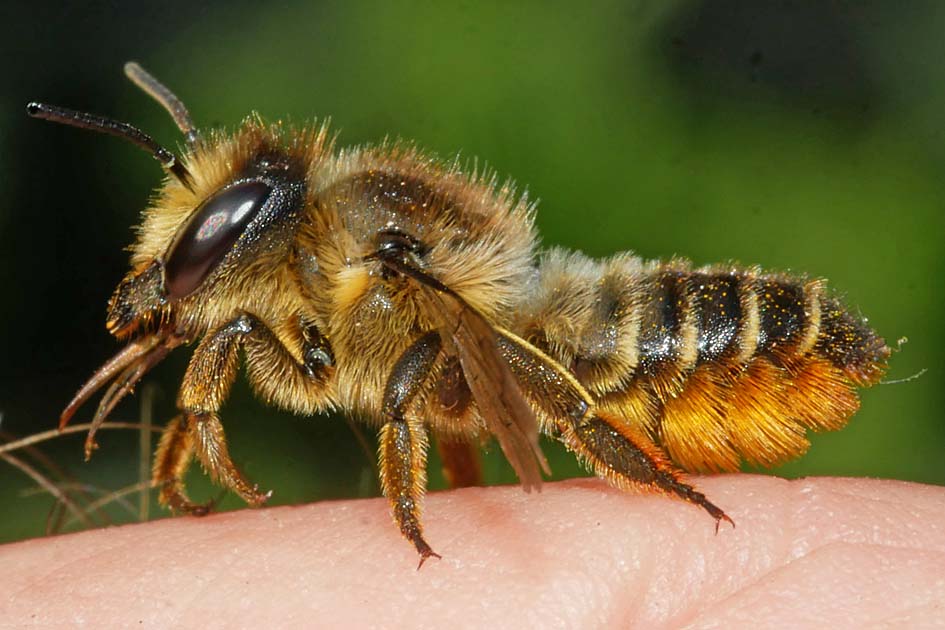
The most intriguing visitor for pollen collection is the leaf cutter bee. This uses a brush of long orange hairs on the underside of its abdomen to collect pollen, and in the final picture you can see how it walks around the circle of open florets, sweeping up pollen with those hairs as it goes. 


Monday, February 20, 2023

Yew tree pollination

 February is the month when the tiny male cones of yew trees begin to shed their yellow pollen. These were photographed in Teesdale a couple of days ago. 


Yew trees are dioecious - either male of female - and the male pollen is carried on the wind to single female ovules hidden amongst the foliage on another tree. These are tiny and can be hard to spot, but here is one, ready to receive pollen.


After fertilisation the outer wall of the ovule swells to become a soft, fleshy, aril that surrounds the single hard seed inside. It turns bright red in autumn, to attract the attention of birds. 

Every part of a yew tree, except the aril, is poisonous to humans but thrushes, fieldfares and redwings quickly devour them. Nuthatches extract the hard seed, wedge it into crevices in yew trunks and hammer it open to extract the kernel. There's more about them in this Guardian Country Diary.


Thursday, July 30, 2020

Broad-leaved helleborine, pollinated by wasps.

We found a population of about 30 broad-leaved helleborines Epipactis helleborine beside the Deerness Valley walk, a disused railway track that has been converted into a pleasant route for walkers and cyclists. 


This is an orchid that thrives on woodland edges, in dappled shade. It's pollinated by common wasps Vespula vulgaris, but this was the first time I have seen the pollinators in action.

The flowers emit a scent that attracts the insects, which have short tongues, so they have to push their head right into the flower to reach a pool of nectar. When they do this the orchid's pollinia, which contain all their pollen, stick to the wasp's face. In the photographs above and below (rather blurred, because the light was poor) you can see a wasp arriving after visiting another plant, carrying the white pollinia on its head, ready to pollinate the flower.

Below, you can see a wasp leaving, taking the sticky pollinia with it, attached to its face.

Click here for a very good YouTube video, by Jean Claessens, of the whole process


Sunday, May 15, 2016

Conifer pollen


The Korean fir Abies koreana in our garden has been releasing vast amounts of pollen over the last few days. 


These are the male, pollen-producing cones near the ends of the branches. Like all conifers it's wind pollinated and the pollen released is quickly diluted in an enormous volume of air, so it tends to be produced in great quantities. If you give the tree a shake it briefly hangs like a yellow cloud in the air.


These are the pollen grains under the microscope, magnified about 80 times.


If you look closely you can see that each pollen grain has two inflated air sacs, which are extensions of the pollen coat. These increase the surface area of the pollen with minimal increase in weight, so enhance its aerial buoyancy.

Click here for more on conifer pollination.


This is where the pollen grains are heading - the new female cone at the top of the tree. Only a few of the pollen grains will successfully complete their journey and fertilise the female ovules, which are arranged in pairs on the upper surface of those whorls of cone scales.

At this time of year they are an attractive shade of purple but by autumn, as they seeds develop, they become brown and then break up through the autumn. Coal tits are particularly partial to the seeds - click here for photographs of them picking the cones apart.


Saturday, June 20, 2015

Ants as nectar thieves and pollinators

I've seen ants visiting small flowers before (like this one visiting sea milkwort) but I didn't notice the ant on this heath bedstraw until I knelt down to photograph the plant .....


..... it's just above and to the right of centre in the picture.


 On closer inspection it was clear that I wasn't just a casual visitor,,,,,


.... but was methodically moving from flower to flower, collecting something .... 


.... which I imagine was nectar rather than pollen. It might have been been transporting some pollen as it walked from flower to flower in the inflorescence but ants like this are unlikely to be very effective pollinators. 

The two-segmented waist indicates that this is an ant in the genus Myrmica.

At this point I had to beat a retreat, because its fellow ants had found their way up my trouser leg.

Tuesday, May 5, 2015

Bees need dandelions but dandelions don't need bees


If I was a fastidious gardener I'd probably have dug out the dandelions in our garden long before now because they seed themselves so prolifically, but instead I've been watching the constant stream of bees - with their pollen baskets stuffed full of orange dandelion pollen - visiting the flowers all afternoon. There are golden drifts of dandelion flowers everywhere just now - along road verges, on waste ground and in pastures - and every year they provide a reliable source of vast amounts of pollen and nectar for bees.


The strange thing is, though, that dandelions don't need nectar, pollen or pollinators to produce a full crop of seeds. Bee and dandelion bloom might seem like a perfect example of a partnership between pollinator and plant, with generous rewards for services rendered by the insects, but this is really a very one-sided relationship.


At first glance it might seem that the elaborate mechanism that dandelions Taraxacum officinale use for presenting pollen to visiting insects is a masterpiece of functional design. Look across the top of a dandelion flower with a magnifying glass and you can see a forest of stigmas, divided and curled back at the top of a long style covered in pollen. This is the last stage in a developmental process that begins in the flower bud ....


 .... where at this stage the individual florets that make up the flower head (capitulum) are just on the point of flowering. From the bottom upwards in the photo above, first you can see the ovaries that contain the egg cells that will become the embryo in the seeds, then above them are the stamens, joined in a long yellow cylinder.....


... seen here in a single floret. Notice how even at this stage the ring of feathery hairs (the pappus), that will form the parachute that will carry the mature seed aloft on the breeze is already well developed. This floret is one from the centre of the flower and has no petal, unlike those around the edge that have ray petals for advertisement ....


... like this one, where you can see the single petal attached. At this later stage of development the style has now elongated inside that cylinder of stamens, forcing its way upwards like a piston and sweeping out the pollen as it goes, then splitting at the tip to reveal the receptive stigma where pollen delivered by a visiting insect will germinate.


The outer surface of the style is covered in a forest of short hairs that help to sweep the pollen out of that cylinder of stamens. Pollen adheres to the outseide of the style until an insect arrives and collects it, at the same time cross-pollinating the stigma with the pollen from another that it arrived with.


But to the dandelions, all of this elaborate floral choreography is redundant - a waste of energy. 

At some point in their evolution they acquired mutations that allows their ovules (above) to develop into seeds without any need for pollination, producing clonal, identical copies of the parent plant. It's a process called apomixis, that's also found in several other plants, including some bramble species.

 So in dandelions all that complex and energetically expensive floral development and the provision of pollen and nectar to attract pollinating insects now serves no purpose - it's a legacy of an earlier stage in evolution, when dandelions did need to be cross pollinated. In some species of dandelion the pollination mechanism is still functional, but not in the apomitic common dandelion Taraxacum officinale

Nevertheless, all that redundant nectar and pollen is a wonderful asset for bees and for butterflies like....


...the orange tip, and .......


...the peacock