Showing posts with label Gean. Show all posts

Friday, July 4, 2025

Ripe cherries

 Wild cherries Prunus avium have been ripening this week in Weardale. I've tasted quite a lot of wild cherries over the years and most are sour or bitter-tasting, but occasionally I come across a tree with unusually juicy, deep red fruits that make excellent cherry sauce for pouring over ice cream. It looks like a bird has already had a peck at one in the first picture, below. Once they begin to ripen the birds take them very quickly. 


Rooks often eat those that fall under the tree but only hawfinches have beaks that are strong enough to split open the stones. Otherwise the seeds pass unharmed through their gut and are dispersed to become new seedling trees, unless field mice find them. 

When I demolished our old garden shed a few years ago I found a wood mouse's stash of scores of cherry stones from the tree that used to grow in our garden hedge, each with a neat hole nibbled in it, where the rodent had extracted the kernel.


Wednesday, June 22, 2016

Blossom

From March until July, this has been the best for native tree blossom that I can recall in our part of the North Pennines. It started with sloe and is now coming to an end with elder. Here they are, in chronological sequence

Blackthorn aka Sloe


Wild cherry aka gean


Hawthorn


Bird cherry


Rowan aka mountain ash


Elder


Monday, April 20, 2015

Woodland walk along the river Tees that J.M.W.Turner trod 200 years ago


This is the view of the river Tees from Abbey bridge near Egglestone, on a tranquil spring day. When the snow melts in Upper Teesdale this becomes a raging torrent, roaring through the rocky gorge. 


The woodland on the steep banks of the river here is exceptionally beautiful in spring, carpeted with wild flowers. Last week wood anemones were the star of the show; next week the bluebells will take over.


Fallen trees are left to gently decay and often develop their own 'garden' of flowers as they rot - like this one with a flora of wood anemone, ramsons and herb Robert.


Last week the bluebells had just begun to flower but it will be early May before the tree leave canopy begins to close over them. The fully-grown trees are mostly sycamore and oak.


The path winds through a dense carpet of wood anemones, high above the river.


Wood speedwell Veronica montana


When we arrived there was still a chill in the air and dew on the leaves, so the wood anemone flowers were all nodding downwards ...


..... but by mid-morning, as the sun climbed higher in the sky, they turned to face it.


This wood anemone had purple leaves.


Some early wild cherry blossom, hanging over the river.


Wood sorrel, nestling against a moss-covered tree base. The leaves fold down at night, like triangular tents.


Beyond the woodland the path passes through pastures, with ground ivy Glechoma hederacea flowering in the shelter of a dry stone wall.


Last week the first influx of warblers arrived, with this willow warbler and blackcaps singing


Last time we passed this way the elms were just coming into flower. Today their clusters of seeds were well-formed.


A bee-fly, a parasite of mining bees, sunbathing in a clearing.


Crane-flies mating.


A comma butterfly soaking up the spring sunshine after a long hibernation.


In 1816 J.M.W. Turner must have walked this footpath and perhaps sat somewhere near here to sketched this scene, at the confluence of the river Greta and the river Tees, which he painted in 1818. I like to think that perhaps he sat under this ancient oak, which would have been more youthful then, to view the scene, which you can see in his painting by clicking here.

Thursday, April 21, 2011

Room to Grow

Unless they're deliberately cultivated in an arboretum, most trees never get the chance to spread their limbs and assume their natural shape throughout their life - all too often they're confined to hedges and hacked about during hedge trimming or struggle to compete for light and space in a woodland. But this ancient wild cherry has been given room to grow. For some unknown reason it was planted (or maybe accidentally sown by a bird) in the centre of a field near Harperley in County Durham. Here it is in in magnificnet isolation, in the snow-covered landscape last winter........


........ and here it is today, photographed from exactly the same spot, covered in blossom and with a few sheep enjoying its shade on an unusually hot April day.

Monday, April 11, 2011

A Tree-Spotter's Guide to Flowers: 3


Sloe (blackthorn) blossom is produced before any leaves appear, often in such profusion that whole hedgerows can look as though they're covered in snow.


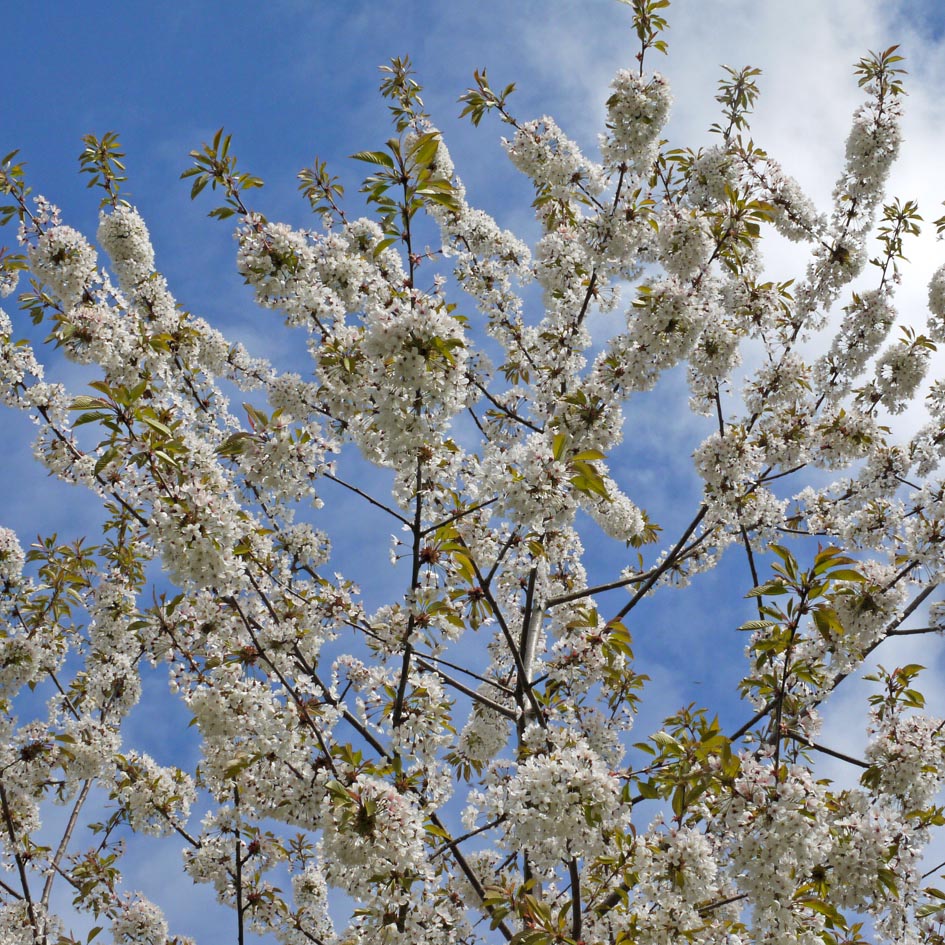
Wild cherry (gean) blossom - clusters of large flowers set against expanding foliage that has a bronze tint when it's young.


Male ash flowers. Ash trees flower long before their leaves expand - this is usually the last tree species to come into leaf, in May. There are three basic kinds of ash tree. All-male trees like this produce dense clusters of crimson pollen-producing anthers when their flower buds burst. All-male trees never produce ash 'keys' in autumn.


 Female trees produce clusters of flowers with bright red stigmas and styles - the style will later develop into the wing of the ash 'key'. Female trees produce heavy crops of  'keys' in autumn.


Close-up of female ash flowers. There are also hermaphrodite trees, whose flowers look similar to these female flowers but have a pair of pollen-producing anthers attached on either side of those slender green stalks. They too produce heavy crops of 'keys' in autumn.

Just to complicate matters even further, some trees produce any two of the above three flower types on the same tree i.e. male + female; male + hermaphrodite; female + hermaphrodite.

For more information on trees click here