Showing posts with label weeds. Show all posts

Tuesday, March 12, 2024

Rusty groundsel

 To many gardeners it's a weed; to botanists it's a wild flower; to ecologists it's a ruderal - a primary coloniser of disturbed ground. Call it what you will, groundsel Senecio vulgaris is a remarkable plant. It flowers all-year-round, produces seeds by self-pollination without the aid of pollinators and can thrive in an extraordinary range of habitats. 

Tenacious two-inch-tall plants can grow in a crack in the pavement and produce a single flower. Bushy, lush plants growing in a nutrient-rich farmyard can produce hundreds of flowers and thousands of seeds, which are carried away on the wind but are also eaten by finches, though the seeds can also pass unharmed through a bird's gut and germinate successfully. The seeds also have a covering of microscopically small hairs that extend when wet and help the seed to stick to animals' feet. 

The generation time of a groundsel plant is often around three months, so in a single year,  in favourable conditions, a single seedling can give rise to a million descendants. 

A wild flower for all seasons, then, and a plant on a world tour, taken to North America and Australia by European migrants long ago.


The name groundsel comes from the Old English word grundeswilage, meaning ground swallower. I always imagined that the generic name, Senecio, derived from the Latin senex, meaning 'old man' referred to the greyish-white whiskery plumes of its airborne seeds, but the real explanation can be traced back to botanist William Turner in 1538, who wrote that 'when the wynde bloweth it away, then it appeareth like a bald headded man, therefore it is called Senecio' ..... and in the photo below you can see what he meant.


Groundsel has an Achilles heel, a rust fungus called Puccinia lagenophorae, which has an interesting history. It is an Australian fungus, that infected groundsel there and was imported into the UK on groundsel that accidentally made the return journey to the UK, most likely with imported horticultural plants, and was first noted here in 1961. It has since spread throughout Britain and somehow crossed the Atlantic, first being observed on groundsel plants there in 2001.


Groundsel rust, being an efficient parasite, doesn't kill its host outright but does weaken it and render it susceptible to other fungal pathogens, like mildews.


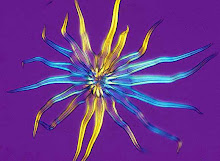
The spore cups of Puccinia lagenophorae are quite beautiful when you look at them like this, magnified under a low-power microscope, appearing like tiny sunbursts with sunbeams formed from radiating chains of spores. 

Friday, June 24, 2016

Boot-mud seedlings


I first read Weeds and Aliens, a volume in the New Naturalist series written by Sir Edward Salisbury, a former Director of the Royal Botanic Gardens at Kew, almost fifty years ago. One particular section, where he discussed seeds distributed on footwear, has always stuck in my mind.

Salisbury went to some lengths to demonstrate the effectiveness of seeds dispersal by our feet as we walk around. He even swept up the soil on the floor between the pews of churches after services and germinated seeds of plantains, daisies, irongrass, pearlwort, chickweed and several grasses that had been carried in on the feet of the congregation.

He had a particular bee-in-his-bonnet about Roman soldiers carrying seeds across Britain in mud on their hobnailed sandals.


Early this year after a visit to Hayley Wood in Cambridgeshire  I followed Salisbury's example and scraped the mud from my walking boots into a seed tray to see what would germinate. The picture above shows some of the seedlings. So far I've been able to identify:

Broad-leaved dock
Broad-leaved plantain
Dandelion
Chickweed
A willow herb species
Mouse-ear chickweed
Wood avens
Herb robert
Hairy bittercress
Toad rush
4 unidentified seedlings

plus four species of grass that I haven't identified yet.

No real surprises but quite a mixture. The wood is famous for its oxlips but I don't seem to have had any luck picking up their seeds on my boots!

Wednesday, January 6, 2016

Inner beauty of a successful weed


Hedgerows are full of young goosegrass Galium aparine plants at the moment, whose rapid growth has been encouraged by mild winter temperatures. 


This is one of our most successful and ubiquitous weeds, beautifully adapted to fast growth, prolific seed production and efficient seed dispersal.

The seeds, which are covered in tiny hooks and are dispersed in the fur and feathers of animals, germinate in late autumn and early winter so that by spring the young plants have a head start on surrounding vegetation and begin to flower quickly.


The stems elongate very quickly too and the plant is finely adapted to using surrounding plants for support, thanks to ....


... a covering of tiny, backward-facing hooks on the stems and leaves, seen here under the microscope. In fertile agricultural soils the plant can thread its way through a hedge by early summer, sometimes reaching a length of six feet or more and smothering the hedge by the end of summer, all the while producing thousands of hooked seeds from tiny white flowers that are visited by small insects but probably self-pollinate too.

One reason why goosegrass is such a prolific seed producer is that its habit of scrambling over other plants, using those hooks, means that it doesn't need to invest much energy to producing a strong stem. It takes a hawthorn several years to reach a height of six feet, building stem strength through woody tissue production, but goosegrass can reach the same height in about three months.


 This image shows a one cell-thick section through a stem and those yellow stained cells, in a ring in the centre, are the only ones that have any woody strengthening in their cell walls - all the blue-stained cells are pure cellulose. 

The narrow line of yellow staining on the outside of the stem is the waxy cuticle, that protects the plant from water loss.

Tuesday, September 24, 2013

Beauty in the eye of the beholder (provided you have a hand lens)

When I started out in botany the first field guide I owned was McClintock and Fitter's Pocket Guide to Wild Flowers, which used a one-, two- or three-star system to indicate rarity. And I was obsessed with finding rarities (though not very successfully). I still get a buzz out of finding something uncommon but have come to appreciate the subtle charms of the less ostentatious wild flowers, realising that if you can't see anything interesting about a plant then you probably aren't looking closely enough.

Here's a case in point: knotgrass Polygonum aviculare. This is the rather attractive little flower, which is only a few millimetres in diameter ......


...... and this is the scruffy plant, growing in a gap between the paving stones in our garden path. I must have trodden on it scores of times as I've been walking up and down the path, but now I've looked more closely at the flowers I tend to step over it.

Its tiny seeds probably provide food for the sparrows that are always fossicking in the crevices in the garden path.

In his Weeds and Aliens (1961) Sir Edward Salisbury mentions that in sandy soils the tap root of this tough annual can penetrate to a depth of three feet and that its seeds remain viable for up to sixty years.


Wednesday, August 17, 2011

Opportunists

Last autumn I watched a bulldozer scraping away topsoil to level an area of building land, and made a mental note at the time to return this year to see what opportunist plants had established themselves on the bare soil. This one, common field speedwell Veronica persica, was well represented there. Usually the lowermost petal in this species is much paler, but this particular individual had exceptionally vivid blue flowers with deep blue, heart-shaped stamens. This species is an alien and was first recorded in Britain in 1825, and I imagine that its small seeds arrived on birds' feet, unlike .....


... this common sowthistle Sonchus oleraceus that must have staged an airborne invasion with its parachute-equipped plumed seeds.
I've been walking past this piece of land long enough to remember when it was arable land, with a wheat crop, and several of the other opportunists probably germinated from the residual seed bank of arable weeds in the soil ..... like this red-leg Persicaria maculosa....

...... this fumitory Fumaria officinalis ....

... and this field pansy Viola arvensis.

All of these are common and would be classified as weeds if they were competing with crop plants, but as colonisers of disturbed bare ground they're classed botanically as ruderals - species with constantly shifting populations that colonised disturbed habitats before more permanent vegetation establishes itself.

Common they may be, but the world would be a poorer place without them and just occasionally something a little less common reappears when the soil is disturbed.......

...... like this henbit Lamium amplexicaule which is much less abundant than it once was, thanks to the use of herbicides in intensive agriculture.