Showing posts with label hoverflies. Show all posts

Thursday, August 13, 2020

Batman Hoverfly

 I first noticed this beautiful golden hoverfly Myatropa florea by the sound it made - a load buzz - when it was hovering close to my head in the garden. 

While I watched it settled on the rim of a flower pot full of rainwater and began laying eggs around the rim. 

This is one of the easier hoverflies to identify because of the distinctive markings on its bluish-grey thorax - that black marking at the rear edge looks like batman's silhouette.


When the eggs hatch they'll develop as rat-tailed maggots like these, with an extendable breathing tube that acts like a snorkel, allowing them to breathe air while submerged.


Tuesday, September 3, 2019

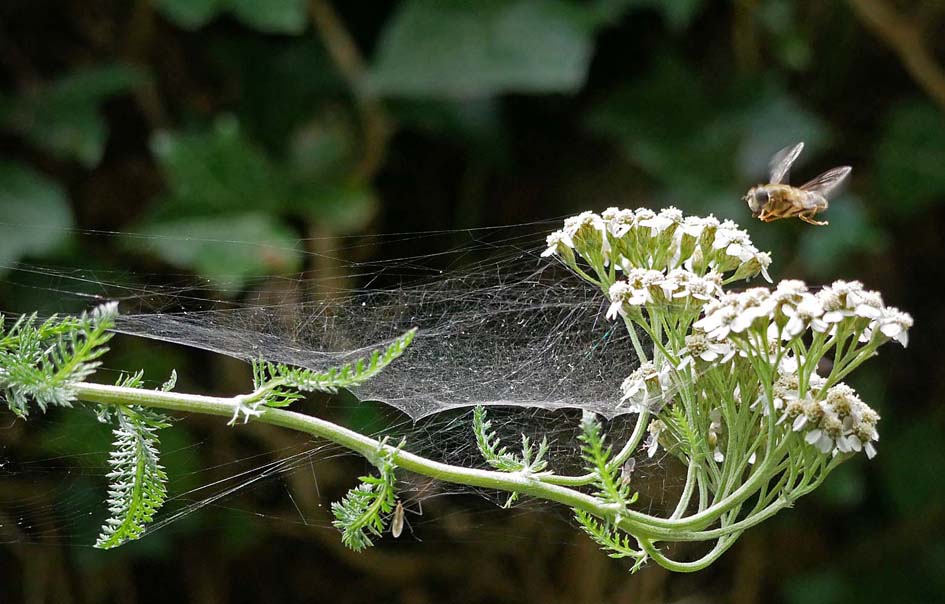
Fatal attraction, to yarrow


Yarrow Achillea millefolium is a later summer wild flower that provides easily-accessed pollen and nectar for visiting insects, right up until the end of autumn. It's particularly popular with flies, like this greenbottle, and with hoverflies and droneflies. They can feed without expending much energy, simply by landing and walking from floret to floret across the flat-topped umbel.  


But sometimes just landing on the flowers can be hazardous. About thirty yarrow plants were hanging over a wall along Mortham Lane beside Rokeby park in Teesdale. They had been blown sideways by high winds during their early growth, and at the same time their flower heads had defied gravity and curled upwards, so the whole plant protruded from the wall like a long coat hook. And in that hook, in every plant, a money spider had built its hammock-shaped web, beside the flower head. Money spiders usually sling their horizontal hammock webs in hedges or low in the grass, but this population had taken advantage of the yarrow scaffolding that an accident of wind and gravity had provided.


I watched these plants swaying in the wind, while a long procession of insects came to feed. Drone flies are skilled hoverers and negotiated the risky landing successfully, and .....


.... hoverflies timed their approach and landing with even more precision, avoiding the spider's snare. But there was plenty of evidence, in the form of wings and legs in the webs, that other flies had been less fortunate, and had made a fatal landing in the money spider's web. I saw a blundering greenbottle land in the web, but with good fortune and some frantic buzzing it just managed to extricate itself before the spider arrived.


And in this old web a well-fed occupant had evidently done enough feeding, and had woven its egg cocoon amongst the leaves below the flower head, that had acted as bait for its victims.

Sunday, October 13, 2013

In praise of some non-natives


Wildlife gardening evangelists frequently exhort us to plant native species in our gardens - quite rightly, as there are indeed many native plants that are decorative and provide valuable resources for insects and their larvae. 

But when it gets to this point in autumn the choice of flowering natives is pretty narrow. There's ivy, which is certainly a terrific source of pollen and nectar for insects and also food plant for holly blue butterfly larvae, but that's about it  - other that a few late hogweed flowers and yarrow, which flower up until the first frosts but don't bring much colour to a garden.

So that's when Michaemas daisies Aster amellus, whose natural range extends across southern Europe into Asia, come into their own. Whenever the sun shines the Michlaelmas daisies in our garden attract a constant stream of visitors, including ....


.... hoverflies, like this Heliophilus pendulus


..........honeybees ......


.............. small tortoiseshells ............


.............and red admirals, all photographed in the space of a few minutes at the end of last week.


Marigold Calendula officinalis, which originated in southern Europe, provides similar services for butterflies throughout autumn.


Buddleia davidii, the famous butterfly bush from Central China and Japan, has - until recently - been a favourite amongst wildlife gardeners as a nectar source for butterflies, even though it usually finishes flowering long before the late autumn generation of small tortoiseshells, peacocks, red admirals and commas get into their stride. These days conservationists give B.davidii the thumbs down, on account of its invasive tendencies, but there is a much better Buddleia alternative - B x weyeriana, which is an interspecific hybrid between B.davidii and B.globosa and has very attractive pinkish-orange flowers and none of its parent's tendency to seed itself around prolifically. It's extremely hardy and continues to flower long after the first frosts, offering a 'last-chance saloon' for any insects that need to top up with nectar before going into hibernation.


Tuesday, August 20, 2013

Life in the undergrowth .....


Some insects in our garden undergrowth (it's a jungle out there!)


An anxious cabbage white butterfly, checking that the coast is clear. Beautiful eyes.


A marmalade hoverfly Episyrphus balteatus, hanging in the air in a sun fleck.


Amazing eyes of a much larger hoverfly Volucella pellucens , feeding on some leeks that we never ate and have now flowered - the big, spherical flower heads are very popular with bees and hoverflies. 


Volucella pellucens is a hoverfly that breeds inside wasp nests........ 


........... and might even have laid eggs in the nest of this wasp, that was hunting for small insects on dill umbels.


This froghopper was on the same umbel as the wasp but well beyond its reach, tucked in amongst the 'spokes' of the dill's umbrella-shaped inflorescence.


Thursday, July 18, 2013

Aphids living on borrowed time...........


The tops of the broad beans in our garden are infested with aphids that are breeding at a phenomenal rate in this hot weather.


The wingless forms stay more or less where they were born, sucking sap from the plant, while the winged forms disperse from plant to plant. There's a simple way to control infestations like this now that the beans have finished flowering - just break off the aphid-infested tops - but natural predators are also doing their bit.


If you take a close look at the top aphid in this group you'll see a white cylindrical object next to it: that's a hoverfly egg, one of many that have been laid amongst the aphid colonies. As soon as they hatch the hoverfly larvae have almost unlimited food within easy crawling distance. It only those aphids knew the horror that is about to be unleashed .....

You can see what happens next by clicking here.


Tuesday, June 25, 2013

Rhingia campestris


This is the commonest hoverfly in our garden at the moment - Rhingia campestris. Here it's on sweet rocket Hesperis matrionalis. When the insect is at rest its proboscis sticks out in front and looks quite menacing, but when it's actually feeding ..


..... the proboscis hinges downwards and the stretched soft tissue between it and the 'snout' that faces forward acts like a pump for sucking up nectar.


This individual has just withdrawn its proboscis from the flower, giving a better impression of how long it is. It's often assumed that this hoverfly is exclusively a nectar feeder but a study published back in 1989 by John Haslett at the Department of Zoology at Oxford University found substantial amounts of pollen in the guts of females, which need the protein that it contains for the production of their eggs. Male R. campestris were mainly nectar feeders, using the sugars as their energy source.

The books say that R. campestris breeds in dung, something of a contrast to the smell of sweet rocket that it's feeding on here - this is one of the most fragrant plants in the garden, with a strong carnation scent.


Sunday, June 16, 2013

What goes on in a hoverfly's brain when its head rotates?.

Owls are famously capable of swivelling their heads so that they can look directly behind them, but hoverflies have even more flexible necks. This one landed in front of me and began to clean its tongue with one of its feet, then........


..... swivelled its head through 180 degrees to clean the top of its head. That's its tongue pointing upwards.


Consider for a moment what goes on in a hoverfly's brain during this contortion.

Those large compound eyes given it almost 360 degree vision, above, below, to both sides and also, to a considerable extent, behind. So when it rotates its head like this its image of the world must invert in a fraction of a second. Often they'll rotate their heads clockwise through 180 degrees, and then do the same anticlockwise.

 I'm struggling to imaging what the sensation must feel like .... maybe something like one of those big dipper rides .....?


Monday, September 17, 2012

What's the model for this mimic?


Hoverflies, without stings, are well known for mimicking the colours and patterns of stinging wasps so the standard issue markings for most hoverflies are some variation on the theme of black and yellow stripes. This species, Leucozona glauca, is the exception to the rule and is turned out in this attractive black and denim blue colour scheme ...... which begs the question as to whether it's mimicking something or is simply a genetic variant with no particular natural selective benefit or disadvantage. 


According to British Hoverflies by Alan Stubbs and Steven Falk the markings on this species are normally yellow but this blue variant occurs frequently.  I haven't encountered it often and this one is part of a population that lives along a woodland ride in Hamsterley Forest, Co. Durham and is often quite abundant when hogweed and angelica are in flower. This individual is a female, identifiable by the widely spaced eyes.


It seems to have been quite a good summer for some hoverflies in my part of Co. Durham. I had a quite a few of this one, which I think is a particularly attractive variant of Helophilus pendulus, in my garden where it seemed to be partial to meadow crane'sbill flowers. 


I'm not completely sure what this large hoverfly species is but I think it may well be Sericomyia  silentis..... a convincing wasp mimic. It's been quite common in Teesdale throughout August and early September and I've seem several on  devil's bit scabious, which is supposed to be particular attractive to this species.


Wednesday, September 5, 2012

After the Deluge .....


It was what my granny used to call "a clearing-up" shower. 

The ferocity of the rain hammering on the car roof drowned out our conversation, the road was awash and the windscreen wipers struggled to cope with the deluge. We were forced to pull over and park. We contemplated turning around and heading for home. 

But, as is often the way with the trailing clouds in a band of rain passing overhead during a depression, the short, intensive downpour suddenly slackened ....... and then stopped. Within a few minutes the sound of bird calls was added to the sound of water trickling down drains. A break in the clouds appeared, then a small patch of blue sky, then sunshine. 

We got out and walked.


The air was still cold and the vegetation was festooned with raindrops.


A few butterflies, sheltering in the undergrowth, cautiously opened their wings.


Somehow this skipper had survived unscathed, even though raindrops still clung to the harebell where it had taken refuge.


Bumblebees began to return to operating temperature in the sun, but this one was still so chilled that all it could do was raise a leg in self-defence ...


... but the butterflies were soon feeding on the devil's bit scabious flowers again ...


... in competition with hoverflies ......


... all seeking nectar supplies to restore their energy levels.


Within half an hour the breeze had shaken most of the water from the leaves and this caterpillar returned to feeding on nettle foliage ...


... where a cranefly sunbathed ......


.... and finally the bumblebees got busy again on the bramble blossom, which is very late after this soggy summer. They'd better get busy.......... 


........... because autumn is just around the corner, and the thistles are already releasing clouds of thistledown.

Arranging any kind of outdoor event in the British summer can be a nightmare, but our fast-changing weather patterns provide naturalists with some of their most memorable moments.

All pictures taken along the disused railway line between Romaldkirk and Cotherstone in Teesdale, last Wednesday, 29th. August.

Saturday, June 30, 2012

Common


Buttercups are amongst the commonest of all wild flowers and tend to be taken for granted because of that, but they represent a vital, reliable resource for wildlife at the bottom of the food chain. All that pollen supplies food for an amazing array of small insects. 


This young earwig, was nibbling buttercup petals....


............ while this unidentified beetle was feeding on the stamens........


.... and this hoverfly was making a meal of the pollen.

Understandably, naturalists tend to be obsessed with rarities, but it's the common stuff that's really important when it comes to maintaining the stability of  ecosystems.