Showing posts with label speckled wood butterfly. Show all posts

Friday, May 9, 2025

Speckled wood butterfly laying eggs

 Speckled wood butterflies have been expanding their range northwards, into County Durham and beyond, for fifteen years now. They've been visiting our garden for about a decade and for the last five years they've been present from early spring until late autumn, so we guessed that they must be breeding here, producing a second summer generation. Last week I found proof.


A female laying her eggs on grass stems, carefully placing them one at a time.


The tiny, glassy pale green eggs provide an excellent excuse for not pulling up the grasses that are infesting the flower borders.


Sunday, October 13, 2013

In praise of some non-natives


Wildlife gardening evangelists frequently exhort us to plant native species in our gardens - quite rightly, as there are indeed many native plants that are decorative and provide valuable resources for insects and their larvae. 

But when it gets to this point in autumn the choice of flowering natives is pretty narrow. There's ivy, which is certainly a terrific source of pollen and nectar for insects and also food plant for holly blue butterfly larvae, but that's about it  - other that a few late hogweed flowers and yarrow, which flower up until the first frosts but don't bring much colour to a garden.

So that's when Michaemas daisies Aster amellus, whose natural range extends across southern Europe into Asia, come into their own. Whenever the sun shines the Michlaelmas daisies in our garden attract a constant stream of visitors, including ....


.... hoverflies, like this Heliophilus pendulus


..........honeybees ......


.............. small tortoiseshells ............


.............and red admirals, all photographed in the space of a few minutes at the end of last week.


Marigold Calendula officinalis, which originated in southern Europe, provides similar services for butterflies throughout autumn.


Buddleia davidii, the famous butterfly bush from Central China and Japan, has - until recently - been a favourite amongst wildlife gardeners as a nectar source for butterflies, even though it usually finishes flowering long before the late autumn generation of small tortoiseshells, peacocks, red admirals and commas get into their stride. These days conservationists give B.davidii the thumbs down, on account of its invasive tendencies, but there is a much better Buddleia alternative - B x weyeriana, which is an interspecific hybrid between B.davidii and B.globosa and has very attractive pinkish-orange flowers and none of its parent's tendency to seed itself around prolifically. It's extremely hardy and continues to flower long after the first frosts, offering a 'last-chance saloon' for any insects that need to top up with nectar before going into hibernation.


Monday, August 26, 2013

Reason to be cheerful....

Less than a decade ago, seeing a speckled wood butterfly in Durham or Northumberland would have been something to get excited about; then they were rare vagrants. Now they can only be described as common - we must have seen more than twenty when we walked along the south bank of the river Tyne between Wylam and Newburn yesterday, and today there were several in our garden in south west Durham. Now you can expect to see them almost anywhere along woodland edges and in sunlit glades. The rapid expansion of their range has to be one of the wildlife success stories of the last decade.


Saturday, July 20, 2013

A Butterfly Bank: third visit


It's almost three weeks since we last visited the sunny magnesian limestone railway embankment on the disused railway line between Garmondsway and Trimdon, and during that time the withering heatwave has had a major impact on the flora. Most of the species that were in their prime then are coming to the end of flowering and are run to seed, but new flowers have appeared in their place.


The most notable newcomers are fragrant orchids, which are now present in large numbers. Fragrance is rare in orchids - they tend to rely on elaborate floral architecture and colour to attract pollinators - but this species has a powerful, sweet scent. It's individual flowers have a long spur filled with nectar that's only easily accessible to the long tongues of moths and butterflies - and on this visit there were plenty of butterflies along the bank, including .....


..... common blues ....


...... meadow browns, in very large numbers in glades along wooded parts of the old railway line


...... ringlets .....


...... small heaths.....


..... large skippers ....


... and a very fresh-looking small tortoiseshell that must have emerged recently, sunbathing on a limestone ledge, and .........


.......... in glades along the wooded parts of the old railway line, speckled woods. These two are courting - notice how the male is touching the underside of the female's wings with his antenna, perhaps detecting scent scales there (?). The courtship didn't last long because another male arrived and .........


....... a furious butterfly dogfight ensued, during which the female lost interest and flew away.

The newspapers and conservation organisations are quite rightly hailing this as a wonderful year for butterflies, during which their numbers have rebounded, but this seems to overlook the fact that most of those that are on the wing in early summer have actually hatched from eggs that were laid during last year's disastrous summer and have survived the longest, coldest winter in living memory as hibernating caterpillars, pupae or, in some cases adults. That surely says something about the resilience of butterflies to the annual vagaries of our weather and suggests that we need to be far more concerned about protecting habitats, like this wonderful butterfly bank, than the effects of annual weather extremes (not to be confused with long-term climate change, though) 


Tuesday, September 7, 2010

Something to Celebrate

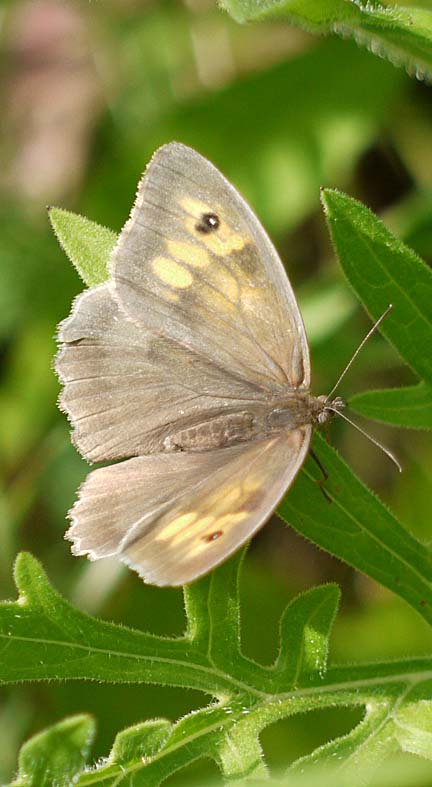
Much that is reported in the media about wildlife is bad news - usually about catastrophic declines in species abundance, so the rapid northwards extension of the range of the speckled wood butterfly has been somewhat under-appreciated. This butterfly was known in Victorian times as the Wood Argus or Wood Lady and in the 1870 edition of his History of British Butterflies the Rev. F.O. Morris described it a being "...a common species in all parts of the country, from the extreme north to the extreme south..." but it seems that by then it was already declining in the north. By 1986 T.C. Dunn and J.D. Parrack, in their Moths and Butterflies of Northumberland and Durham  lamented that "We must now consider it to be extinct in out two counties, but it still survives in Yorkshire and it is theoretically possible for it to return". I don't think I'd seen one of these delightful insects in County Durham until about five years ago, although I'd occasionally seen them in North Yorkshire, but now they are just about everywhere I look. They arrived in woodlands around Durham city about three years ago and are now so frequently seen that the novelty has already worn off. They have even turned up in my garden on several occasions this year, where I hope that their larvae might make inroads into the common couch that is one of their food plants, along with cock's foot grass and Yorkshire fog.

The speckled wood's ability to produce two generations a year and overwinter as a larva or a pupa must have some bearing on the speed that it establishes itself once it arrives. This is a species where the males are highly territorial and in the ten minutes that I spent watching the individual in these photographs it twice fought short but furious aerial dogfights with an intruder, spirally upwards before returning each time to this sunlit leaf once it had seen it off; a remarkable display of aggression in such an apparently fragile insect. The butterfly literally defends its own personal patch of sunlight, where it poses to attract the attention of a female. Dr Paul Whalley, an entomologist at the Natural History Museum described this territoriality in detail in his book Butterfly Watching in 1980 and suggested that the males probably scent mark their territory. Describing six contesting the same patch of sunlight, he wrote "They flew in an up and down, follow-my-leader fashion which resembled a well-drilled dance routine". Male and female speckled woods are hard to tell apart but the artist and naturalist David Measures came up with a sure-fire solution to the problem in his book Bright Wings of Summer. "Unless you have a male and female side by side it is difficult to distinguish the sexes by the markings" he wrote, but noted that it's 'undoubtedly a cock if it flies up at everything that passes, in true territory-claiming style..." Measures' book, published in 1976, is full of delightfully spontaneous watercolours of butterflies, produced during a decade of patient and meticulous field studies of butterfly behaviour, that perfectly evoke the vibrancy of these wonderful insects - it's well worth reading if you can find a copy.

Thursday, April 30, 2009

Return of the native


Catching sight of a speckled wood butterfly isn’t a big deal in many parts of the country, but up here in County Durham it was, until about three years ago, something to get excited about. Until the 1840s this butterfly was quite common in the region, then it went into steep decline. When Tom Dunn and Jim Parrack published ‘The Moths and Butterflies of Northumberland and Durham’ in 1986 they considered it to be extinct in both counties but wistfully noted that “since it still survives in Yorkshire it is theoretically possible for it to return”. How heartening, then, to find that over the last few years it has recolonised both counties, moving rapidly northwards. It seems that climate change is the reason. I photographed this one in Durham University Botanic Garden yesterday.