Showing posts with label Galloway. Show all posts

Wednesday, July 14, 2010

Portpatrick and the Southern Uplands Way


The little harbour of Portpatrick on the Galloway coast is the starting point for the Southern Upland Way, but before climbing the steps to the cliff top at start of the route it's worth taking a look around the harbour because....


.... there are usually black guillemots fishing there, and if you're lucky .....


.... they'll be posing for a photograph on the harbour wall.


...... where there is often a vigorous exchange with others ...


..... that nest in cavities between the building blocks of the harbour wall. These are birds with a startlingly simple colour scheme - sooty black and pure white plumage and wonderful crimson feet with matching interior colour scheme in their bills.


Very approachable birds - although there didn't seem to be as many as when we first visited, in 2006.


There's also a well established herring gull breeding colony on the cliffs as you leave the town, with some vulnerable chicks on narrow ledges ........


.........protected by fierce-looking adults


The first mile or so further on the path skirts a series of sandy bays and in one - Lairds bay , marked as Port Mora/Port Kale on the Ordnance Survey map - lies this fascinating telegraph station, built at the landfall of the first submerged telegraph cable to Donaghadee in Northern Ireland, across what is now known as the North Channel but was then the Irish Channel, in 1853. More recently the building has been a visitor centre but now seems disused. You can still see the frayed cable partially buried in the shingle on the beach: an interesting fragment of telecommunications archaeology.


There's a fine cliff-top flora along this stretch of coast that includes the almost hemispherical umbels of wild carrot. Once these begin to set seed the stalks of the outer clusters of florets elongate and curl inwards, so the ripe seed head resembles a clenched fist.


The cliffs here are festooned with honeysuckle and as you climb the path up from the beach the scent is glorious on a fine summer evening.


Slender St. John's wort, with red undersides to its petals, is also a feature of the cliffs here, as is ...


... the sea spleenwort fern with its leathery fronds, that grows in rock crevices close to the beach, well within reach of salt spray. Fresh water trickling down the cliffs is probably the antidote to this saline assault.

Tuesday, July 13, 2010

Pink Pyramids


Port Logan, on the Rhins of Galloway peninsula, is sandy bay backed by a stony beach and sand dunes, that takes the full force of the wind and weather sweeping in from the North Channel and Atlantic beyond.


Not, maybe, the kind of place you'd choose to stop on a wet and windy day, but we noticed some interesting-looking flowers in the dunes as we drove by, so stopped to investigate - and we were glad that we did.


When we reached the beach this ringed plover flew off and settled a few yards away, obviously trying to distract our attention....


... and we soon discovered why ..... this wonderfully camouflaged clutch of eggs, laid in a depression in the sand.


But it was the pyramidal orchids - dozens of them - that had first attracted our attention....


Most were the typical deep pink-flowered form but ....


... this one stood out - a much paler pink-flowered plant.


On this coast the weather changes rapidly and within a few minutes the sun broke through, coaxing out the bumblebees to feed on the sea bindweed blooms.


Unlike the climbing bindweed species that plague gardens, this species stays close to the ground, sheltered from the drying wind and conserving water in its succulent, heart-shaped  leaves.

Friday, July 9, 2010

Mull of Galloway 5


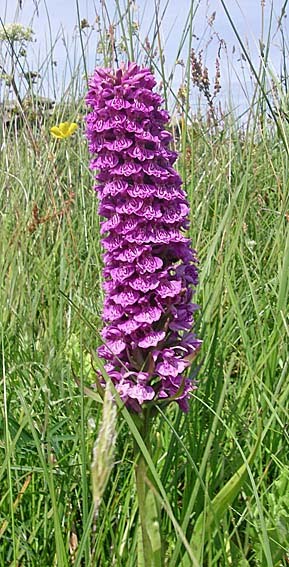
I've seen a lot of marsh orchids, but,...


....whichever way you look at it .....


... this is the finest specimen I've ever seen - in the peak of perfection, on the Mull of Galloway, last week.

Thursday, July 8, 2010

Mull of Galloway 4


In late June and early July the Mull of Galloway is home to a large population of six-spot burnet moths, feeding on a carpet of wild flowers that includes this pink-flowered form of yarrow.


Thyme is also a popular source of nectar. These moths are weak fliers and I often wonder how many get blown out to sea from these coastal sites, which are windy most of the time.


These two are making provision for any casualties that might be swept off the cliffs by the blustery wind.


There are cinnabar moths here too - this caterpillar was in the final stages of demolishing a ragwort plant.


Wednesday, July 7, 2010

Mull of Galloway 3: An Unlikely Defence against Rabies


Last week we spent a few days in Galloway where, down on the Mull of Galloway we found several of these stunning rose chafer beetles Cetonia aurata. They seem to have a particular liking for hogweed flower umbels - in fact, I don't think we saw any on any other flower.


I spent an hour on a hot afternoon photographing them and - for such large beetles (20mm. long) - they are remarkable active, taking to the air with a loud buzz if you get too close. When rose chafers fly they extend their wings and then close their wing cases (elytra) over their abdomen again, unlike beetles like the ladybird that keep their wing cases extended to generate aerodynamic like. You can see a wonderful compostite picture of a rose chafer in flight at http://en.wikipedia.org/wiki/File:Cetonia_aurata_take_off_composition_05172009.jpg
- take a look, you'll be amazed.
Also take a look at a video of this beetle feeding and taking off at http://www.arkive.org/rose-chafer/cetonia-aurata/video-00.html
and another of one hatching from a pupa at
http://www.youtube.com/watch?v=vDH2UV41OLA


While I was searching for these videos on the web - which has a fantastic tendency to throw up random, interesting items - I came across this remarkable snippet of information from a 150 year-old edition of the British Medical Journal (the 'hydrophobia' it refers to is the old name for rabies):

ALLEGED REMEDY FOR HYDROPHOBIA. At a recent meeting of the Academy of Sciences in Palis, M. Guerin-Meneville sent in a letter on the Cetonia aurata, or rose beetle, which for some time past has engrossed the attention of naturalists as a remedy for hydrophobia. M. Meneville stated, from personal experience, that in the governments of Voroneje and Koursk, in Russia, it is customary to give dogs half a beetle in powder from time to time, mixed with bread crumbs, as a preservative against that disease;


British Medical Journal 5th. December 1857,Medical News p. 1017


Tuesday, July 6, 2010

Mull of Galloway 2


The cliff top wild flowers on the Mull of Galloway are exquisite in late June and early July. Here bell heather. the first of the three common heather species to flower, mingles with heath bedstraw.


Carpets of wild thyme form part of a natural rock garden, shared with ....

...yellow lady's bedstraw ....


...... and the powder blue flowers of sheepsbit ....


... a member of of the campanula family.


The short, dry turf is also home to the pink and yellow flowers of centaury...


... and English stonecrop survives in tiny pockets of soil ....


... alongside rock sea spurrey


... with its pink, star-shaped flowers.


In a patch of boggy grass, in the shade of a wall, we found this ragged robin and...

.. this unusual double-flowered version of lady's smock

Monday, July 5, 2010

Mull of Galloway 1


Last week's trip down to the Mull of Galloway was an absolute delight. This is the southernmost point in Scotland - further south in latitude than Durham, where we'd driven from. The fine lighthouse stands at the point where the waters of the North Channel and Solway Firth mingle and from this spot you can see Northern Ireland, the Isle of Man and the peaks of the Lake District.


The cliffs here are an RSPB reserve noted for nesting seabirds like these ....


... guillemots that nest on impossibly narrow ledges ....


... where there's standing room only during the breeding season.


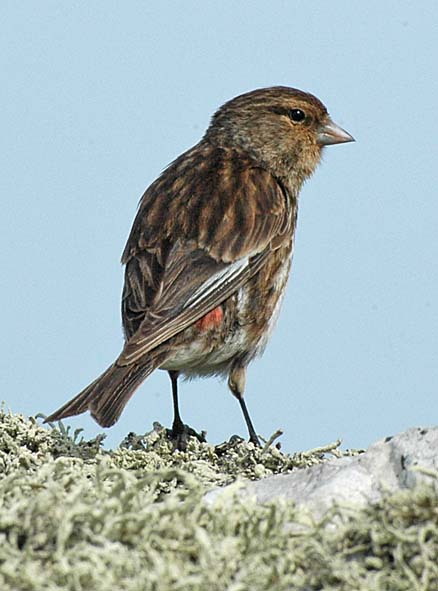
The cliff top grassland provides fine habitat for species like this twite .....


... and a hard-working meadow pipit that seemed to have lost its tail feathers.