Showing posts with label Wood Pigeon. Show all posts

Thursday, April 9, 2026

Wood pigeons: the mating game

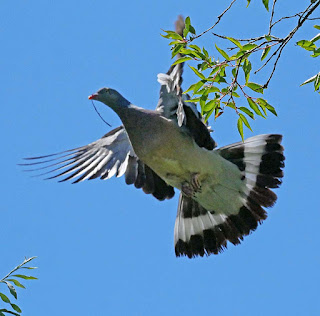
 The wood pigeon breeding season in our garden never seems to end, but it reaches a peak in spring. Show-off parabolic flights, ridiculous chasing, bowing and tail-fanning courtship rituals, bouts of violence between rival males - all part of the endless pageant of ornithological entertainint when I look out of the window.

Here are a few pictures from a recent performance.


A seemingly disinterested female looks on while rival males slug it out with wing blows, until one is knocked off the fence ..... but wait, he's not deterred ...


.... he circles back, swoops so low over his rival that he's forced to duck his head, sees his opportunity and descends on the female ...


.... who is taken by surprise while his alarmed, outflanked rival looks on ..


.... but she bats her assailant away with her wings...


----- whereupon the outflanked bird seizes his opportunity 


... and so it goes, most days in March and April

Wednesday, June 3, 2020

Wood pigeons: a self-domesticating species?

I sometimes wonder whether wood pigeons are becoming a self-domesticating species. We have had resident breeders in our small garden for almost a decade and over the last five they have bred at least twice a year, so this locally adapted population hasn't had much experience of the big, wide world beyond the row of suburban gardens around us. 


They behave quite differently from the wood pigeons on farmland just a mile away, where they are very wary birds. Here in the garden they walk up and down the garden path, ignoring us while we garden, and will only flutter out of the way when we come within a few feet of them. They behave almost like chickens.


They do have a comfortable life here, with bird table food in winter. This one sits under the sunflower seed feeder, picking up seed dropped by visiting finches and coal tits.


This is the tree where they have bred for the last five years - a weeping pear Pyrus salicifolia in the centre of the garden.


The tree is the hub of garden bird activity, with a tangle of pendulous branches and a cool, shady dome of foliage in summer. Tree sparrows occupy the nest box and the wood pigeons have built a flimsy nest platform of twigs directly above.


The breeding season usually begins in late February, with male birds following the females up and down the garden path, fanning out their tails and performing a kind of bowing dance. After a series of half-hearted rejections a pair bond quickly forms and then they progress to this rather endearing 'billing-and-cooing' routine, with mutual grooming.


The same basic nest platform is used every time, with the female bringing some extra twigs to add a personal touch.


The weeping pear, which is about 35 years old, constantly sheds dead twigs so there is a convenient source of nest material underneath. Sometimes, walking down the garden path, I have top duck to avoid low-flying pigeons.


The nest is about six feet above our heads as we pass underneath, so the mother bird, and the squabs when the eggs hatch, just stare down at us, undisturbed, as we pass below on our way up and down the garden.


The squabs are not the prettiest of fledglings when they leave the nest, and have peculiar soft, pointed beaks, adapted to taking an avian form of mother's milk from the crop of the parent bird, a secretion that is highly nutritious, so the juvenile birds develop quickly.


Wood pigeons generally only lay two eggs in each breeding cycle, but they are assiduous parents so chick survival rates must be comparatively high. The very demanding squabs beg to be fed by putting one wing over the parent bird's back.


You can see here how the squab pushes its beak right down into the parent bird's crop to reach that strange, milky secretion.


This is a squab in late May at about three weeks after leaving the next, still partially dependent on its parent but with a beak that's developing for foraging for an independent diet.  


The adult diet is mostly vegetable, feeding on leaves, buds and seeds, but in early spring the big event in the birds' dietary calendar is the ripening of ivy berries in the hedge in the front garden. The whole crop disappears over a period of a few days in April.

Sunday, May 3, 2015

Wood pigeon parenting skills


We witnessed this touching scene outside our kitchen window yesterday evening. The quality of the pictures isn't good because the light was fading fast but they show a fascinating aspect of pigeon behaviour.


These birds feed their young with a kind of 'milk' - a sweet, sticky liquid - secreted in their crop and the youngster has to push it's beak well down its parent's throat to reach it.


As the youngster grows the 'milk' is mixed with more of the bird's normal food, which is mostly vegetable matter - leaves and seeds. I suspect these birds have been responsible for nipping off my pea seedlings as soon as they've appeared through the soil.


These birds were clearly trying to wean their youngster away from dependence on the contents of its parents crop, by pecking at objects in the soil. it seemed to get the message because after they left it was clearly trying to forage for itself.

Top quality avian parenting skills!


Tuesday, October 15, 2013

Does a wood pigeon's breeding season ever end?

This mother and child combo turned up outside our living room window this morning. Wood pigeons have been breeding in the garden for several years, but I think this is the latest-ever squab. It must have left the nest during the gales and driving rain over the last couple of days, but seems to be in good fettle, pestering the life out of its mother.

More scenes from wood pigeon family life here.


The relentless rise of the wood pigeon as a garden bird has been a notable ornithological trend over the last decade. It's now the fifth most frequent bird species in gardens. In many ways wood pigeons are charming, especially during their courtship, but they are the bird equivalent of a Hoover on a bird table, gobbling up the food at a phenomenal rate. 


Sunday, February 24, 2013

It was there when I pressed the shutter release ......


The most useful photographic advice I ever received was "if you want people to believe you're a competent photographer, never show anyone your failures". That's meant dumping well over 99% of my photographs, which is much easier and cheaper to do in these days of digital photography, when they disappear into the ether with the click of a button, at no cost. 

But digital photography also delivers its own special kind of failures, thanks to the phenomenon of shutter-lag - that interval between pressing the shutter release and the sensor capturing the image. So I've got plenty of pictures like those below, which looked really good when I composed them and pressed the shutter....


This long-tailed tit was sitting perfectly on that twig in the foreground, looking at me over its shoulder as I pressed the shutter release  ..... it must have taken off like a rocket.


In those last few milliseconds, this pigeon decided that it didn't want any publicity. Its feet came out well, though ...


.... and this guillemot was overcome with shyness at the last moment too....


Saturday, February 23, 2013

Depressed Woodpigeon


It's been a long winter. Earlier in the week there was spring in the air and this wood pigeon was courting a potential mate in our garden. Then, last night, it snowed again. And the bird food is under two inches of the snow on the bird table. 

I can't help thinking that this wood pigeon looks depressed.


Wednesday, June 10, 2009

Squabs


The wood pigeons visiting our garden seem to be undergoing something of a population explosion lately. They first bred two summers ago, raising one pair of squabs, and did the same last year. This year they have bred twice already – and it’s only June. I’m rather fond of their soporific coo-cooing on warm summer evenings but what I find particularly interesting is the way they feed their squabs. The parent birds park them in secluded spots in the garden and when they return the excited squab first raises its wings then shuffles up to the parent and puts one wing around its back, as though its hugging a long-lost friend. Then comes the less cute part, where the squab pushes its head down the parent’s throat to induce it to regurgitate food. This ‘hugging’ performance goes on long after the young are well fledged, although as time goes by the parents become less responsive, until the youngsters are forced to fend for themselves. These pictures show the mother-and-child performance on our garden seat this evening.