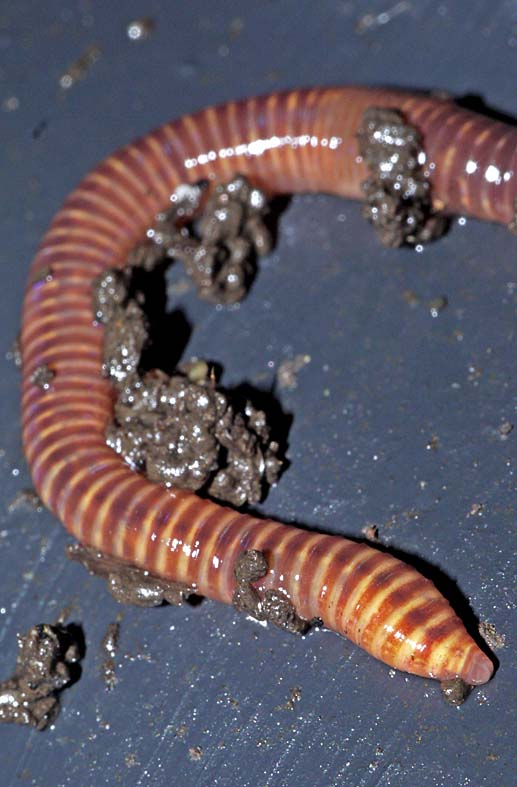
This is a rather alarming view of a very familiar animal - an earthworm. That's its mouth at the tip. As Charles Darwin observed in his book The Formation of Vegetable Mould, through the Action of Worms, published 1881, 'the whole country has passed many times through, and will again pass many times through, the intestinal canals of worms'.
This was one of many that I disturbed when I was digging our vegetable garden yesterday.

Darwin's book - the last that he wrote - remains one of the most fascinating sources of information about these useful animals. In his day there were still many people who treated them as pests, but he confirmed their essential role in maintaining soil fertility. Darwin was an inveterate experimentalist, demonstrating that earthworms swallowed earth 'for the nutritious matter it contains' and finding tiny smooth stones in their gizzards 'used as millstones' for grinding up buried leaf material. His treatise contains information about their food preferences (he showed that they preferred onion, celery, carrot and cherry leaves above all others) and reports experiments that showed that up to 53,767 worms can live in a single acre of healthy garden soil, that they add fine soil to the surface (via worm casts) at the rate of between 7.56 and 16.1 tons per acre per year (depending on soil type) and that their constant 'ploughing' of the soil, via tunnelling and feeding, buries objects like large stones at the rate of about 0.2 inches per year.

Worms' bodies are beautifully adapted for tunnelling. The inside of that spindle-shaped body is a fluid-filled cavity which forms a hydraulic skeleton, so that contractions of the circular muscles that run around the segments or the longitudinal muscles between them, acting on the incompressible fluid within, makes sections of the body shorter and fatter or longer and thinner.
Here, contraction of the circular muscles elongates the front segments of the body. You can also see the 'upper lip' (prostomium) of the mouth which, with the aid of powerful pharygeal muscles within, can act as a kind of sucker and allow the animal to grip and drag leaves - and surprisingly large stones used to block its burrow entrance. Those little pores on each segment are the site of retracted bristles.
When the longitudinal muscles contract and the circular muscles relax the body becomes shorter and fatter, filling the tunnel and forcing out short, curved bristles that give the animal purchase on the tunnel walls, allowing it to drag the hind segments forward or resist being pulled out by a predatory bird if caught dangling its tail out of the tunnel - as earthworms are prone to do.
The bristles are too small to see with the naked eye but you can hear them - put a worm on a sheet of paper and you'll hear them scratching the surface as the worm wriggles.
Darwin investigated the senses of earthworms in considerable detail, demonstrating that they could detect light but had no sense of hearing, although they were 'extremely sensitive to vibrations in any solid objects' - like soil, for example. His famous description of these experiments in his book are worth quoting in full.
'Worms do not possess any sense of hearing' he wrote. 'They took not the least notice of the shrill notes from a metal whistle, which was repeatedly sounded near them; nor did they of the deepest and loudest notes of a bassoon. They were indifferent to shouts, if care were taken that the breath did not strike them. When placed on a table close to the keys of a piano, which was played as loudly as possible, they remained perfectly quiet'.
He then went on to show that if he moved his pot of worms from the adjacent table onto the piano, they immediately retreated into their tunnels when notes were played, because the vibrations travelled through the piano, pot and soil.
You can download the whole of The Formation of Vegetable Mould, through the Action of Worms from Darwin on-line, here - it's well worth reading.






 Posts
Posts


