Wednesday, December 10, 2014
Some interesting fungi
Striated bird's nest Cyathus striatus growing on decayed wood. Each of the cup-shaped 'nests' contains egg-shaped structures called peridioles that contain the spores. Photographed in Slindon Woods, near Chichester, West Sussex.
In these field bird's nests Cyathus olla you can see the 'eggs', which are attached to a fine thread and are splashed out of the 'nest' by raindrops and become entangled in surrounding vegetation. When they dry out they then discharge their spores into the airstream. For more detailed explanation, click here.These specimens were photographed in Durham, growing in a garden border of perennial plants that had been cut back for the winter.
Bog beacon Mitrula paludosa, a tiny jelly fungus.
These bog beacons were growing on a waterlogged bed of decaying spruce needles in Hamsterley Forest, Co. Durham.
Eyelash fungus Scutellinia scutellata growing on wood chips after tree felling in Hamsterley forest, Co. Durham. Each of the orange cups is surrounded by long hairs that look like eyelashes.
Terracotta hedgehog fungus Hydnum rufescens. The majority of toadstools carry their spores on radial gills or on the surface of pores but in this genus the spores are attached to tooth-like structures under the cap. Growing under beech trees in Hamsterley Forest, Co. Durham.
Thursday, December 4, 2014
Bramble leaf rust
Thursday's Guardian Country Diary concerns the fungus that produces these colourful symptoms on bramble leaves - bramble leaf rust, Phragmidium violaceum.
The fungus initially develops within the green leaf, causing purple patches, but when the leaf begins to die and loses its chlorophyll this vibrant 'plums and custard' colour scheme turns the leaves into some of the brightest objects in the hedgerow in early winter.
These clusters of spores erupt through the underside of the leaf as it begins to die.
The individual spores are just about visible with a camera macro lens but for a clear view you really need a microscope.
A plate from Rust, Smut, Mildew and Mould. The spore of Bramble leaf rust is illustration number 35.
The fungus initially develops within the green leaf, causing purple patches, but when the leaf begins to die and loses its chlorophyll this vibrant 'plums and custard' colour scheme turns the leaves into some of the brightest objects in the hedgerow in early winter.
These clusters of spores erupt through the underside of the leaf as it begins to die.
The individual spores are just about visible with a camera macro lens but for a clear view you really need a microscope.
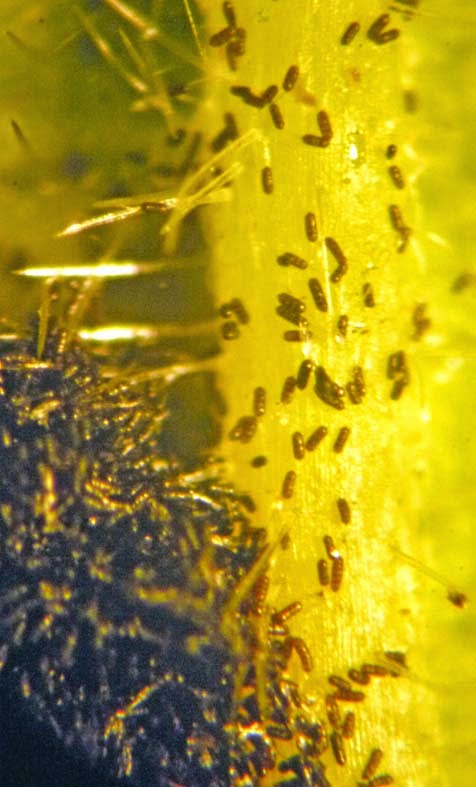
These are the individual spores viewed at about x20 with a low power stereomicroscope, and .....
.... here they are seen though a compound microscope at a magnification of around x100, showing their very distinctive club-shaped structure, with 4-5 spores on a stalk.
In Victorian times rust fungi were popular, easily accessed
subjects for amateur microscopists and in 1870 the somewhat eccentric
naturalist Mordecai Cubitt Cooke devoted a whole book, entitled Rust,
Smut, Mildew and Mould: An Introduction to the study of Microscopic Fungi, to
their study. It’s hard to imagine such a title attracting many buyers now but
in Cooke’s day, without thedistractions of television, radio and the internet,
microscopy was a very popular pastime and the book ran through four editions in
20 years.
Mordecai Cubitt Cooke
[public domain image, source http://tinyurl.com/ohkryyc]
![[rust1.jpg]](https://blogger.googleusercontent.com/img/b/R29vZ2xl/AVvXsEh3rQih89TLacN-G0aVZM484Eu8MHMx4Z9DIrBdbJZKTNl8gRjcBseWrhWR3kS6AkAAo3erdjnAOLmVQQhB_pZ-cp6TnNGRM-nISM2OQwBaE_ouQEjgmxe1kTfdVQ0VOI8TnnbaK7Wg9tq2/s640/rust1.jpg)
Cooke was evangelical when it came to promoting the delights
of microscopy, opening his first chapter with the confidant assertion that “everyone
who possesses a love for the marvellous, or desires a knowledge of some of the
minute mysteries of nature, has, or ought to have, a microscope.” In his
day the lady of the house would be perfectly happy for her husband to retreat
to his study for a close look at smut – or rusts, mildew and mould – in the knowledge
that he would be advancing the cause of science.
![[rust2.jpg]](https://blogger.googleusercontent.com/img/b/R29vZ2xl/AVvXsEhu7w9aRHm_TWozMhyL_62nS5YznldU4gUNMuCAK1zyEiNYNLNacTlsvlkozzqVkZF0JxZANth_iLMb4ZFIsNAFkalxS5ibgklJihjNHcGDcy3z8xICqH-KEIaWMAKiXOzASi6KKwfKTMPV/s640/rust2.jpg)
Saturday, November 29, 2014
Kirkby Stephen's macaws feeding on beech mast
Kirkby Stephen, in the Eden Valley in Cumbria, has a locally famous flock of free-flying feral macaws. It seems that beech mast is their favourite food - all these photographs were taken from under a beech tree outside the local fire station this afternoon.
These spectacular birds originally belonged to a local
farmer and conservationist called John Strutt, who died a couple of years ago.
You can read all about this remarkable man and his amazing free-range parrots by
visiting this web site.
There's also more
about him here.
Labels:
beech mast,
Kirkby Stephen,
Macaws
Subscribe to:
Posts (Atom)