A lot of exotic animals tend to reach our shores these days and when they do they often make lurid newspaper headlines, with scare stories about 'alien invaders' that threaten our native flora and fauna. But there is one alien invader from Morocco that slipped ashore in Bournemouth almost 60 years ago, in 1957, and has steadily conquered the whole of Britain. This extraordinary harvestman, called Dicranopalpus ramosus, reached the Scottish border in 2000 and is still heading north.
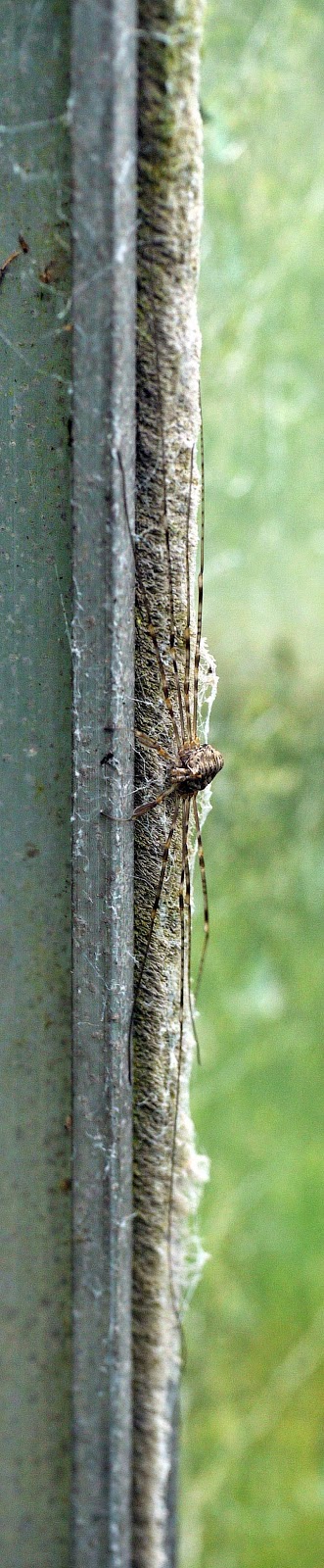
Here's one that lives on the door frame of our greenhouse. Its globular body is only about 4mm. long but its legs are proportionately enormous - they stretch almost from top to bottom of the image above. And because they are all held out at right angles to the body (aligned with the door frame above) the anmials is quite hard to spot unless it moves.
Here it is a little closer, seen from behind and showing less than half of the length of the second pair of legs, which are the longest.
The other distinctive feature of this amazing arthropod is the pair of long, forked pedipalps carried in front of the head .......
That look a little like crab claws and ......
..... are quite menacing, although they are primarily sensory structures - the jaws lie between them, under the front of the head.
When you give Dicranopalpus a gentle poke it abandons its cryptic behaviour and rises up on its splayed legs, much like any other harvestman. If you look carefully at the image above you can see the full extent of one of the second pair of legs, stretched out in front, towards the bottom of the picture.
Here you can see the fine covering of sensory hairs on one branch of those forked pedipalps and also the paired eyes carried on a turret on top of the animal, giving it all-round vision, although harvestmen have rather poor eyesight - their senses of taste, touch and scent, localised on the pedipalps and that second pair of extra-long legs, are far more acute.
So there you have it - the Moroccan invader that conquered Britain, almost unnoticed except by those who take pleasure in finding and watching this obscure but extraordinary group of animals. This is the first one I've seen - I'd never have noticed it if it hadn't moved when I shut the greenhouse door.
They are quite common now in most of Britain, apparently. They're probably in your garage, shed, greenhouse of garden right now.






 Posts
Posts


