Sunday, April 6, 2014

The daughter of the winds


The name anemone, which is derived from Greek, literally means 'the daughter of the winds' and the Roman naturalist Pliny the Elder believed that spring winds were essential to bring anemones into flower. You certainly need a still, windless day to photograph these  delightful spring flowers, that shiver on their slender stalks if there is the slightest breeze. 


Wood anemones are grow very slowly, spreading via creeping rhizomes, so woodlands with large patches of this flower are likely to be very old. It sets few viable seeds and spreads at a rate of about six feet in one hundred years, according to Richard Mabey in his Flora Britannica. It's plants like this that highlight the foolishness of the government's proposed practice of allowing developers to 'offset' destruction of  old-established woodlands by planting new ones on open fields.  Assuming it was possible, it would take centuries to replicate the drifts of wood anemones that are one of the defining features of ancient woodlands.


This seems to have been an exceptionally good spring for wood anemone, with some wonderful displays in woodlands in Weardale and Teesdale.


Saturday, April 5, 2014

Townhall clock


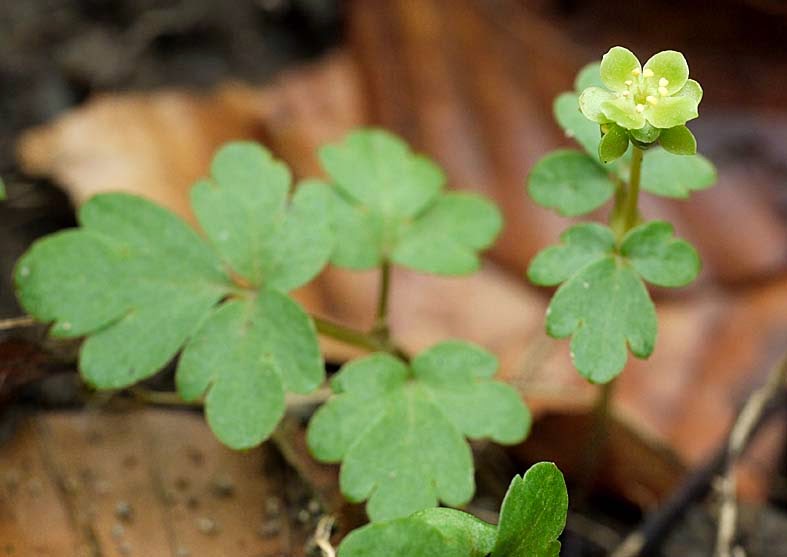
Moschatel Adoxa moschatellina  is one of the most easily-missed woodland spring flowers due to its small size and green flowers, but it's worth taking a close look at its inflorescence because it's really rather remarkable.


The inflorescence, in a two inch-tall stalk, is made up of five small flowers. Four face outwards like the faces of a townhall clock, giving the plant its alternative common name. Each of these has five petals and ten stamens. 

The fifth flower points upwards and this one has four petals and eight stamens. 


There's nothing else quite like it in the British flora. 


Friday, April 4, 2014

Here today, gone tomorrow: leafy liverwort spore capsules

Leafy liverwort leaves are only one cell thick and have no means of controlling water loss, so these plants are always confined to permanently wet places. This is Lophocolea bidentata


The tiny, delicate plants spend most of their year in the vegetative state but in late winter they enter their reproductive phase and produce microscopically small egg cells inside flask-shaped structures called archegonia hidden amongst the leaves, and also minute containers of male sex cells called antherozoids. 

The antherozoids swim in the surface film of water on the leaves, frantically heading for the archegonia that release a chemical attractant. A surface film of water is essential for successful sexual reproduction in these plants. When the sex cells fuse a spore capsule forms, filled with minute spores, and when it's ripe this elongates on a two inch-long stalk, often overnight............and ......


.............. that's what these are - a forest of ripe Lophocolea spore capsules, like little black beads, already beginning to burst and shed their spores (the white fuzzy structures are burst spore capsules). In another day they will all have shed their spores and withered away, their reproductive phase over for another year.

Although their reproductive season is short livrworts been around for about half a billion years, surviving five great mass extinctions that have wiped out many other life forms. Fragile plants, but durable within the great evolutionary time scale.