Sunday, April 4, 2010

Ghosts of 2009..

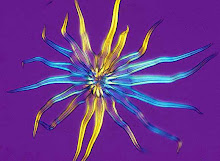
Down amongst the dead leaves left over from last autumn lie the skeletal remains of last summer's wild flowers. We found this partially decayed seed head of giant bellflower Campanula latifolia in the woodland beside the old railway line that leads to the Nine Arches viaduct in the Derwentside Country Park , where the green shoots of this year's plants are already beginning to sprout.

All the softer tissues in the seed capsules have rotted away, leaving the network of tough-walled xylem vessels - the internal plumbing system that that supplied the developing seeds with water. Double-click for larger, clearer images.

Saturday, April 3, 2010

Elm flowers


Back in the early 1970s we lived in the Midlands for a few years and I can still remember the rows of stately elms whose crowns took on a crimson hue at this time of year as the flower buds on their twigs burst. Those magnificent trees are long gone, thanks to the Dutch elm disease fungus and the bark beetle that spread it from tree to tree, but shrubby hedgerow elm is still common enough. These twigs were just coming into flower in Teesdale earlier this week. Nearby there are also a few largish elms, although I guess the bark beetle will sooner or later find them too.


There are still some mature elms in the UK that have either escaped the fungus or are perhaps immune. The Natural History Museum has been surveying their distribution. You can download a leaflet about their Elm Map Project here.

For more posts on tree ID click here

Thursday, April 1, 2010

Spring Greens


Some of the earliest spring wild flowers, like this golden saxifrage Chrysosplenium oppositifolium, are green-flowered and so easily overlooked amongst the prettier violets and primroses, but they do have their own  subtle beauty. This is a plant that's always associated with wet places, like stream banks and the edges of waterfalls. There are two species; this one has opposite pairs of leaves on the main stem, whilst C. alternifolia has its leaves arranged alternately and is much less common. The easiest way to tell them apart is to roll the stems between your fingers - they're square in C.oppositifolia and triangular in C. alternifolia.

Yesterday there were some fine patches of C. oppositifolia just coming into full bloom in Teesdale, on the banks of some of the streams that feed into the Tees along the footpath from Egglestone Abbey to the Meeting of the Waters.